
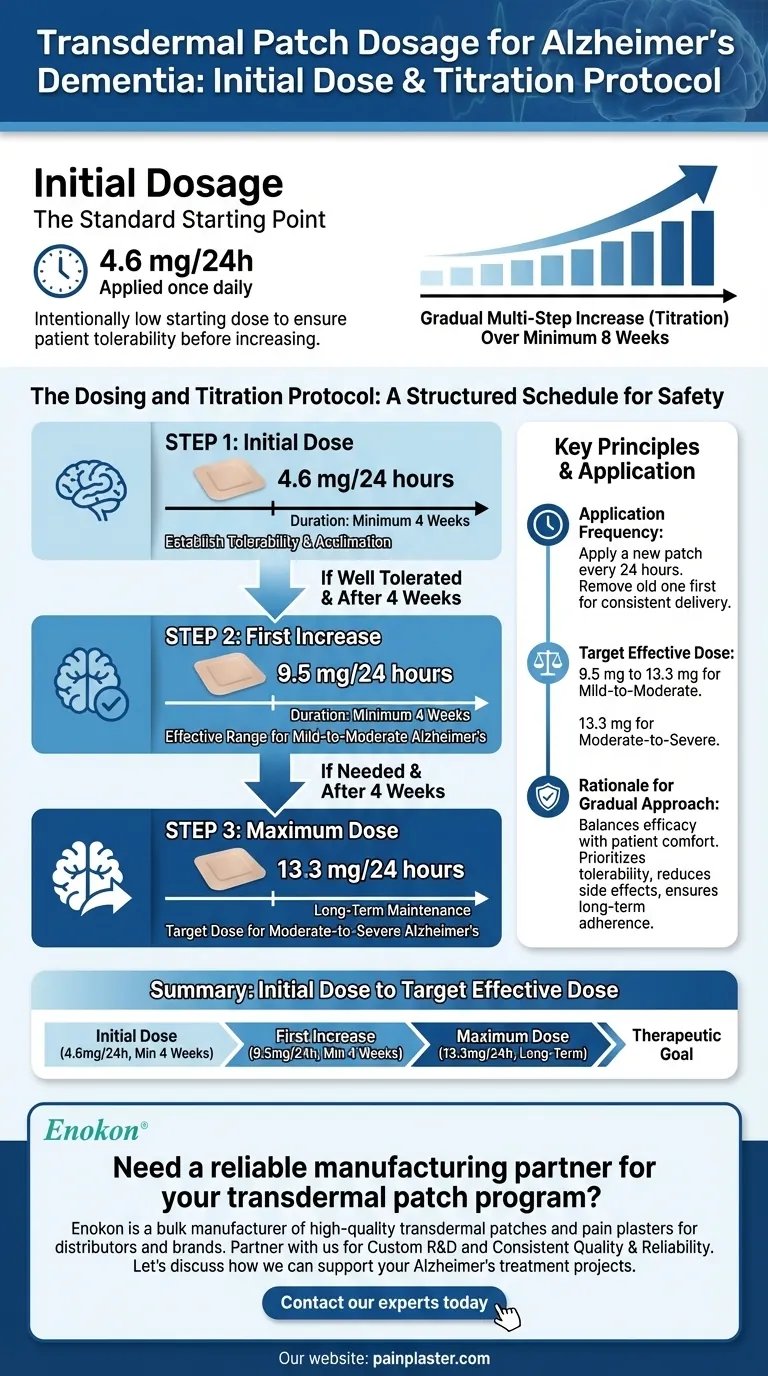
The standard initial dosage for a transdermal patch in treating Alzheimer's dementia is 4.6 mg applied to the skin once every 24 hours. This starting dose is intentionally low to ensure the patient can tolerate the medication before increasing to a more effective level.
The core principle of this treatment is not to remain at the starting dose, but to use it as a safe entry point. The protocol requires a gradual, multi-step increase, or titration, over a minimum of eight weeks to reach a clinically effective dose while minimizing potential side effects.

The Dosing and Titration Protocol
Properly administering this medication involves a structured schedule of dose increases. This gradual approach is critical for patient safety and treatment success.
Step 1: The Initial Dose
The starting point for all patients is the 4.6 mg/24 hours patch. This dose is maintained for a minimum of four weeks.
The primary purpose of this initial phase is to establish tolerability and allow the patient's body to acclimate to the medication.
Step 2: The First Increase
After at least four weeks on the initial dose, and only if it is well tolerated, the dosage may be increased to 9.5 mg/24 hours.
This is often the first dose level considered to be within the effective therapeutic range for mild-to-moderate Alzheimer's disease.
Step 3: Reaching the Maximum Dose
Following a minimum of another four weeks on the 9.5 mg patch, the dose may be further increased to 13.3 mg/24 hours if needed.
This highest dose is the target for patients with moderate-to-severe Alzheimer's disease.
Application Frequency
It is crucial to apply a new patch every 24 hours. The old patch must be removed before the new one is applied to ensure consistent medication delivery.
Understanding the Target Effective Dose
The initial 4.6 mg dose is a starting point, not the long-term therapeutic goal. The effective dose is higher and depends on the severity of the condition.
For Mild-to-Moderate Alzheimer's
The recognized effective dosage range is 9.5 mg to 13.3 mg per 24 hours. The titration schedule is designed to help the patient reach this range safely.
For Moderate-to-Severe Alzheimer's
The recommended effective dose is 13.3 mg per 24 hours. Reaching this dose requires completing the full, multi-step titration process over several weeks.
The Rationale Behind a Gradual Approach
The structured titration schedule is not arbitrary; it is a fundamental safety measure designed to balance efficacy with patient comfort.
Prioritizing Patient Tolerability
Starting with a low dose and increasing it slowly gives the body time to adjust, which significantly reduces the risk and severity of side effects. Abruptly starting at a high dose could be poorly tolerated.
Ensuring Adherence
If a patient experiences significant side effects early on, they are less likely to continue the treatment. The gradual approach improves the chances of long-term adherence, which is essential for managing the condition.
Key Principles for Dosing
Your approach should be guided by the patient's specific condition and their tolerance to the medication.
- If beginning treatment: Always start with the 4.6 mg/24h patch and maintain it for at least four weeks to establish tolerability.
- If treating mild-to-moderate Alzheimer's: Your goal is to gradually titrate upwards to the effective range of 9.5 mg to 13.3 mg/24h, allowing at least four weeks between each dose increase.
- If treating moderate-to-severe Alzheimer's: The target effective dose is 13.3 mg/24h, which should only be reached after the patient has successfully tolerated the lower doses.
Following this structured titration protocol is the key to safely achieving the intended therapeutic benefits of the treatment.
Summary Table:
| Stage | Dosage | Duration | Purpose / Target |
|---|---|---|---|
| Initial Dose | 4.6 mg/24h | Minimum 4 weeks | Establish patient tolerability and safety. |
| First Increase | 9.5 mg/24h | Minimum 4 weeks | Effective dose for mild-to-moderate Alzheimer's. |
| Maximum Dose | 13.3 mg/24h | Long-term maintenance | Target dose for moderate-to-severe Alzheimer's. |
Need a reliable manufacturing partner for your transdermal patch program?
Enokon is a bulk manufacturer of high-quality, reliable transdermal patches and pain plasters. We specialize in serving healthcare and pharmaceutical distributors and brands.
Partner with us to benefit from:
- Custom R&D and Development: Our technical expertise ensures your product meets exact specifications, from initial concept to scalable production.
- Consistent Quality & Reliability: We deliver patches with precise drug delivery and excellent adhesion, batch after batch.
Let's discuss how we can support your Alzheimer's treatment or other transdermal therapy projects.
Contact our experts today for a consultation on your specific needs.
Visual Guide
Related Products
- Silicone Scar Sheets Patch Transdermal Drug Patch
- Icy Hot Menthol Medicine Pain Relief Patch
- Far Infrared Heat Pain Relief Patches Transdermal Patches
- Menthol Gel Pain Relief Patch
- Mugwort Wormwood Pain Relief Patch for Neck Pain
People Also Ask
- What role does a silicone-based transdermal delivery system play in Parkinson's? Enhancing Early-Stage Patient Care
- How is the long-term skin tolerance of silicone-based transdermal patches evaluated in clinical settings? R&D and Safety
- Why is a polarizing microscope used to evaluate the long-term stability of transdermal drug patches? Ensure Efficacy.
- What are common adverse effects of transdermal drug delivery? Risks & Prevention Tips
- What are the advantages of transdermal drug patches? Optimize Medication Delivery with Patches







