
The immediate action you should take if your Ethinyl Estradiol; Norelgestromin patch falls off depends entirely on how long it has been detached from your skin. If it has been less than 48 hours, you can typically replace it without compromising contraceptive efficacy. However, if the patch has been off for 48 hours or more, you must take specific steps to protect against pregnancy.
Your primary goal is to re-establish a consistent level of hormones in your body as quickly as possible. The 48-hour mark is the critical threshold that determines whether you need to use a backup method of birth control.
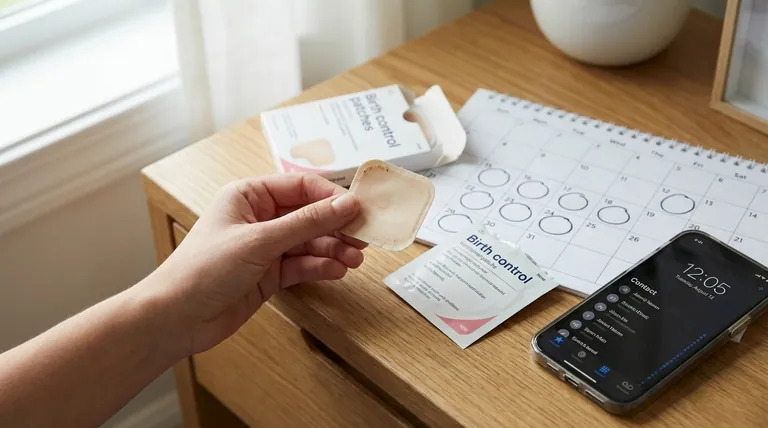
The Critical Time Threshold: Less vs. More Than 48 Hours
The effectiveness of your birth control patch hinges on a steady, uninterrupted delivery of hormones. When the patch detaches, this delivery stops. Your response must be dictated by the length of this interruption.
If the Patch is Off for Less Than 48 Hours
Your risk of pregnancy is low. Try to re-adhere the same patch immediately by pressing down firmly for 10 seconds.
If the patch does not stick securely, discard it and apply a new patch right away.
You do not need to use a backup form of birth control. Your "Patch Change Day" remains the same, and you should change your patch on your regularly scheduled day.
If the Patch is Off for 48 Hours or More (Or an Unknown Duration)
You are at an increased risk of pregnancy and must act immediately to re-establish protection.
Apply a new patch as soon as you realize it is off. This day now becomes Day 1 of a new 4-week cycle. You will have a new "Patch Change Day" based on this day of the week.
Most importantly, you must use a non-hormonal backup method of birth control, such as condoms, for the next 7 consecutive days to ensure you are protected from pregnancy.
Best Practices for Applying a New Patch
Proper application is essential for the patch to work correctly. Rushing this step can lead to another detachment.
Choosing and Preparing the Location
Always apply the patch to a clean, dry, and intact area of skin on your buttock, abdomen, upper outer arm, or upper torso.
Avoid placing it on skin that is red, irritated, or oily. Do not use lotions, creams, or powders on the area where you intend to apply the patch.
What You Must Not Do
To ensure the patch works correctly and safely, avoid these common mistakes.
- Do not try to re-attach a patch with medical tape or other adhesives.
- Do not cut, trim, or alter the patch in any way.
- Do not wear more than one patch at a time to "make up" for a missed dose.
Understanding the Risks and When to Get Help
Knowing why these rules exist helps you manage the situation confidently. The primary concern is always maintaining contraceptive efficacy.
The Risk of Unintended Pregnancy
The patch prevents ovulation by maintaining specific hormone levels. When the patch is off for an extended period (48+ hours), these levels can drop low enough to allow your body to release an egg, increasing the chance of pregnancy.
Using backup contraception for seven days after starting a new cycle gives your body enough time for hormone levels to stabilize and prevent ovulation once again.
When to Consult Your Healthcare Provider
Uncertainty is a signal to seek professional advice.
Contact your doctor or pharmacist if you are unsure how long the patch was off or if you had unprotected intercourse during the time it may have been detached. They can provide guidance specific to your situation.
Making the Right Choice for Your Situation
Your response to a detached patch can be simplified into a few clear, goal-oriented actions.
- If your patch has been off for less than 48 hours: Immediately reapply it or replace it with a new one. No backup birth control is needed, and your Patch Change Day stays the same.
- If your patch has been off for 48 hours or longer: Apply a new patch immediately, starting a new 4-week cycle. You must use a backup method of birth control for the next 7 days.
- If you are ever unsure about the timeline: Use a backup method of birth control and contact your healthcare provider for definitive advice.
Following these time-based rules empowers you to manage mishaps confidently while maintaining effective protection.
Summary Table:
| Time Detached | Action Required | Backup Contraception Needed? | Patch Change Day |
|---|---|---|---|
| Less than 48 hours | Reapply or replace patch immediately. | No | Remains the same. |
| 48 hours or more (or unknown) | Apply a new patch to start a new cycle. | Yes, for 7 days | Changes to the day of reapplication. |
Need a reliable birth control patch that stays securely in place? As Enokon, a bulk manufacturer of reliable transdermal patches for healthcare and pharma brands, we understand that adhesion is critical for patient safety and efficacy. Benefit from our technical expertise in custom R&D to develop patches with superior wear characteristics. Contact our team today to discuss how we can support your product development needs.
Visual Guide

Related Products
- Far Infrared Heat Pain Relief Patches Transdermal Patches
- Menthol Gel Pain Relief Patch
- Silicone Scar Sheets Patch Transdermal Drug Patch
- Icy Hot Menthol Medicine Pain Relief Patch
- Mugwort Wormwood Pain Relief Patch for Neck Pain
People Also Ask
- Why is the selection of matrix materials critical when developing customized transdermal patches? Optimize Efficacy
- What are the physical impacts of external heat exposure on the performance and safety of transdermal patches? - Guide
- What role does a skin tolerance scoring system play in the safety evaluation of transdermal patches? Key Safety Metrics
- What are the clinical advantages of local transdermal delivery systems? Unlock Safer, More Effective Pain Relief Solutions
- How does high-purity far-infrared ceramic powder contribute to the efficacy of far-infrared physical therapy patches?



















