
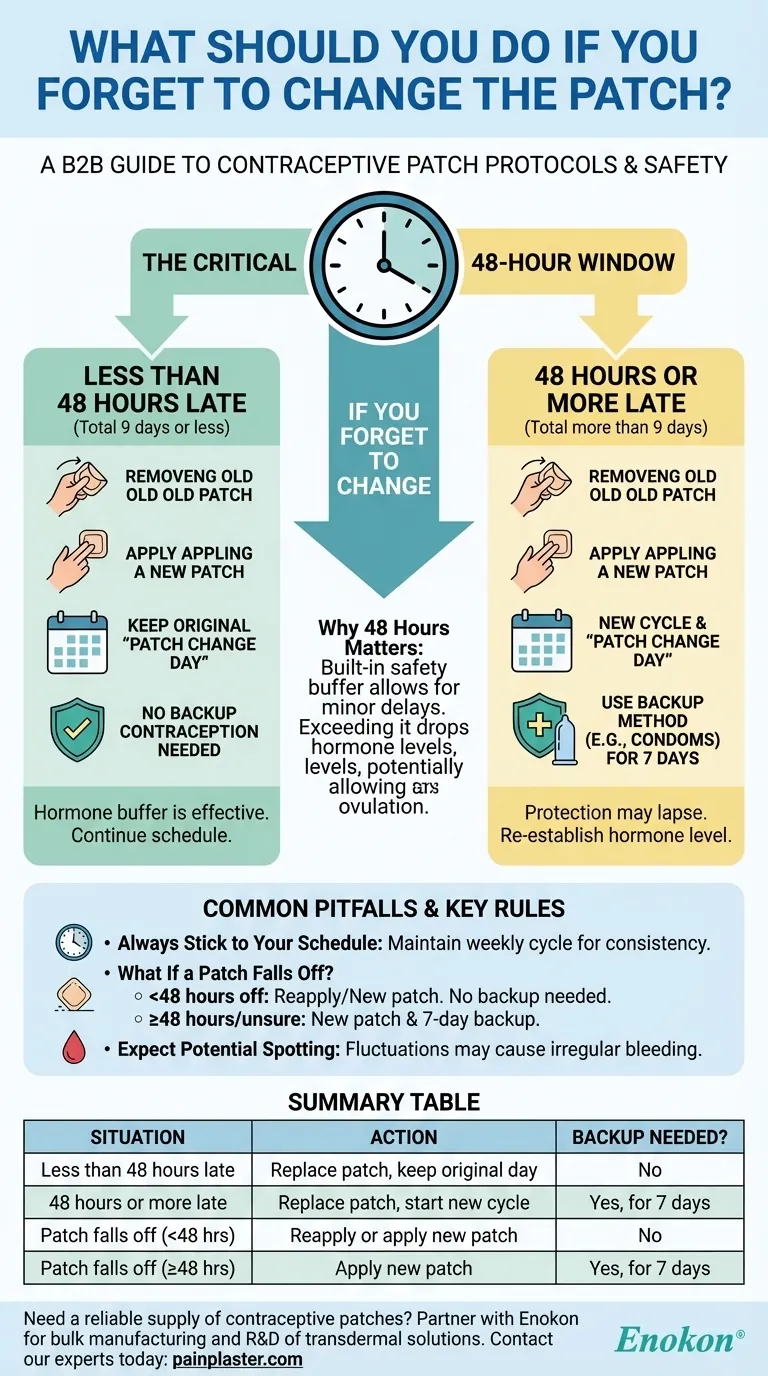
If you forget to change your contraceptive patch, your immediate action depends on how long you've left the old patch on. If it has been less than 48 extra hours, you can simply replace it and continue your schedule. If it has been 48 hours or longer, you must replace the patch and use a backup form of contraception for the next seven days to ensure you are protected.
The core principle is simple: the patch has a built-in grace period of under 48 hours. Exceeding this window means the hormone levels in your system may have dropped, temporarily compromising its effectiveness against pregnancy.

The Critical 48-Hour Window
The effectiveness of the contraceptive patch relies on maintaining a consistent level of hormones in your body. Forgetting to change it disrupts this consistency, but the risk is manageable if you act quickly.
Why 48 Hours Matters
Each patch is designed to release hormones for seven days. However, it contains enough hormones to remain effective for a short period beyond that, creating a safety buffer.
This buffer is generally considered to be up to 48 hours. After this point, hormone levels can fall low enough to allow for ovulation, which is what the patch is designed to prevent.
Protocol: If You Are Less Than 48 Hours Late
If you forgot to change your patch but it has been on for less than 48 extra hours (a total of 9 days or less), your contraceptive protection is not compromised.
Follow these steps:
- Remove the old patch immediately.
- Apply a new patch.
- Keep your original "patch change day." For example, if you always change it on a Sunday but remembered on Monday, you will still change your next patch on the following Sunday.
No backup contraception, like condoms, is needed.
Protocol: If You Are 48 Hours or More Late
If the patch has been on for an extra 48 hours or longer (a total of more than 9 days), you must assume your protection has lapsed.
Follow these steps:
- Remove the old patch immediately.
- Apply a new patch to start a new cycle.
- This day is now your new "patch change day."
- You must use a backup method of contraception (like condoms) for the next seven consecutive days.
This seven-day backup period is crucial for the new patch to re-establish a stable, effective level of hormones in your body.
Common Pitfalls and Key Rules
Mistakes happen, but following a few hard rules prevents them from becoming a serious issue. Understanding the logic behind them will help you manage your contraception with confidence.
The Risk of Reduced Efficacy
The primary risk of leaving a patch on for too long is an unplanned pregnancy. The 48-hour and seven-day backup rules are designed specifically to mitigate this risk by giving your body time to get back on a protected hormonal cycle.
Always Stick to Your Schedule
Do not change your "patch change day" unless you have been more than 48 hours late. Maintaining a consistent weekly schedule is the easiest way to ensure you remember and that the patch works as intended.
What If a Patch Falls Off?
The same 48-hour rule generally applies if a patch becomes detached.
If it has been off for less than 48 hours, you can reapply it if it's still sticky or apply a new patch immediately. No backup contraception is needed.
If it has been off for 48 hours or more, or if you are unsure how long it was off, you must apply a new patch and use backup contraception for seven days.
Expect Potential Spotting
When you miss a patch change, the fluctuation in hormones can sometimes cause irregular bleeding or spotting. This is generally not a cause for alarm but is something to be aware of.
Making the Right Choice for Your Situation
Your goal is to restore your contraceptive protection as quickly and safely as possible. Use your specific situation to determine the correct action.
- If your primary focus is correcting a minor delay (less than 48 hours late): Simply replace the patch and continue with your original weekly change day.
- If your primary focus is restoring protection after a major delay (48+ hours late): Replace the patch immediately and use a backup contraceptive method for the next seven days.
- If your primary focus is managing a detached patch: Assess how long it was off using the 48-hour rule to decide if backup protection is necessary.
- If your primary focus is safety when you are unsure: Always use backup contraception for seven days and contact your healthcare provider for personalized advice.
Following these clear guidelines ensures you can manage a mistake while maintaining control over your contraceptive protection.
Summary Table:
| Situation | Action | Backup Contraception Needed? |
|---|---|---|
| Less than 48 hours late | Replace patch, keep original change day | No |
| 48 hours or more late | Replace patch, start new cycle, new change day | Yes, for 7 days |
| Patch falls off (<48 hrs) | Reapply if sticky or apply new patch | No |
| Patch falls off (≥48 hrs) | Apply new patch | Yes, for 7 days |
Need a reliable supply of contraceptive patches? Partner with Enokon, a bulk manufacturer of trusted transdermal patches for healthcare distributors and pharmaceutical brands. We offer custom R&D and development to meet your specific product needs. Contact our experts today to discuss how we can support your business with high-quality, effective transdermal solutions.
Visual Guide
Related Products
- Heating Pain Relief Patches for Menstrual Cramps
- Prostate Pain Kidney Health Care Patch for Men
- Silicone Scar Sheets Patch Transdermal Drug Patch
- Lidocaine Hydrogel Pain Relief Patch for Pain Relief
- Menthol Gel Pain Relief Patch
People Also Ask
- What are the benefits of Period Pain Heat Patches? Drug-Free, On-the-Go Relief
- What are the key benefits of heating patches for elderly individuals? Relieve Pain & Improve Mobility
- What are the different types of heat patches? Find the Right Pain Relief for Your Needs
- What are the key differences between conventional heat patches and deep heat devices? Choosing the Right Pain Relief Solution
- What percentage of people with back pain use heat patches for relief? Discover the Popular Choice for Pain Management












