
The birth control patch offers the hormonal consistency of the pill without the daily commitment. It functions by delivering a combination of hormones (estrogen and progestin) through the skin, requiring a simple weekly change rather than a daily pill. In terms of perfect-use effectiveness, it is comparable to methods like the IUD, but its real-world effectiveness depends heavily on consistent user adherence.
The core difference between birth control methods is not just effectiveness, but the trade-off between user maintenance and duration. The patch occupies a middle ground, offering a convenient weekly schedule but requiring more diligence than long-acting methods like IUDs or implants.

How the Patch Compares: Key Dimensions
To understand where the patch fits, we must evaluate it across three critical factors: hormone delivery, user maintenance, and effectiveness. Each factor highlights its relationship to other common contraceptives.
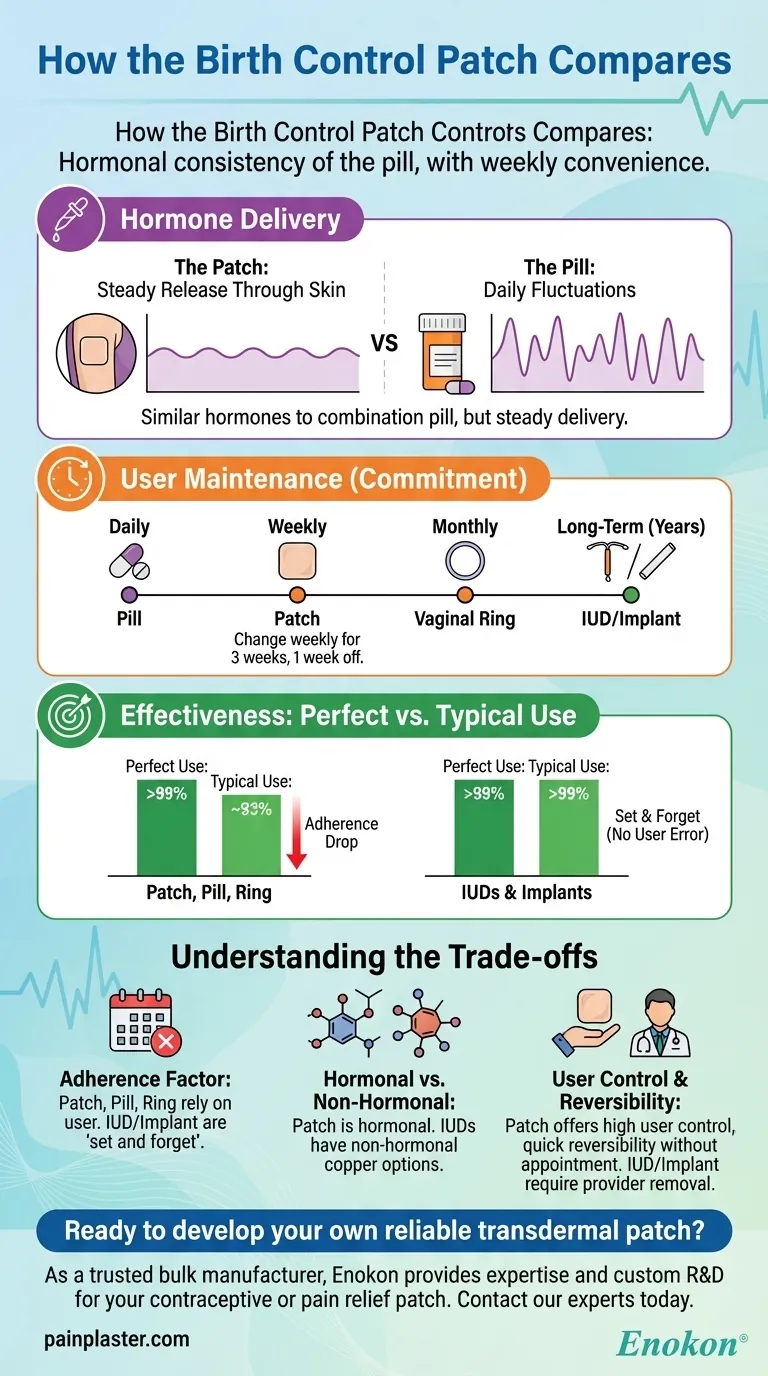
Hormone Delivery: A Steady Alternative
The patch is hormonally similar to combination birth control pills. Both use estrogen and progestin to prevent ovulation.
The key difference is the delivery mechanism. The patch provides a continuous, steady release of hormones through the skin, while the pill creates daily hormonal fluctuations.
User Maintenance: The Weekly Commitment
This is the most significant differentiating factor. The level of user involvement varies drastically between methods.
- Daily: The birth control pill.
- Weekly: The birth control patch.
- Monthly: The vaginal ring.
- Long-Term (Years): IUDs and the arm implant.
The patch requires you to remember to replace it on the same day each week for three weeks, followed by a patch-free week.
Effectiveness: Perfect Use vs. Typical Use
Effectiveness rates are a crucial comparison point. The patch is over 99% effective with perfect use, meaning it is changed on time, every time.
However, with typical use, which accounts for human error like forgetting to change it, effectiveness drops to around 93%. This is a larger drop than seen with long-acting methods.
In contrast, IUDs and implants have almost identical perfect-use and typical-use effectiveness rates (over 99%) because they remove the possibility of user error.
Understanding the Trade-offs
Choosing a contraceptive method involves balancing convenience, control, and potential side effects. The patch presents a clear set of advantages and disadvantages.
The Adherence Factor
The primary drawback of the patch, pill, and ring is their reliance on user adherence. Forgetting to change a patch or take a pill significantly reduces its effectiveness.
This is the main reason why long-acting reversible contraceptives (LARCs) like IUDs and implants are often considered more effective in real-world scenarios. They are "set and forget."
Hormonal vs. Non-Hormonal Options
The patch is a hormonal method. This may not be suitable for individuals who are sensitive to hormones or have certain medical conditions.
Other methods offer a wider range. IUDs come in both hormonal (Mirena, Kyleena) and non-hormonal copper versions (Paragard). The implant is hormonal, while methods like condoms are non-hormonal.
User Control and Reversibility
The patch offers a high degree of user control. You can decide to stop using it at any time without needing a clinical appointment, and fertility typically returns quickly.
This is a key advantage over IUDs and implants, which require a healthcare provider for removal. This factor is important for those planning for pregnancy in the near future.
Making the Right Choice for Your Goal
Your personal priorities will determine which method is the best fit for your life.
- If your primary focus is maximum effectiveness with minimal daily thought: An IUD or the implant is likely your best option.
- If your primary focus is avoiding daily pills but you want user-controlled hormonal birth control: The patch (weekly) or the vaginal ring (monthly) are excellent alternatives.
- If your primary focus is having the ability to stop your method instantly without a doctor's visit: The patch, pill, and ring offer superior flexibility.
Ultimately, the right method is the one that integrates seamlessly and reliably into your life.
Summary Table:
| Method | Hormone Type | Maintenance Schedule | Perfect-Use Effectiveness | Typical-Use Effectiveness |
|---|---|---|---|---|
| Birth Control Patch | Estrogen & Progestin | Weekly | >99% | ~93% |
| Birth Control Pill | Estrogen & Progestin | Daily | >99% | ~93% |
| Vaginal Ring | Estrogen & Progestin | Monthly | >99% | ~93% |
| IUD (Hormonal) | Progestin Only | Every 3-10 Years | >99% | >99% |
| Arm Implant | Progestin Only | Every 3 Years | >99% | >99% |
| Copper IUD | Non-Hormonal | Every 10 Years | >99% | >99% |
Ready to develop your own reliable transdermal patch?
As a trusted bulk manufacturer for healthcare and pharmaceutical distributors, Enokon provides the technical expertise and custom R&D needed to bring your contraceptive or pain relief patch to market. Benefit from our experience in developing effective, user-friendly transdermal solutions.
Contact our experts today to discuss your custom patch development needs.
Visual Guide
Related Products
- Heating Pain Relief Patches for Menstrual Cramps
- Prostate Pain Kidney Health Care Patch for Men
- Silicone Scar Sheets Patch Transdermal Drug Patch
- Cooling Fever Patches Color Change Cold Fever Patch
- Mugwort Wormwood Pain Relief Patch for Neck Pain
People Also Ask
- What are the benefits of Period Pain Heat Patches? Drug-Free, On-the-Go Relief
- What are the key benefits of heating patches for elderly individuals? Relieve Pain & Improve Mobility
- What percentage of people with back pain use heat patches for relief? Discover the Popular Choice for Pain Management
- What are the common uses of heat patches? Soothe Muscle Pain, Joint Stiffness & More
- Can heat patches be used for fresh injuries? Avoid This Common Mistake for Faster Recovery




