
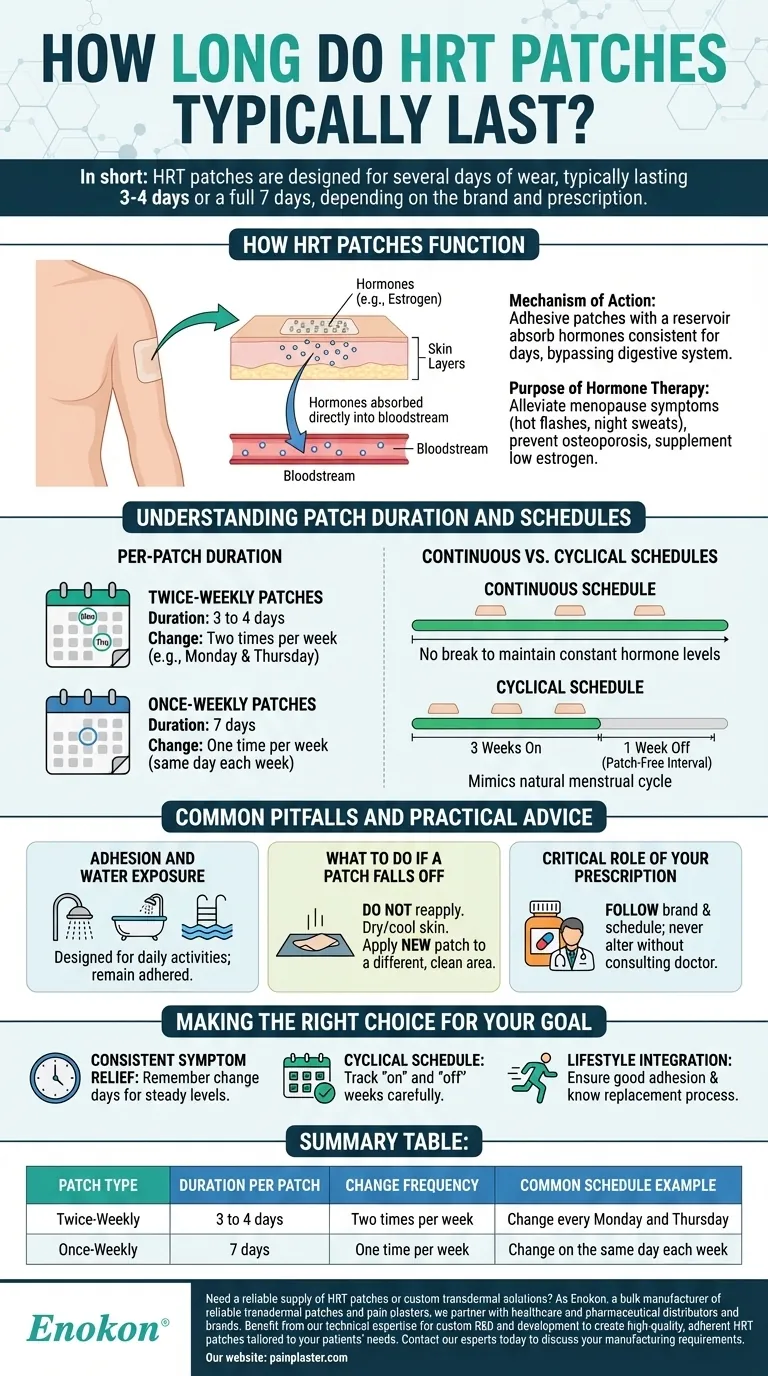
In short, Hormone Replacement Therapy (HRT) patches are designed to be worn for several days at a time. Depending on the specific brand and your prescription, a single patch typically lasts for either 3-4 days (requiring twice-weekly changes) or a full 7 days (requiring a once-weekly change).
The duration of a single patch is straightforward, but the critical factor for effective treatment is understanding how it fits into your prescribed schedule—either continuous hormone delivery or a cyclical plan that includes hormone-free periods.

How HRT Patches Function
The Mechanism of Action
HRT patches are adhesive patches that contain hormones, most commonly estrogen. When applied to the skin, the patch creates a reservoir that allows a small, consistent dose of these hormones to be absorbed directly into the bloodstream over several days.
This method of delivery bypasses the digestive system, providing a steady state of hormones that can help manage symptoms effectively.
The Purpose of Hormone Therapy
Physicians prescribe HRT patches for several primary reasons. They are most commonly used to alleviate the symptoms of menopause, such as hot flashes and night sweats.
They are also used to help prevent bone density loss (osteoporosis) in postmenopausal individuals or to supplement estrogen in those whose bodies do not produce sufficient amounts naturally.
Understanding Patch Duration and Schedules
Per-Patch Duration
The lifespan of a single patch is determined by its brand and formulation. Your prescription will be for one of two common types:
- Twice-weekly patches: These are changed every 3 to 4 days on a consistent schedule (e.g., Monday and Thursday).
- Once-weekly patches: These are changed on the same day each week.
Continuous vs. Cyclical Schedules
Beyond the duration of one patch, your overall treatment regimen will follow a specific schedule.
A continuous schedule involves wearing patches without a break to maintain constant hormone levels. In contrast, a cyclical schedule often involves wearing patches for three consecutive weeks, followed by a one-week, patch-free interval. This cyclical approach is designed to mimic a natural menstrual cycle.
Common Pitfalls and Practical Advice
Adhesion and Water Exposure
HRT patches are designed to be robust and should remain adhered to your skin during normal daily activities, including showering, bathing, and swimming.
What to Do if a Patch Falls Off
If a patch does come off, do not try to reapply it. Let the area of skin dry completely and cool down. Then, apply a brand-new patch to a different, clean, and dry area of skin to avoid irritation.
The Critical Role of Your Prescription
It is essential to follow the brand and schedule prescribed by your healthcare provider. The dosage, duration, and schedule (continuous vs. cyclical) are all tailored to your specific health needs and clinical goals.
Never alter your schedule or switch brands without consulting your doctor, as this can disrupt the intended therapeutic effect and hormone balance.
Making the Right Choice for Your Goal
Your primary task is to maintain the schedule set by your healthcare provider. How you approach this depends on your specific treatment plan.
- If your primary focus is consistent symptom relief: Your priority is remembering your change days (e.g., every Monday, or every Monday/Thursday) to ensure a steady hormone level.
- If you are on a cyclical schedule: The key is carefully tracking your "on" and "off" weeks to ensure you are following the prescribed rhythm of your therapy.
- If your primary concern is lifestyle integration: Confirm that the patch adheres well during your regular activities and know the procedure for replacing one that accidentally falls off.
Ultimately, adhering strictly to your prescribed schedule is the most important factor in achieving successful and stable hormone therapy.
Summary Table:
| Patch Type | Duration per Patch | Change Frequency | Common Schedule Example |
|---|---|---|---|
| Twice-Weekly | 3 to 4 days | Two times per week | Change every Monday and Thursday |
| Once-Weekly | 7 days | One time per week | Change on the same day each week |
Need a reliable supply of HRT patches or custom transdermal solutions?
As Enokon, a bulk manufacturer of reliable transdermal patches and pain plasters, we partner with healthcare and pharmaceutical distributors and brands. Benefit from our technical expertise for custom R&D and development to create high-quality, adherent HRT patches tailored to your patients' needs.
Contact our experts today to discuss your manufacturing requirements.
Visual Guide
Related Products
- Far Infrared Heat Pain Relief Patches Transdermal Patches
- Far Infrared Deep Heat Relief Patches Medicated Pain Relief Patches
- Far Infrared Pain Patch Relief Pain Reliever for Back
- Far Infrared Knee Pain Patch Heat Patches for Pain Relief
- Icy Hot Menthol Medicine Pain Relief Patch
People Also Ask
- Why is the selection of matrix materials critical when developing customized transdermal patches? Optimize Efficacy
- What role does a skin tolerance scoring system play in the safety evaluation of transdermal patches? Key Safety Metrics
- How does high-purity far-infrared ceramic powder contribute to the efficacy of far-infrared physical therapy patches?
- Why is an optical microscope used for the quality assessment of transdermal patches? Ensure Safety & Matrix Integrity
- What is the purpose of vacuum filtration for polymer solutions? Ensuring Quality in Transdermal Patch Manufacturing



















