
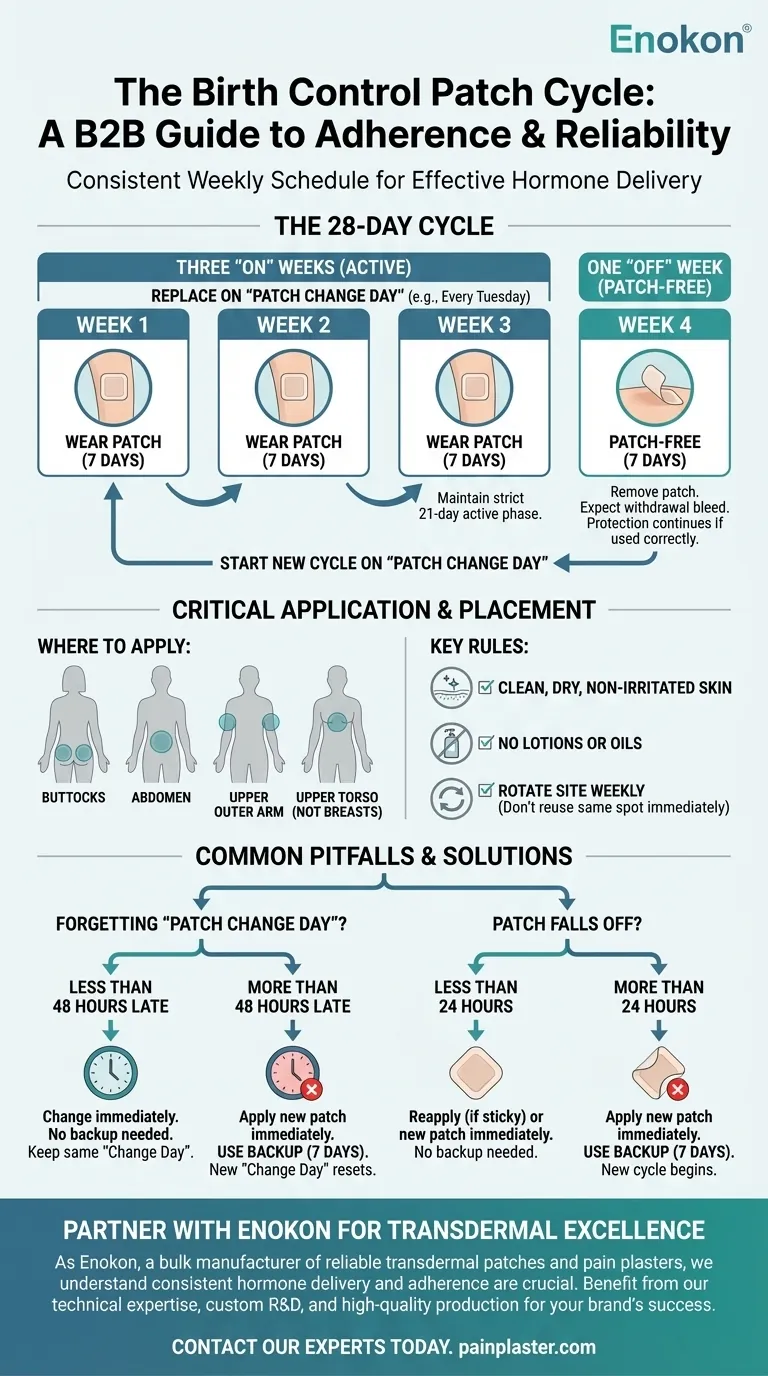
In short, the standard birth control patch is replaced once a week. You wear one patch for seven days, replace it with a new one on the same day each week for three consecutive weeks, and then go patch-free for the fourth week to allow for a menstrual period.
The core principle of the birth control patch is maintaining a consistent level of hormones to prevent pregnancy. Its effectiveness hinges entirely on a strict 28-day cycle: 21 days with a patch on, and 7 days with the patch off.

Understanding the 28-Day Patch Cycle
The contraceptive patch works by releasing a steady dose of hormones through your skin. This process requires a precise schedule to be effective, which is broken down into a simple, repeatable four-week cycle.
The "Patch Change Day"
The first day you apply a patch becomes your "Patch Change Day." If you put your first patch on a Tuesday, then every Tuesday will be the day you either change your patch or remove it for the patch-free week.
Creating a recurring weekly reminder is the most reliable way to stay on schedule.
The Three "On" Weeks
For Week 1, Week 2, and Week 3, you will wear a patch for seven full days. On your "Patch Change Day" at the end of each week, you will remove the old patch and immediately apply a new one.
The One "Off" Week
Week 4 is your patch-free week. On your "Patch Change Day" at the end of Week 3, you simply remove the patch and do not apply a new one. During this week, you will likely experience a withdrawal bleed, which is like a period.
You are still protected from pregnancy during this patch-free week, provided you used the patch correctly for the previous three weeks and start your next patch on time.
The Critical Role of Application and Placement
How and where you apply the patch is just as important as when you apply it. Proper adhesion is essential for the hormones to be absorbed correctly into your bloodstream.
Choosing the Right Spot
The patch must be applied to clean, dry, and non-irritated skin. Common and effective locations include the buttocks, abdomen, upper outer arm, or upper torso (but not on the breasts).
Avoid applying lotions, oils, or creams to the area where you plan to put the patch, as this can prevent it from sticking properly.
The Importance of Rotation
To prevent skin irritation, you must rotate the application site each week. If you used your upper-left arm one week, consider your right abdomen the next.
Never apply a new patch to the exact same spot of skin you just used.
Common Pitfalls and How to Avoid Them
With typical use, which accounts for human error, the patch is about 93% effective. Following the schedule perfectly increases this effectiveness significantly. Understanding what to do when mistakes happen is key to staying protected.
Forgetting Your "Patch Change Day"
If you forget to change your patch at the start of a new week (Week 2 or 3), what you do next depends on how late you are. If it has been less than 48 hours, change it as soon as you remember. You are still protected.
If it has been more than 48 hours, apply a new patch immediately, but you must use a backup birth control method (like condoms) for the next seven days. Your "Patch Change Day" now resets to this new day.
If the Patch Falls Off
Check your patch daily to ensure it is still firmly attached. If it falls off, your next step depends on how long it has been detached.
If it has been less than 24 hours (or you're unsure how long), you can reapply it if it's still sticky or apply a new patch immediately. No backup contraception is needed.
If it has been more than 24 hours, apply a new patch immediately and use a backup birth control method for the next seven days. This begins a new cycle, and your "Patch Change Day" will now be this new day.
Making the Right Choice for Your Goal
Adhering to the patch's schedule is the single most important factor in ensuring its effectiveness.
- If your primary focus is maximum effectiveness: Strictly follow the weekly schedule, check daily to ensure the patch is secure, and use backup contraception immediately if you deviate from the instructions.
- If your primary focus is convenience: Set a recurring weekly alarm on your phone for your "Patch Change Day" to make the routine automatic and effortless.
- If your primary focus is preventing mistakes: Always consult the specific instructions that come with your brand of patch and speak with your healthcare provider about what to do in case of an error.
Ultimately, consistent and correct use turns the birth control patch into a simple and highly reliable contraceptive method.
Summary Table:
| Week | Action | Key Details |
|---|---|---|
| Week 1, 2, 3 | Wear a patch | Replace with a new patch on the same day each week (your "Patch Change Day"). |
| Week 4 | Patch-free week | Remove the patch. A withdrawal bleed occurs. Protection continues if the schedule was followed. |
Need a reliable partner for your transdermal patch production?
As Enokon, a bulk manufacturer of reliable transdermal patches and pain plasters for healthcare and pharma distributors and brands, we understand the critical importance of consistent hormone delivery and patient adherence. Our technical expertise ensures high-quality, effective patches.
Benefit from our custom R&D and development services to create a product that meets your specific needs.
Contact our experts today to discuss your project and how we can support your brand's success.
Visual Guide
Related Products
- Prostate Pain Kidney Health Care Patch for Men
- Heating Pain Relief Patches for Menstrual Cramps
- Silicone Scar Sheets Patch Transdermal Drug Patch
- Menthol Gel Pain Relief Patch
- Icy Hot Menthol Medicine Pain Relief Patch
People Also Ask
- What are the key components of Chinese herbal pain patches? Discover the Science Behind Natural Pain Relief
- What role do Chinese pain patches play in arthritis relief? Discover Natural Pain Management Solutions
- What additional practices can enhance the effectiveness of Chinese pain patches? Boost Relief with Holistic Strategies
- What should be avoided when using Chinese pain patches? Key Safety Tips for Effective Relief
- What are some popular Chinese pain patches and their uses? Discover Top Herbal Solutions for Pain Relief








