
To use the estrogen and progestin contraceptive patch correctly, you apply one new patch to your skin each week for three consecutive weeks. This is followed by one full week without a patch, during which you will likely experience withdrawal bleeding. This four-week cycle is then repeated to maintain continuous pregnancy prevention.
While the contraceptive patch offers a simple weekly schedule, its effectiveness is critically dependent on consistent and correct application. Understanding the proper procedure and its limitations is essential for preventing unintended pregnancy.
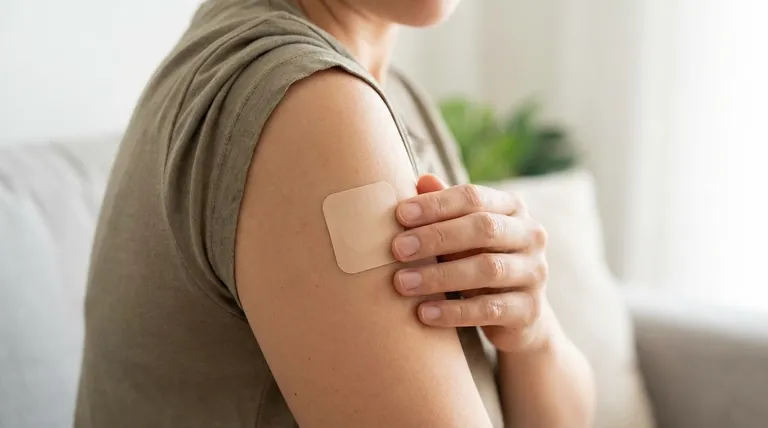
The Core 4-Week Cycle Explained
The patch operates on a straightforward 28-day (4-week) cycle. Consistency is the most important factor for success.
Week 1, 2, and 3: The "Patch-On" Weeks
You will apply a new patch and wear it for exactly seven days. On the same day of the week each time (your "patch change day"), you will remove the old patch and apply a new one.
For example, if you apply your first patch on a Sunday, you will change it every following Sunday for three weeks.
Week 4: The "Patch-Free" Week
After wearing a patch for three full weeks, you will enter a seven-day patch-free period. You should not wear a patch during this fourth week.
This is when you can expect withdrawal bleeding, similar to a period. You will start a new cycle by applying a new patch at the end of this week, even if you are still bleeding.
Starting Your First Patch
To ensure you are protected from pregnancy immediately, it is often recommended to apply your very first patch on the first day of your menstrual period.
Proper Application for Maximum Effectiveness
Where and how you apply the patch directly impacts how well it works. The goal is to ensure your body consistently absorbs the hormones.
Where to Apply the Patch
The patch should be applied to skin that is clean, dry, and not very hairy. Avoid skin that is irritated or has lotions, creams, or oils on it.
Common and effective locations include the upper outer arm, upper back, buttocks, or lower abdomen.
How to Prepare Your Skin
Before applying, wash and dry the area thoroughly. Do not use any lotions or powders on the skin where you plan to place the patch, as this can prevent it from sticking properly.
Applying the New Patch
When you change your patch, apply the new one to a different spot to avoid skin irritation. Press it down firmly with the palm of your hand for about 10 seconds to ensure the edges are securely attached.
Understanding the Trade-offs and Risks
No contraceptive method is perfect or suitable for everyone. Understanding the realities of patch use is key to making an informed decision.
Effectiveness: Perfect vs. Typical Use
With perfect use—changing the patch on time, every time—it is 99% effective at preventing pregnancy.
However, with typical real-world use, which accounts for mistakes like forgetting to change it, the effectiveness drops to about 93%. This means that for every 100 people using the patch, approximately 7 may become pregnant in a year.
Medical Considerations are Crucial
The patch is not safe for everyone. A doctor will screen you for risk factors before prescribing it.
You must inform your doctor if you have a history of blood clots, stroke, heart disease, certain types of cancer, or liver disease. It is also important to disclose if you are pregnant, breastfeeding, or have had recent surgery.
How to Apply This to Your Goal
Your personal habits and health profile will determine if the patch is the right choice for you.
- If your primary focus is convenience: The patch's weekly schedule is simpler than a daily pill, but only if you can reliably remember your single "patch change day" each week.
- If your primary focus is the highest possible effectiveness: You must commit to perfect use—applying it correctly and changing it on time, every time—to approach the 99% efficacy rate.
- If your primary focus is safety: A thorough and honest discussion with your doctor about your personal and family health history is the most important step before starting the patch.
Ultimately, consistent and correct use is the key to making the contraceptive patch a reliable part of your health plan.
Summary Table:
| Key Aspect | Details |
|---|---|
| Cycle | 3 weeks on, 1 week off |
| Patch Change | Same day each week |
| Perfect Use Effectiveness | 99% |
| Typical Use Effectiveness | 93% |
| Common Application Sites | Upper arm, buttocks, abdomen, back |
Need a reliable, custom-developed transdermal patch?
As Enokon, a bulk manufacturer of proven transdermal patches and pain plasters, we provide healthcare and pharma brands with expert custom R&D and development services. Let us help you bring a safe, effective product to market.
Contact our team today to discuss your project requirements.
Visual Guide

Related Products
- Heating Pain Relief Patches for Menstrual Cramps
- Prostate Pain Kidney Health Care Patch for Men
- Silicone Scar Sheets Patch Transdermal Drug Patch
- Lidocaine Hydrogel Pain Relief Patch for Pain Relief
- Menthol Gel Pain Relief Patch
People Also Ask
- What are the benefits of Period Pain Heat Patches? Drug-Free, On-the-Go Relief
- What are the key benefits of heating patches for elderly individuals? Relieve Pain & Improve Mobility
- What are the different types of heat patches? Find the Right Pain Relief for Your Needs
- What are the key differences between conventional heat patches and deep heat devices? Choosing the Right Pain Relief Solution
- What percentage of people with back pain use heat patches for relief? Discover the Popular Choice for Pain Management













