
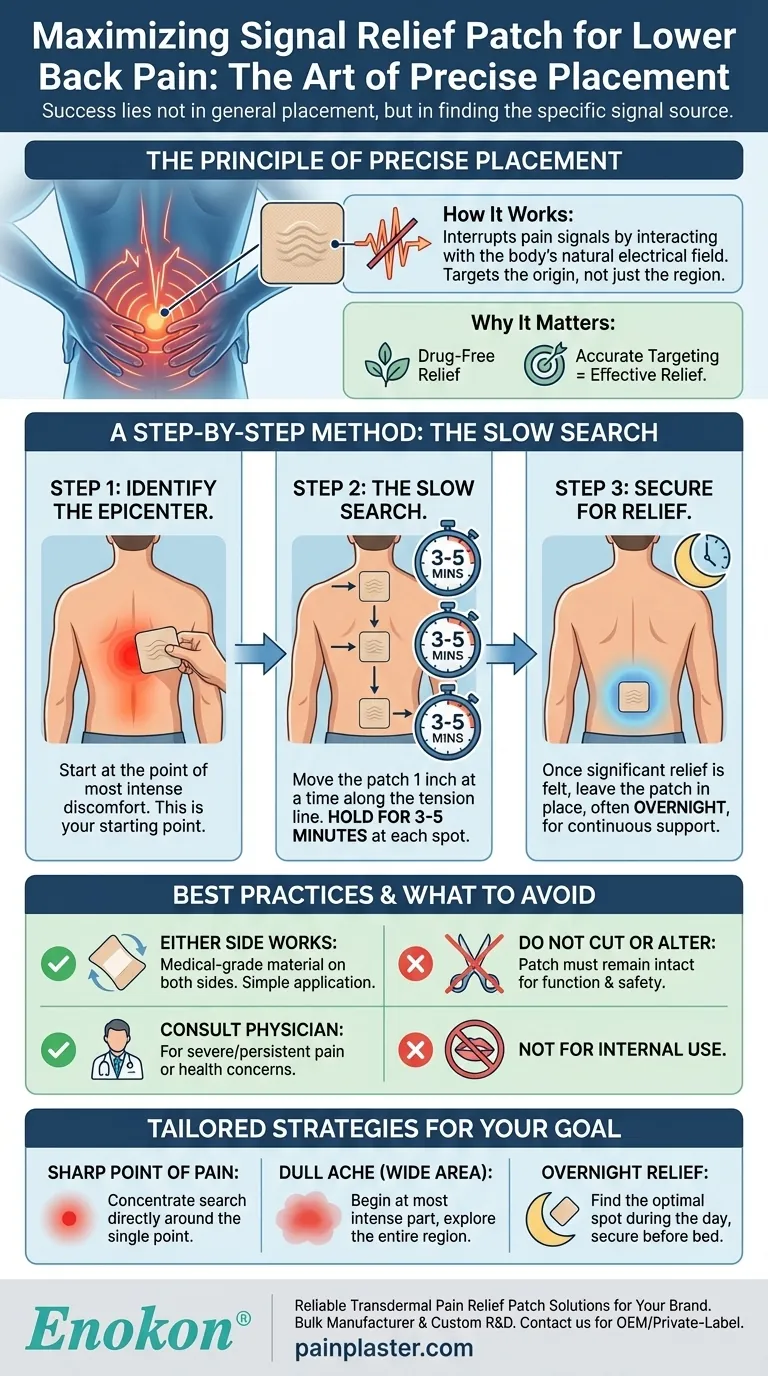
To use the Signal Relief patch for lower back pain, you must first identify the precise point of your discomfort. The key is to methodically move the patch around the general area of pain, holding it in place for several minutes at each spot, until you find the exact location that provides the most significant relief. Once found, you can leave it on the area, often overnight, for extended relief.
The effectiveness of the Signal Relief patch lies not in general placement, but in patiently and precisely locating the specific origin point of your discomfort. It works by interrupting pain signals, so finding the source is the most critical step.

The Principle of Precise Placement
The Signal Relief patch is designed to be versatile and can be used on any part of the body. Its success, however, depends on accurately targeting the source of the pain signal.
Why Finding the Source Matters
The patch offers drug-free relief by interacting with the body's natural electrical signals. To do this effectively, it needs to be placed directly over the area where the discomfort originates, not just the general region where it is felt.
Activating Discomfort to Pinpoint the Area
Before applying the patch, it can be helpful to gently move your back in a way that activates the tension or discomfort. This helps you become more aware of your range of motion and the exact epicenter of the pain, making it easier to find the right spot.
A Step-by-Step Method for Your Lower Back
Finding the optimal placement is a process of exploration. Follow these steps to maximize your chances of success.
Step 1: Identify the Epicenter
Start by holding the patch on the area of your lower back where the discomfort feels most intense or irritating. This is your initial starting point.
Step 2: The Slow Search
Slowly move the patch in small increments—about one inch at a time—along the line of tension you feel in your back. In each new spot, hold the patch firmly in place for 3 to 5 minutes to give it time to work.
Step 3: Secure for Long-Term Relief
When you find a spot that provides a noticeable reduction in discomfort, you have found the correct placement. For lower back issues, it is often recommended to leave the patch on this spot overnight to provide continuous relief.
Best Practices and What to Avoid
While the process is straightforward, following a few key guidelines ensures safe and effective use.
There Is No "Wrong" Side
The patch is made of the same medical-grade material on both sides. You can place it with either side facing your body, which simplifies application.
General Placement vs. Targeted Relief
Simply placing the patch on the lower back may provide some benefit, but it will be far less effective than taking the time to perform the slow search. Targeting the precise source is the key to significant relief.
Do Not Cut or Alter the Patch
The patch is designed to work as a single, intact unit. It should not be cut or altered in any way, as this could compromise its function and safety. It is also intended for external use only.
When to Consult a Physician
The Signal Relief patch is not a substitute for medical advice. If you have concerns about your health conditions or if the pain is severe or persistent, always consult with your physician.
Making the Right Choice for Your Goal
Your specific type of pain will guide your application strategy.
- If your primary focus is a sharp, specific point of pain: Concentrate your search directly on and around that single point until relief is maximized.
- If your primary focus is a dull ache across a wider area: Begin at the most intense part of the ache and methodically explore the entire region to find the true source of the signal.
- If your primary focus is consistent overnight relief: Use the slow search method during the day to identify the optimal spot, and then secure the patch there before you go to bed.
By patiently finding the precise source of the discomfort, you empower the patch to provide effective, targeted relief.
Summary Table:
| Key Consideration | Guideline |
|---|---|
| Primary Goal | Pinpoint the exact origin point of the pain signal for maximum relief. |
| Application Method | Perform a 'slow search,' moving the patch in 1-inch increments and holding for 3-5 minutes per spot. |
| Optimal Usage | Once the source is found, leave the patch on, often overnight, for extended relief. |
| Important Note | Do not cut the patch. It is safe for external use with either side against the skin. |
Need a reliable, high-quality transdermal pain relief patch for your brand or distribution network?
As Enokon, a bulk manufacturer of reliable transdermal patches and pain plasters, we understand that effective pain management requires precise product design and consistent quality. Our technical expertise in custom R&D and development ensures your customers get the targeted relief they need.
Let us help you deliver superior pain management solutions. Contact our team today to discuss your specific requirements for OEM or private-label patches.
Visual Guide
Related Products
- Far Infrared Deep Heat Relief Patches Medicated Pain Relief Patches
- Far Infrared Pain Patch Relief Pain Reliever for Back
- Far Infrared Heat Pain Relief Patches Transdermal Patches
- Far Infrared Knee Pain Patch Heat Patches for Pain Relief
- Natural Herbal Patch for Motion Sickness and Car Sickness Relief
People Also Ask
- How do Deep Heat Pain Relief Patches provide pain relief? Discover the Drug-Free Mechanism
- How effective are pain relief patches for muscle pain? Target Localized Pain with Transdermal Delivery
- When should you consider using pain relief products like creams and patches? Optimize Comfort & Safety
- What are pain relief patches and how are they used? A Guide to Safe, Targeted Relief
- Who should consult a healthcare professional before using pain relief patches? Ensure Your Safety with Medical Advice



















