
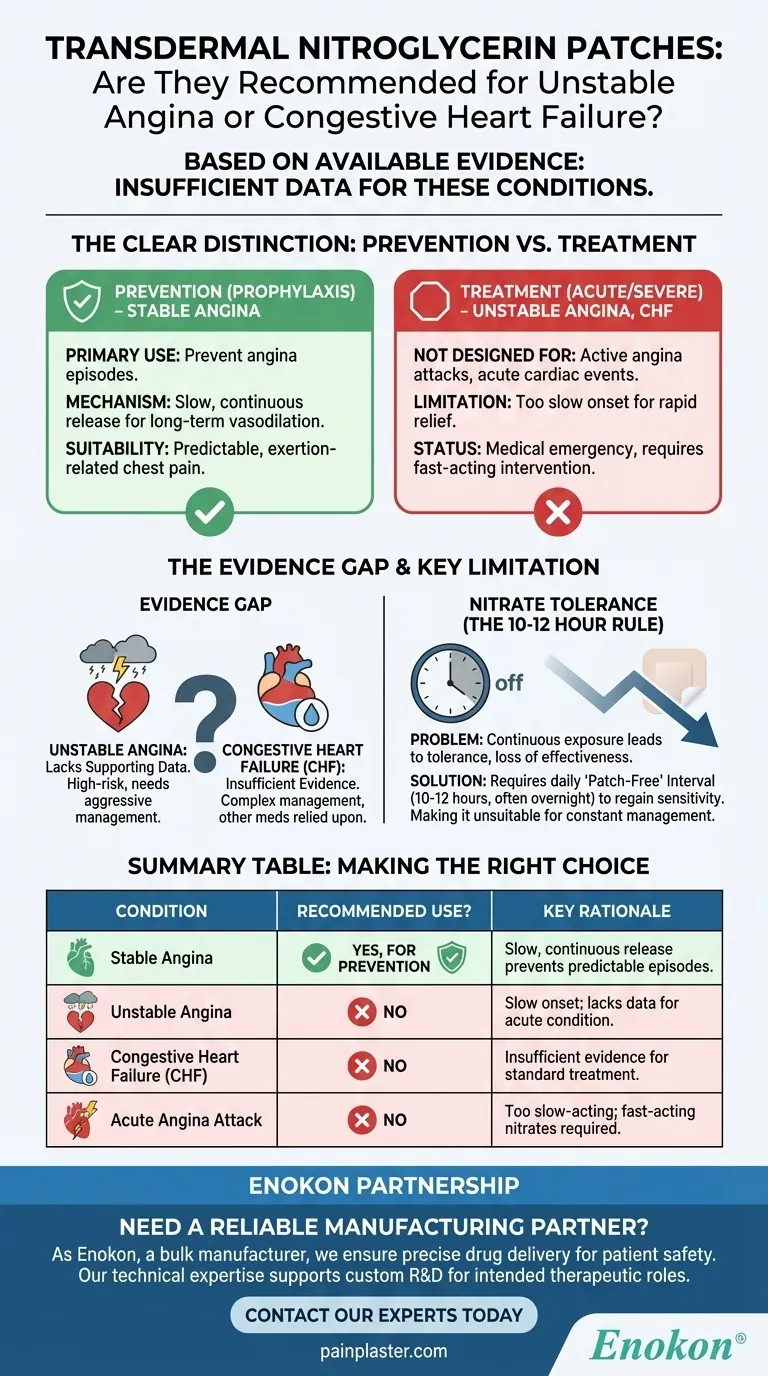
Based on the available evidence, the answer is clear. There are insufficient data to recommend the use of transdermal nitroglycerin patches for treating patients with unstable angina or congestive heart failure. Their established role is much more specific and limited.
The core takeaway is that transdermal nitroglycerin patches are designed for long-term prevention of chest pain in stable angina, not for the treatment of acute or severe cardiac conditions like unstable angina or heart failure, where their efficacy has not been established.

The Clear Distinction: Prevention vs. Treatment
To use any medical tool effectively, we must first understand its intended purpose. Nitroglycerin patches are not an emergency intervention; they are a prophylactic, or preventative, measure.
What Patches Are Designed For: Prophylaxis
Transdermal nitroglycerin patches are primarily used to prevent episodes of angina (chest pain) in people with stable coronary artery disease.
Their slow, continuous release of medication is designed to keep blood vessels dilated over a long period, reducing the frequency of predictable, exertion-related chest pain.
Why They Fall Short for Acute Conditions
These patches are not suitable for treating an active angina attack. The onset of action is too slow to provide the rapid relief needed during an acute cardiac event.
Unstable angina is a medical emergency that requires immediate, fast-acting interventions, a role for which transdermal patches are not designed.
The Evidence Gap for Unstable Angina and CHF
The specific conditions you asked about fall outside the proven application of this therapy. The lack of a recommendation is based on a lack of supporting evidence.
Unstable Angina: A Lack of Supporting Data
Current clinical data does not support the use of transdermal nitroglycerin for unstable angina. This condition signifies a high-risk situation that demands more aggressive and proven medical management.
Congestive Heart Failure: Insufficient Evidence
Similarly, there is insufficient evidence to recommend transdermal nitroglycerin as a standard treatment for congestive heart failure (CHF). The management of CHF is complex and relies on other classes of medications.
Understanding the Key Limitation: Nitrate Tolerance
A critical factor limiting the use of nitroglycerin patches is the body's physiological response to continuous exposure.
The Problem of Nitrate Tolerance
When nitroglycerin is delivered continuously, the body quickly develops a tolerance, and the medication loses its effectiveness. This is a major reason why it is not a simple solution for persistent conditions.
The Necessity of a "Patch-Free" Interval
To remain effective for preventing stable angina, the patches must be used on an intermittent schedule.
This typically involves a daily "patch-free" period of 10-12 hours (often overnight) to allow the body to regain its sensitivity to the drug's effects. This required interval makes it unsuitable for conditions needing constant management.
Making the Right Choice for Your Goal
The decision to use this therapy must be aligned with the specific clinical objective.
- If your primary focus is preventing predictable angina in a stable patient: Transdermal patches can be an appropriate option, provided a daily nitrate-free interval is maintained to prevent tolerance.
- If your primary focus is treating an acute angina attack or unstable angina: These patches are contraindicated due to their slow onset of action; fast-acting nitrates and emergency care are necessary.
- If your primary focus is managing congestive heart failure: There is not enough clinical evidence to support recommending transdermal nitroglycerin for this purpose.
Understanding the precise role and limitations of a treatment is the foundation of effective and safe patient care.
Summary Table:
| Condition | Recommended Use of Transdermal Nitroglycerin Patches? | Key Rationale |
|---|---|---|
| Stable Angina | Yes, for prevention | Slow, continuous release prevents predictable chest pain episodes. |
| Unstable Angina | No | Slow onset of action; lacks supporting clinical data for this acute condition. |
| Congestive Heart Failure (CHF) | No | Insufficient evidence to recommend as a standard treatment. |
| Acute Angina Attack | No | Too slow-acting; fast-acting nitrates are required for immediate relief. |
Need a reliable manufacturing partner for your transdermal patch development?
As Enokon, a bulk manufacturer of reliable transdermal patches and pain plasters, we understand that precise drug delivery is critical for patient safety and efficacy. Our technical expertise supports healthcare and pharma distributors and brands in custom R&D and development, ensuring your product is designed for its intended therapeutic role from the start.
Contact our experts today to discuss how we can help bring your safe and effective transdermal solutions to market.
Visual Guide
Related Products
- Far Infrared Heat Pain Relief Patches Transdermal Patches
- Silicone Scar Sheets Patch Transdermal Drug Patch
- Menthol Gel Pain Relief Patch
- Icy Hot Menthol Medicine Pain Relief Patch
- Mugwort Wormwood Pain Relief Patch for Neck Pain
People Also Ask
- Why is the selection of matrix materials critical when developing customized transdermal patches? Optimize Efficacy
- What role does a skin tolerance scoring system play in the safety evaluation of transdermal patches? Key Safety Metrics
- How does high-purity far-infrared ceramic powder contribute to the efficacy of far-infrared physical therapy patches?
- Why is an optical microscope used for the quality assessment of transdermal patches? Ensure Safety & Matrix Integrity
- What is the purpose of vacuum filtration for polymer solutions? Ensuring Quality in Transdermal Patch Manufacturing



















