
To improve transdermal drug delivery, researchers are primarily focused on two strategic areas: developing advanced materials to help drugs passively cross the skin barrier and creating active systems that physically and temporarily bypass it. Key innovations include novel adhesives, nanoparticles, and chemical permeation enhancers, alongside energy-based methods and microneedles designed to breach the skin's outer layer.
The core challenge in transdermal delivery is overcoming the skin's highly effective outer barrier, the stratum corneum. Current research aims to solve this either by making drugs more adept at navigating this barrier chemically or by creating microscopic, temporary pathways through it.
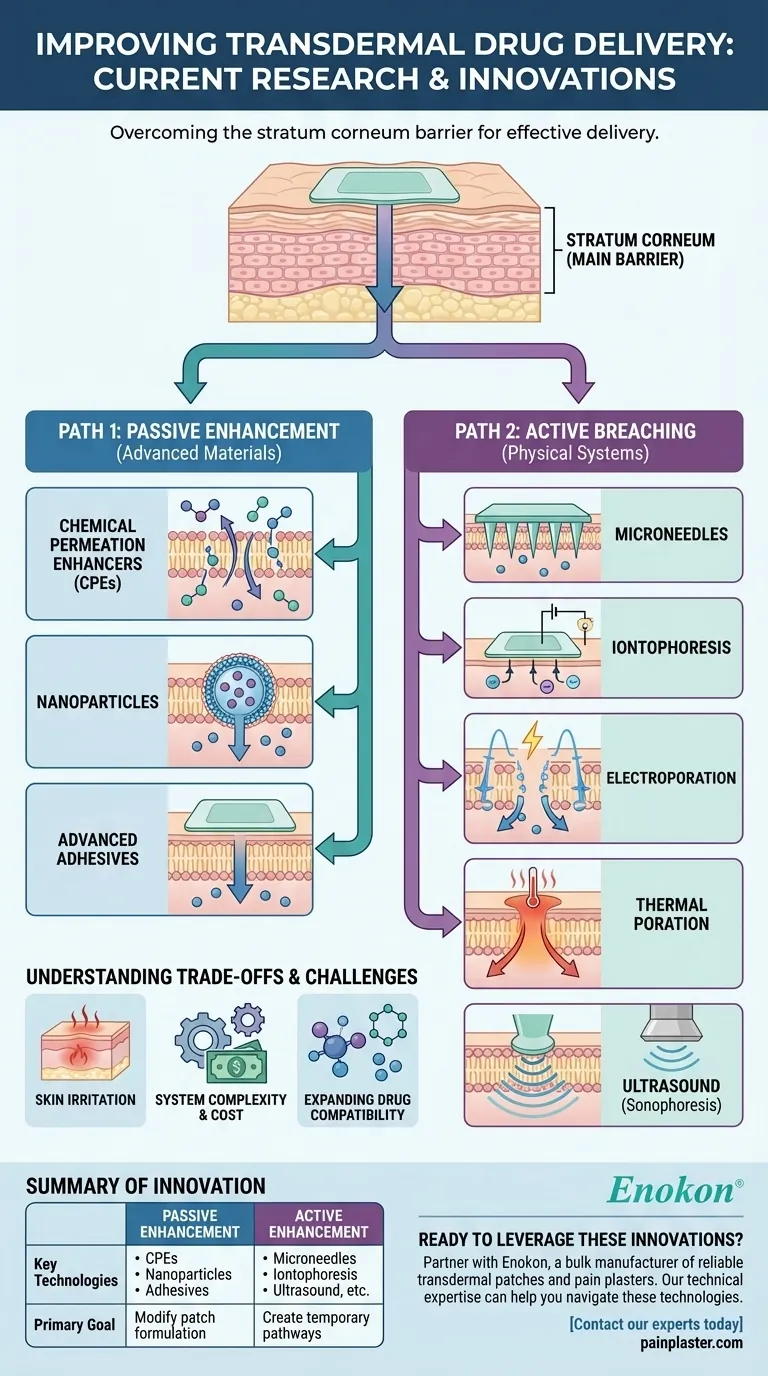
The Two Primary Strategies for Innovation
The fundamental goal of all transdermal research is to move a wider range of drug molecules through the skin safely and efficiently. The methods being developed fall into two distinct categories: passive enhancement through advanced materials and active enhancement through physical intervention.
Path 1: Enhancing Passive Delivery
This approach focuses on improving the components of the patch itself to make drug absorption more effective without external energy.
Chemical Permeation Enhancers (CPEs)
CPEs are compounds added to the patch's drug formulation. They work by temporarily and reversibly disrupting the highly ordered structure of the stratum corneum, making it more permeable.
Nanoparticles
Researchers are engineering nanoparticles to encapsulate drug molecules. This can improve the drug's solubility and stability, allowing for better interaction with and transport across the skin barrier.
Advanced Adhesives
The adhesive is not just for keeping the patch on; it's a critical component of the drug delivery system. Innovations focus on creating adhesives that provide consistent skin contact while also controlling the rate at which the drug is released from the patch into the skin.
Path 2: Actively Breaching the Barrier
This strategy uses energy or mechanical means to create temporary, microscopic pathways through the stratum corneum, allowing drugs to bypass the main barrier.
Microneedles
These are arrays of tiny, painless needles that pierce only the outermost layer of skin. They create micro-channels that allow drugs, especially large molecules that cannot typically pass through the skin, to be delivered more effectively.
Iontophoresis
This technique applies a low-level electrical current to the patch. The current helps drive charged drug molecules through the skin, increasing the rate and efficiency of delivery.
Electroporation
Similar to iontophoresis, electroporation uses short, high-voltage electrical pulses. These pulses create temporary pores (poration) in the stratum corneum for drug molecules to pass through.
Thermal Poration
This method uses heat to make the skin more permeable. Controlled heating can temporarily fluidize the lipids in the stratum corneum, creating pathways for the drug to enter.
Ultrasound
Also known as sonophoresis, this technique uses low-frequency ultrasonic waves. The energy from these waves disrupts the stratum corneum, creating temporary openings for enhanced drug delivery.
Understanding the Trade-offs and Challenges
While these innovations hold immense promise, they are not without practical challenges that researchers are actively working to solve.
Skin Irritation
A primary concern with any transdermal system is the potential for skin application site reactions. Even with advanced materials, continuous contact can cause mild irritation, which is why proper site rotation is crucial.
System Complexity and Cost
Active enhancement methods like iontophoresis or microneedle arrays are inherently more complex and expensive to manufacture than a simple passive patch. This can impact the accessibility and cost-effectiveness of the final product.
Expanding Drug Compatibility
Currently, only a limited number of drugs are suitable for transdermal delivery, typically those with low molecular weight that can passively diffuse through the skin. A major goal of all new technologies is to expand this list to include larger and more complex molecules.
Applying This to Future Development
The technology chosen depends entirely on the therapeutic goal, the nature of the drug, and the desired patient experience.
- If your primary focus is delivering large-molecule drugs (like biologics): Microneedles and electroporation are the most promising avenues as they physically create pathways large enough for these molecules.
- If your primary focus is improving the delivery of existing small-molecule drugs: Innovations in chemical enhancers, nanoparticles, and advanced adhesives offer a more cost-effective path to increased efficiency.
- If your primary focus is increasing the speed of drug action: Energy-based methods like iontophoresis and ultrasound can significantly accelerate drug transport across the skin for faster therapeutic effect.
These advancements are poised to transform transdermal systems from a niche delivery method into a mainstream platform for a wide range of therapies.
Summary Table:
| Innovation Area | Key Technologies | Primary Goal |
|---|---|---|
| Passive Enhancement | Chemical Permeation Enhancers, Nanoparticles, Advanced Adhesives | Improve drug absorption by modifying the patch formulation. |
| Active Enhancement | Microneedles, Iontophoresis, Ultrasound, Thermal Poration | Create temporary pathways to bypass the skin's main barrier. |
Ready to leverage these innovations for your next-generation transdermal product?
Partner with Enokon, a bulk manufacturer of reliable transdermal patches and pain plasters. Our technical expertise in custom R&D and development can help you navigate these advanced technologies—whether you're targeting large-molecule delivery, faster drug action, or improved efficiency for existing compounds.
Contact our experts today to discuss your specific project requirements and benefit from our manufacturing excellence.
Visual Guide
Related Products
- Far Infrared Heat Pain Relief Patches Transdermal Patches
- Silicone Scar Sheets Patch Transdermal Drug Patch
- Icy Hot Menthol Medicine Pain Relief Patch
- Menthol Gel Pain Relief Patch
- Mugwort Wormwood Pain Relief Patch for Neck Pain
People Also Ask
- Why is the selection of matrix materials critical when developing customized transdermal patches? Optimize Efficacy
- What are the physical impacts of external heat exposure on the performance and safety of transdermal patches? - Guide
- What role does a skin tolerance scoring system play in the safety evaluation of transdermal patches? Key Safety Metrics
- What are the clinical advantages of local transdermal delivery systems? Unlock Safer, More Effective Pain Relief Solutions
- How does high-purity far-infrared ceramic powder contribute to the efficacy of far-infrared physical therapy patches?



















