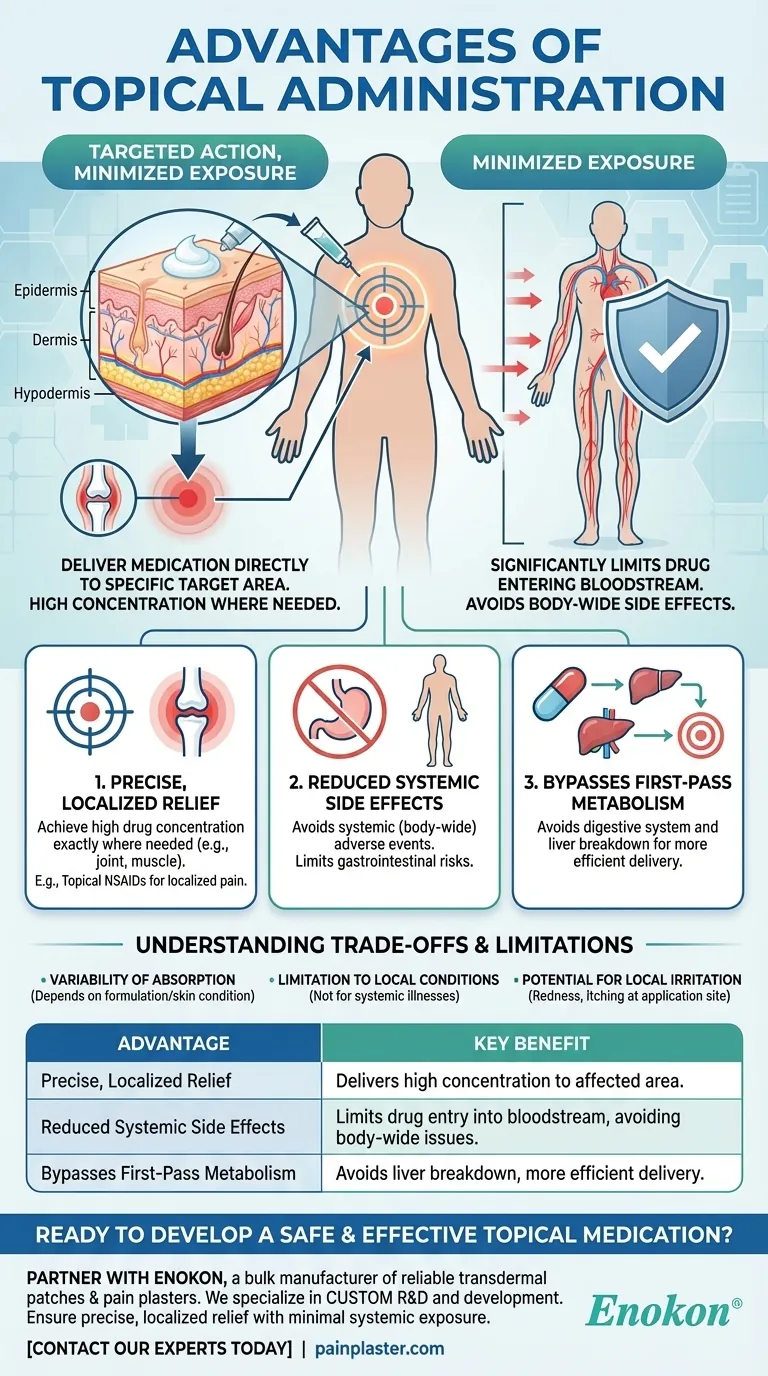
The primary advantage of topical administration is its ability to deliver medication directly to a specific target area on the skin. This targeted approach provides localized treatment while significantly limiting the amount of drug that enters the bloodstream, thereby reducing the risk of body-wide side effects.
The core value of topical administration lies in maximizing the therapeutic effect at a specific site while minimizing unwanted exposure and side effects throughout the rest of the body.

The Core Principle: Targeted Action, Minimized Exposure
Topical medications are designed to work at or just below the surface of the skin. This fundamental difference from oral or injected drugs, which circulate throughout your entire system, is the source of its key benefits.
Advantage 1: Precise, Localized Relief
By applying a medication directly to the affected area, you achieve a high concentration of the drug exactly where it is needed most.
For example, topical NSAIDs (nonsteroidal anti-inflammatory drugs) can penetrate the skin to relieve pain and inflammation in a specific joint or muscle without affecting the entire body.
Advantage 2: Reduced Systemic Side Effects
The greatest benefit of limiting a drug's entry into the bloodstream is the avoidance of systemic, or body-wide, adverse events.
This is why topical NSAIDs are often preferred for localized pain; they avoid the significant risks of gastrointestinal bleeding or peptic ulcers that can be associated with their oral counterparts.
Advantage 3: Bypassing First-Pass Metabolism
When you take a pill, it goes through your digestive system and is metabolized by the liver before it ever reaches the rest of your body—a process called the "first-pass effect."
This can reduce the drug's effectiveness and create byproducts that cause side effects. Topical administration bypasses this entire process, allowing for a more efficient and direct delivery mechanism.
Understanding the Trade-offs and Limitations
While highly effective for specific goals, topical administration is not a universal solution. Its effectiveness is governed by several factors that must be considered.
Factor 1: The Variability of Absorption
The amount of drug that gets absorbed is not always consistent. It depends heavily on factors like the specific formulation of the medication and the location where it is applied.
The thickness and condition of the skin can vary significantly across the body, impacting how much of the drug actually penetrates to the target tissue.
Factor 2: The Limitation to Local Conditions
Topical administration is, by design, for local problems. It cannot achieve the high plasma levels required to treat systemic illnesses like a widespread infection or an autoimmune disease.
Its purpose is to contain the drug's effect, making it unsuitable for conditions that require medication to circulate throughout the body.
Factor 3: Potential for Local Irritation
While systemic side effects are low, the direct contact of the medication with the skin can sometimes cause local reactions.
This may include redness, itching, or irritation at the site of application.
Making the Right Choice for Your Goal
Selecting a delivery method depends entirely on the therapeutic goal. Topical administration offers a powerful tool when the problem is localized and avoiding systemic impact is a priority.
- If your primary focus is treating a localized condition (like skin inflammation or joint pain): Topical administration is often the ideal choice for delivering a high drug concentration directly to the source.
- If your primary focus is minimizing side effects: Topical delivery is superior for avoiding systemic issues like gastrointestinal distress or unwanted drug-drug interactions.
- If your primary focus is treating a body-wide illness: This method is generally inappropriate, as it is specifically designed to prevent the drug from reaching the high systemic levels you would need.
Ultimately, understanding this trade-off between localized action and systemic exposure empowers you to align the treatment method with the specific health outcome you need to achieve.
Summary Table:
| Advantage | Key Benefit |
|---|---|
| Precise, Localized Relief | Delivers high drug concentration directly to the affected area (e.g., joint, muscle). |
| Reduced Systemic Side Effects | Limits drug entry into the bloodstream, avoiding body-wide adverse events. |
| Bypasses First-Pass Metabolism | Avoids liver breakdown, leading to more efficient and direct drug delivery. |
Ready to develop a safe and effective topical medication?
Partner with Enokon, a bulk manufacturer of reliable transdermal patches and pain plasters. We specialize in custom R&D and development for healthcare and pharmaceutical distributors and brands. Our technical expertise ensures your product delivers precise, localized relief with minimal systemic exposure.
Contact our experts today to discuss your custom topical formulation needs.
Visual Guide
Related Products
- Herbal Pain Relief Cream Pain Relieving Creams
- Capsaicin Chili Medicated Pain Relief Patches
- Icy Hot Menthol Medicine Pain Relief Patch
- Menthol Gel Pain Relief Patch
- Natural Herbal Tube Cream for Pain Relief Analgesic Cream
People Also Ask
- What safety precautions should be followed when using topical pain relievers? Essential Guidelines for Safe Pain Relief
- What factors determine the effectiveness of a topical pain reliever? Match the Active Ingredient to Your Pain
- What is the takeaway regarding natural and herbal pain relief patches? Discover Safer, Targeted Pain Relief
- What are the advantages of natural and herbal pain relief patches? Get Targeted Relief with Fewer Side Effects
- Are natural and herbal pain relief patches effective and safe? Discover the Benefits of Targeted Relief