
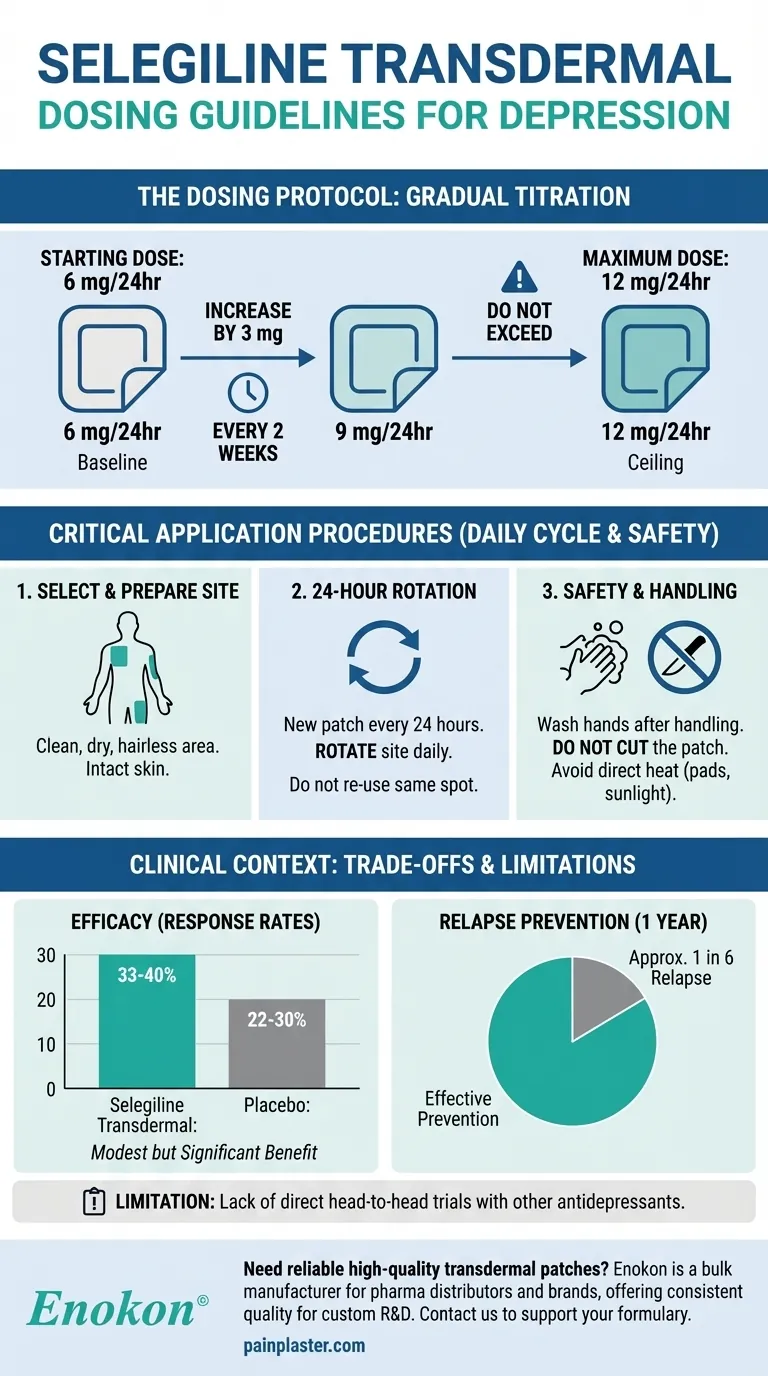
The standard dosing regimen for selegiline transdermal (the patch) in treating major depressive disorder begins at 6 mg per 24 hours. If needed, this dose can be increased in increments of 3 mg every two weeks. The maximum recommended dose is 12 mg per 24 hours.
Selegiline transdermal requires a carefully managed titration schedule, not just to find the effective dose, but to balance therapeutic benefit with potential side effects. Success with this treatment depends equally on correct dosing and meticulous application technique.
The Dosing Protocol Explained
Understanding the rationale behind the dosing schedule is key to using this medication effectively. The protocol is designed to introduce the drug slowly, allowing for assessment of both patient response and tolerability.
Starting Dose: The 6 mg/24hr Baseline
Treatment always begins with the 6 mg/24 hour patch. This initial dose serves as a baseline to establish how a patient tolerates the medication before considering any increases.
Titration Strategy: A Gradual Approach
If the initial dose is not sufficiently effective, it can be increased. The standard is to raise the dose by 3 mg/24 hour increments. This titration should occur no more frequently than every two weeks to allow adequate time to observe the clinical effects of the new dose level.
Maximum Recommended Dose: The 12 mg/24hr Ceiling
The highest dose studied and recommended for depression is 12 mg/24 hours. Doses beyond this are not advised as they have not been shown to provide additional benefit and may increase the risk of side effects.
Critical Application Procedures
Because this is a transdermal system, the method of application is just as important as the dose itself. Improper application can lead to inconsistent drug delivery and reduced effectiveness.
Selecting and Preparing the Site
Apply the patch to a clean, dry, and hairless area of intact skin. Recommended locations include the upper torso (chest or back), the outer surface of the upper arm, or the thigh.
The 24-Hour Cycle and Site Rotation
A new patch should be applied every 24 hours. It is critical to rotate the application site each day. Do not apply a new patch to the same exact spot you used the day before to prevent skin irritation.
Handling and Safety Precautions
Always wash your hands after handling the patch. Do not cut the patch, as this damages the drug-delivery matrix and can lead to an incorrect and potentially unsafe dose. Avoid exposing the application site to direct heat sources like heating pads or excessive sunlight, as this can increase the rate of drug absorption.
Understanding the Trade-offs and Limitations
While selegiline transdermal is an established treatment, it's important to understand its clinical context and limitations to set realistic expectations.
Efficacy in Context
In clinical trials, response rates for patients on transdermal selegiline were between 33-40%, compared to 22-30% for those on placebo. This shows a statistically significant, but modest, benefit over placebo. Real-world effectiveness may be lower.
Relapse Prevention
The medication has been shown to be more effective than a placebo at preventing relapse over a one-year period. However, it is important to note that approximately one in six patients may still experience a relapse while on the treatment.
Lack of Comparative Data
A significant limitation is the absence of direct, head-to-head clinical trials comparing selegiline transdermal to other common antidepressant medications. Its precise place in a treatment sequence is therefore based on clinical judgment rather than direct comparative evidence.
Making the Right Choice for Your Goal
Your approach to dosing and patient counseling should be guided by the specific clinical objective.
- If your primary focus is initiating treatment: Start with the 6 mg/24hr patch and assess for tolerability and initial response over at least two weeks before considering a dose increase.
- If your primary focus is optimizing efficacy: Use the gradual titration schedule (increasing by 3 mg every two weeks) to find the lowest effective dose for the patient, up to the 12 mg/24hr maximum.
- If your primary focus is patient safety and adherence: Provide clear, repeated instructions on proper application, the importance of site rotation, and the absolute rule to never cut the patch.
Successful use of selegiline transdermal is achieved through a combination of patient titration and rigorous adherence to the application protocol.
Summary Table:
| Dosing Element | Guideline |
|---|---|
| Starting Dose | 6 mg/24 hours |
| Titration Increment | 3 mg/24 hours |
| Titration Frequency | No more than every 2 weeks |
| Maximum Dose | 12 mg/24 hours |
Need a reliable supply of high-quality transdermal patches for your treatment protocols? As Enokon, a bulk manufacturer of reliable transdermal patches and pain plasters, we provide healthcare and pharma distributors and brands with the consistent quality and technical expertise needed for custom R&D and development. Let us support your formulary with dependable drug delivery systems. Contact our team today to discuss your requirements.
Visual Guide
Related Products
- Silicone Scar Sheets Patch Transdermal Drug Patch
- Far Infrared Heat Pain Relief Patches Transdermal Patches
- Menthol Gel Pain Relief Patch
- Icy Hot Menthol Medicine Pain Relief Patch
- Mugwort Wormwood Pain Relief Patch for Neck Pain
People Also Ask
- What role does a silicone-based transdermal delivery system play in Parkinson's? Enhancing Early-Stage Patient Care
- How is the long-term skin tolerance of silicone-based transdermal patches evaluated in clinical settings? R&D and Safety
- Why is a polarizing microscope used to evaluate the long-term stability of transdermal drug patches? Ensure Efficacy.
- What are common adverse effects of transdermal drug delivery? Risks & Prevention Tips
- What are the advantages of transdermal drug patches? Optimize Medication Delivery with Patches











