
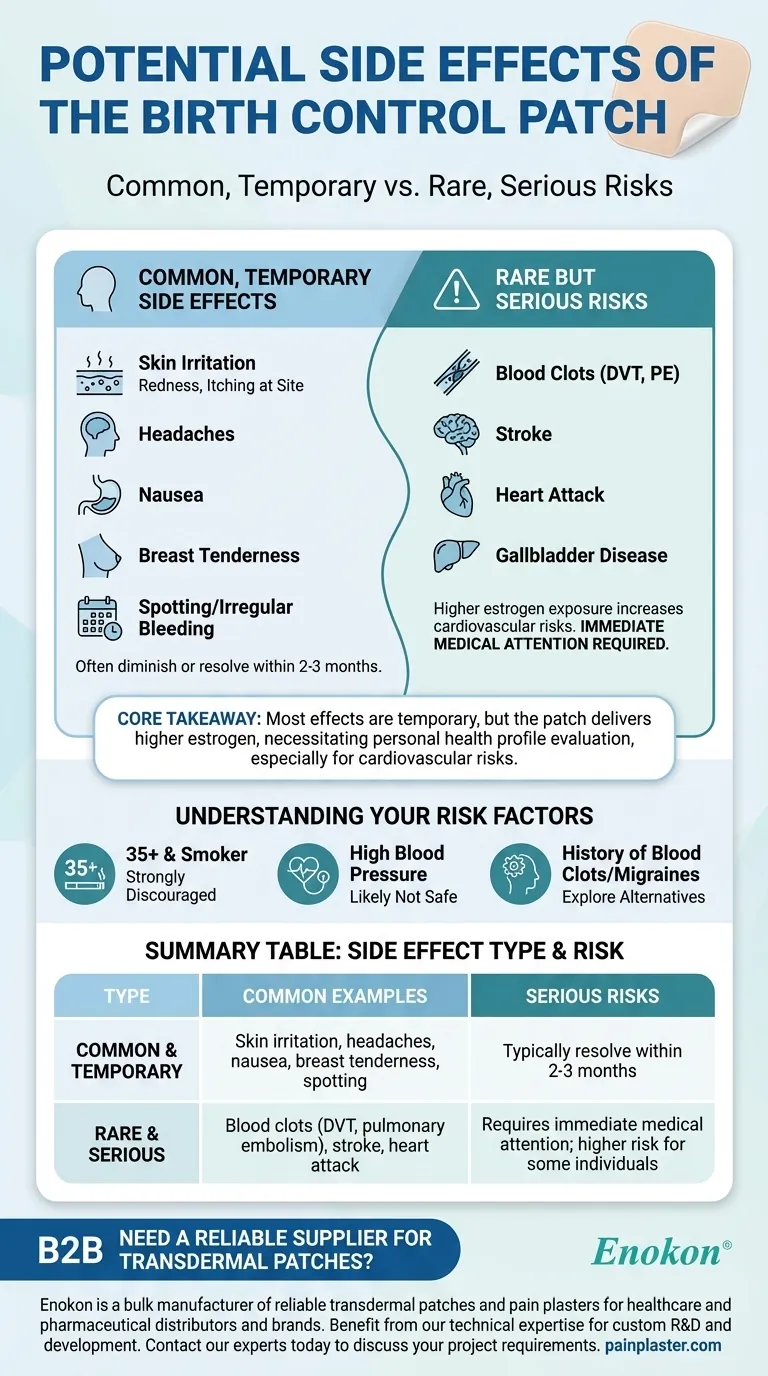
The potential side effects of the birth control patch range from common, mild issues to rare but serious health risks. The most frequently reported effects are skin irritation at the application site, breast tenderness, headaches, nausea, and irregular menstrual bleeding or spotting. For many users, these milder side effects diminish or resolve entirely after the first two to three months as their body adjusts to the hormones.
The core takeaway is that while most side effects are temporary and manageable, the patch delivers a higher level of estrogen than some combination pills. This makes it critical to evaluate your personal health profile, particularly for cardiovascular risks, before deciding if it's the right method for you.

Differentiating Common Symptoms from Serious Risks
The side effects associated with the patch can be separated into two distinct categories: common hormonal adjustments and rare but significant health events. Understanding this distinction is the first step in making an informed decision.
Common, Temporary Side Effects
These effects are primarily the body's reaction to the introduction of synthetic hormones. They are typically not dangerous and often fade with time.
Common symptoms include headaches, nausea, breast tenderness, and mood changes. You may also experience menstrual cramps, bloating, acne, dizziness, or fatigue.
Breakthrough bleeding or spotting between periods is also very common, especially during the initial adjustment period of the first few cycles.
Rare but Serious Cardiovascular Risks
The most serious risks associated with the patch are related to the vascular system and are directly linked to the hormone estrogen. While rare, these events can be life-threatening.
These risks include the formation of blood clots, which can lead to a deep vein thrombosis (DVT), a pulmonary embolism (a clot in the lungs), a stroke, or a heart attack.
Other serious but rare risks include high blood pressure, gallbladder disease, and, very rarely, certain types of liver tumors.
The Role of Estrogen Exposure
Some research indicates that the birth control patch continuously exposes the body to a higher total amount of estrogen compared to many daily birth control pills.
This elevated estrogen level is why the risk of estrogen-related side effects, particularly blood clots, may be slightly higher than with some oral contraceptives.
Understanding the Trade-offs and Risk Factors
A side effect profile is not just a list of possibilities; it's a measure of risk. Your personal health history is the most important factor in determining your individual risk level.
Who Is at Higher Risk?
This method is not safe for everyone. You should not use the birth control patch if you have a history of certain conditions.
Key risk factors include being a smoker over the age of 35, having uncontrolled high blood pressure, a personal or family history of blood clots, or a history of heart attack or stroke.
Other contraindications include a history of breast or uterine cancer, liver disease, or unexplained vaginal bleeding.
Skin Irritation: A Unique Challenge
Unlike oral contraceptives, the patch can cause a localized reaction at the application site.
This may appear as redness, itching, or a rash where the patch is placed. Rotating the application site each week can help minimize this irritation.
Potential Non-Contraceptive Benefits
Objectively, it's also important to note that hormonal contraception can have positive side effects.
Many users experience lighter, more regular periods and a reduction in menstrual cramps. Some also report an improvement in acne.
Making an Informed Decision with Your Doctor
Choosing a contraceptive method requires a careful evaluation of its effectiveness, convenience, and your personal health risks. Discuss your full medical history with your healthcare provider to find the safest option.
- If your primary focus is convenience and you have low cardiovascular risk: The patch can be an effective option, but be prepared to monitor for common side effects during the first three months.
- If you are over 35 and smoke: This method is strongly discouraged due to the significantly amplified risk of stroke and heart attack.
- If you have a history of migraines with aura, high blood pressure, or blood clots: The patch is likely not a safe choice, and you should explore progestin-only or non-hormonal methods.
- If you are sensitive to hormonal fluctuations: Be aware that mood changes, nausea, or headaches are possible and track your symptoms closely when starting the patch.
Ultimately, understanding your personal health profile is the key to determining if the birth control patch is a safe and effective choice for you.
Summary Table:
| Side Effect Type | Common Examples | Serious Risks |
|---|---|---|
| Common & Temporary | Skin irritation, headaches, nausea, breast tenderness, spotting | Typically resolve within 2-3 months |
| Rare & Serious | Blood clots (DVT, pulmonary embolism), stroke, heart attack | Requires immediate medical attention; higher risk for some individuals |
Need a Reliable Supplier for Transdermal Patches?
Enokon is a bulk manufacturer of reliable transdermal patches and pain plasters for healthcare and pharmaceutical distributors and brands. If you are developing a product like a birth control patch, you can benefit from our technical expertise for custom R&D and development to ensure safety, efficacy, and patient comfort.
Contact our experts today to discuss your project requirements.
Visual Guide
Related Products
- Heating Pain Relief Patches for Menstrual Cramps
- Prostate Pain Kidney Health Care Patch for Men
- Silicone Scar Sheets Patch Transdermal Drug Patch
- Cooling Fever Patches Color Change Cold Fever Patch
- Mugwort Wormwood Pain Relief Patch for Neck Pain
People Also Ask
- What are the benefits of Period Pain Heat Patches? Drug-Free, On-the-Go Relief
- What are the key benefits of heating patches for elderly individuals? Relieve Pain & Improve Mobility
- What are the different types of heat patches? Find the Right Pain Relief for Your Needs
- What are the key differences between conventional heat patches and deep heat devices? Choosing the Right Pain Relief Solution
- What percentage of people with back pain use heat patches for relief? Discover the Popular Choice for Pain Management




