
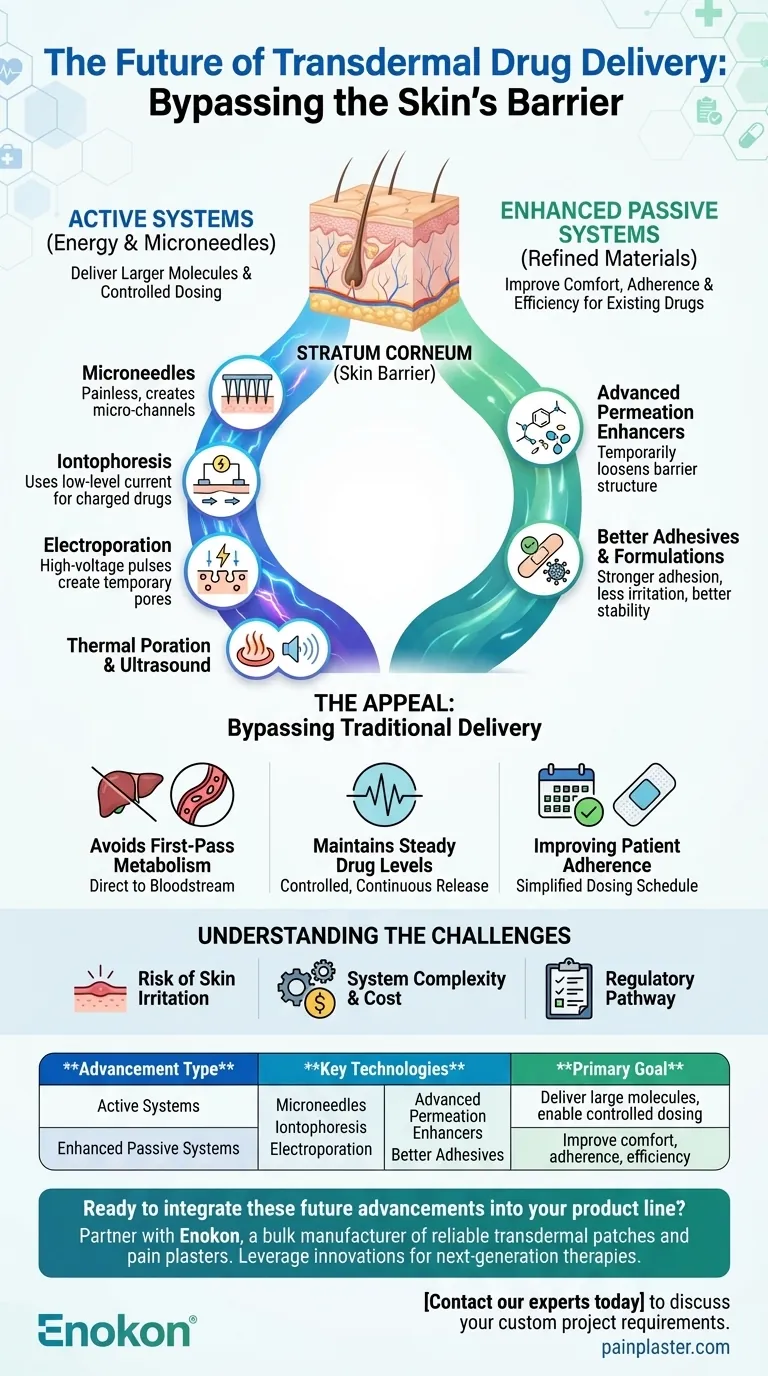
The future of transdermal drug delivery is focused on a dual strategy: refining current "passive" patch technology with better materials and developing "active" systems that use energy or microneedles to bypass the skin's natural barrier. These innovations aim to dramatically expand the range of deliverable drugs, including larger molecules, while improving patient comfort and the efficiency of delivery.
The core challenge in transdermal delivery has always been the skin's outermost layer, the stratum corneum, which is designed to keep substances out. Future advancements are almost entirely dedicated to finding clever and non-invasive ways to temporarily and safely overcome this barrier.
The Appeal of Bypassing Traditional Delivery
To understand where transdermal technology is going, it's crucial to appreciate its existing advantages over methods like oral pills.
Avoiding First-Pass Metabolism
When a drug is taken orally, it passes through the digestive system and liver before entering the bloodstream. This "first-pass metabolism" can significantly reduce the amount of active drug that reaches its target. Transdermal delivery avoids this entirely, allowing for lower and more efficient dosing.
Maintaining Steady Drug Levels
Patches provide a controlled, continuous release of medication over an extended period. This avoids the peaks and troughs in drug concentration common with pills, leading to a more stable therapeutic effect and often fewer side effects.
Improving Patient Adherence
The convenience of a patch that needs to be applied only once a day, every few days, or even weekly is a significant benefit. This simplified schedule can dramatically improve patient adherence compared to therapies requiring multiple daily doses.
The Next Wave: Active Delivery Systems
The most significant future advancements involve "active" technologies that physically or energetically interact with the skin to enhance drug permeation.
Microneedles
These are microscopic needles, often arranged in an array on a patch, that are too small to cause pain or significant bleeding. They painlessly pierce the stratum corneum, creating tiny, temporary channels through which drugs can pass directly into the deeper layers of the skin.
Iontophoresis
This technique uses a weak, low-level electrical current to propel charged drug molecules across the skin barrier. The system uses two electrodes, with the drug being repelled from the active electrode and driven into the skin.
Electroporation
A more intense version of iontophoresis, electroporation applies short, high-voltage electrical pulses to the skin. This creates temporary, microscopic pores in the stratum corneum, allowing larger molecules to pass through.
Thermal Poration
Also known as thermal ablation, this method uses heat to disrupt and temporarily remove cells in the stratum corneum. This creates pathways for drugs to enter the body more easily.
Ultrasound (Sonophoresis)
This approach uses low-frequency ultrasonic waves to create temporary disruptions in the skin's barrier. The acoustic energy increases the fluidity of lipids in the stratum corneum, enhancing drug permeability.
Refining Today's Passive Technology
Alongside active systems, significant research is dedicated to improving the fundamental components of traditional patches.
Advanced Permeation Enhancers
Researchers are developing novel chemical compounds that can be mixed with a drug to temporarily and reversibly loosen the tight structure of the stratum corneum, making it more permeable.
Better Adhesives and Formulations
Future adhesives will be designed for stronger, longer-lasting adhesion with less skin irritation. At the same time, new formulations involving nanoparticles can improve a drug's solubility and stability, making it easier to deliver.
Understanding the Trade-offs and Challenges
While promising, these future technologies are not without hurdles that must be overcome.
The Risk of Skin Irritation
The primary side effect of any transdermal system is skin irritation at the application site. While usually mild, active systems that use energy or needles must be carefully designed to minimize this risk and ensure the skin barrier fully recovers.
System Complexity and Cost
Active delivery systems involving electronics, batteries, and sophisticated controls are inherently more complex and costly to manufacture than a simple passive patch. This could impact accessibility and reimbursement.
The Regulatory Pathway
Any new method for breaching the skin's barrier, even temporarily, faces rigorous scrutiny from regulatory bodies. Proving the long-term safety and efficacy of these advanced systems is a critical and time-consuming step.
Making the Right Choice for the Therapeutic Goal
The choice of technology will depend entirely on the drug being delivered and the desired clinical outcome.
- If your primary focus is delivering large molecules (biologics, vaccines): Active systems like microneedles and electroporation are the most promising avenues for these traditionally injectable-only drugs.
- If your primary focus is improving patient comfort and adherence for existing drugs: Advanced adhesives, better formulations, and novel chemical enhancers will make current patches more effective and easier to wear.
- If your primary focus is on-demand or highly controlled dosing: Energy-based systems like iontophoresis offer the potential for programmable devices that can tailor drug release rates in real time.
Ultimately, the evolution of transdermal technology is turning the skin from a simple barrier into a sophisticated gateway for modern medicine.
Summary Table:
| Advancement Type | Key Technologies | Primary Goal |
|---|---|---|
| Active Systems | Microneedles, Iontophoresis, Electroporation | Deliver large molecules (e.g., biologics) & enable controlled dosing |
| Enhanced Passive Systems | Advanced Permeation Enhancers, Better Adhesives | Improve comfort, adherence, and efficiency for existing drugs |
Ready to integrate these future advancements into your product line?
Partner with Enokon, a bulk manufacturer of reliable transdermal patches and pain plasters. We specialize in custom R&D and development for healthcare and pharmaceutical distributors and brands. Our technical expertise helps you leverage innovations like microneedle arrays and advanced formulations to create next-generation therapies. Benefit from our efficient manufacturing to bring your cutting-edge transdermal solutions to market.
Contact our experts today to discuss your custom project requirements.
Visual Guide
Related Products
- Silicone Scar Sheets Patch Transdermal Drug Patch
- Far Infrared Heat Pain Relief Patches Transdermal Patches
- Icy Hot Menthol Medicine Pain Relief Patch
- Menthol Gel Pain Relief Patch
- Mugwort Wormwood Pain Relief Patch for Neck Pain
People Also Ask
- What role does a silicone-based transdermal delivery system play in Parkinson's? Enhancing Early-Stage Patient Care
- How is the long-term skin tolerance of silicone-based transdermal patches evaluated in clinical settings? R&D and Safety
- Why is a polarizing microscope used to evaluate the long-term stability of transdermal drug patches? Ensure Efficacy.
- What are common adverse effects of transdermal drug delivery? Risks & Prevention Tips
- What are the advantages of transdermal drug patches? Optimize Medication Delivery with Patches







