
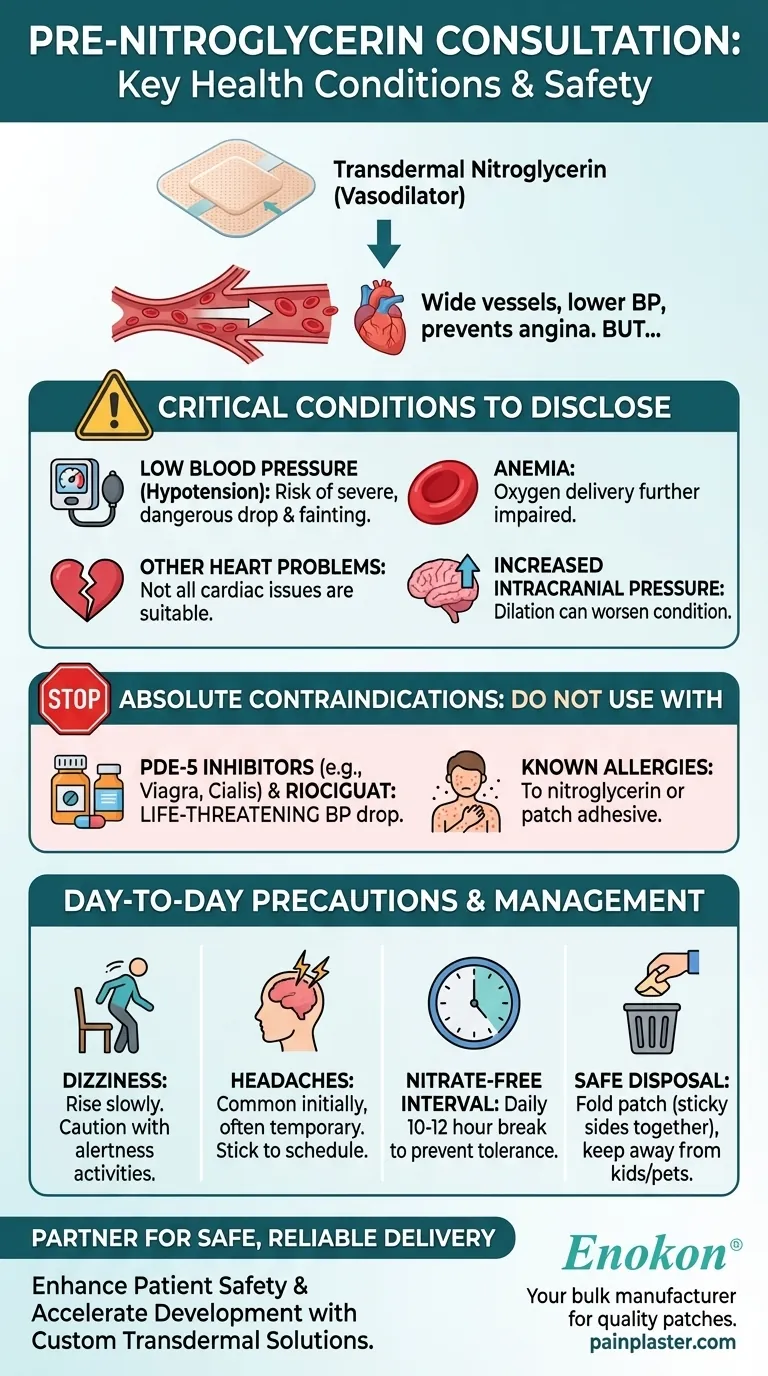
Before using a transdermal nitroglycerin patch, it is essential to have a thorough discussion with your healthcare provider about your complete medical history. Key conditions to disclose include any history of low blood pressure (hypotension), anemia, other heart problems, or increased pressure inside your head (intracranial pressure). You must also inform them if you are pregnant, planning to become pregnant, or breastfeeding.
The core principle is that nitroglycerin works by powerfully widening blood vessels. While this is how it prevents chest pain, it can also create significant risks if you have certain pre-existing conditions or are taking specific medications that also affect blood pressure.

Why Your Full Medical History is Critical
Transdermal nitroglycerin is a vasodilator, meaning its primary function is to relax and widen the blood vessels throughout your body. This action reduces the workload on your heart, preventing the type of chest pain known as angina. However, this powerful mechanism is precisely why a complete medical history is not just a formality—it's a critical safety measure.
Impact on Blood Pressure and Circulation
Nitroglycerin's vessel-widening effect directly lowers your blood pressure.
If you already have low blood pressure (hypotension), the patch can cause a further, potentially dangerous drop, leading to severe dizziness, lightheadedness, or fainting.
Similarly, if you have anemia (a low red blood cell count), your blood's oxygen-carrying capacity is already reduced. Lowering blood pressure can further impair the delivery of oxygen to vital organs.
Pre-existing Heart Conditions
While nitroglycerin is used to treat a symptom of heart disease, it's not appropriate for all cardiac issues.
Your doctor needs to evaluate the specific nature of your heart problems to ensure that altering your blood pressure and vascular tone will be beneficial and not introduce new risks.
Conditions of Increased Pressure
The medication's effects are not limited to the heart.
For individuals with a history of increased intracranial pressure, such as from a head injury, the dilation of blood vessels within the skull could potentially worsen the condition.
Absolute Contraindications: When Nitroglycerin Cannot Be Used
Some conditions and medication combinations create life-threatening risks, making the use of nitroglycerin strictly prohibited. These are known as absolute contraindications.
Interaction with PDE-5 Inhibitors
You must not use nitroglycerin if you are taking phosphodiesterase type 5 (PDE-5) inhibitors.
These are medications commonly used for erectile dysfunction, such as sildenafil (Viagra), tadalafil (Cialis), and vardenafil (Levitra). The combination can cause a sudden, catastrophic drop in blood pressure.
Interaction with Riociguat
Concomitant use with riociguat, a medication used to treat pulmonary hypertension, is also contraindicated.
Both drugs stimulate the same chemical pathway, and their combined use can lead to severe, life-threatening hypotension.
Known Allergies
An allergy to nitroglycerin itself or to the adhesives used in the transdermal patch is another clear contraindication.
Understanding the Day-to-Day Precautions
Beyond initial screening, safe use of nitroglycerin involves being aware of its common effects and potential side effects. These are the practical trade-offs for its therapeutic benefit.
The Risk of Dizziness and Lightheadedness
A drop in blood pressure can cause dizziness, especially when changing positions.
You should always rise slowly from a seated or lying position to allow your body to adjust. Be cautious when driving or performing any activity that requires mental alertness.
The Potential for Headaches
Headaches are a very common side effect of nitroglycerin, particularly when starting treatment.
These headaches often diminish as your body gets used to the medication. It is important not to alter your prescribed schedule to avoid them, as this can reduce the drug's effectiveness.
The Concept of a "Nitrate-Free Interval"
Your body can build a tolerance to nitroglycerin, making it less effective over time.
To prevent this, your doctor will likely prescribe a daily "nitrate-free" period (usually 10-12 hours) where you do not wear a patch. Be aware that some patients may experience an increase in angina during this interval.
Safe Handling and Disposal
A used nitroglycerin patch still contains a significant amount of active medication.
Always fold the used patch in half with the sticky sides together and dispose of it where it cannot be reached by children or pets.
Making the Right Choice for Your Goal
To ensure your safety and the effectiveness of your treatment, your conversation with your healthcare provider should be transparent and comprehensive.
- If your primary focus is safety with existing health conditions: Provide a complete medical history, especially mentioning any issues with blood pressure, anemia, or prior head trauma.
- If your primary focus is avoiding drug interactions: List every single medication you take, including over-the-counter drugs and supplements, and be absolutely certain to mention any use of PDE-5 inhibitors like Viagra or Cialis.
- If your primary focus is managing daily use: Discuss the prescribed schedule, including the nitrate-free interval, and have a plan for managing common side effects like headaches and dizziness.
This proactive communication with your healthcare provider is the foundation of safe and effective treatment.
Summary Table:
| Key Condition to Discuss | Reason for Caution |
|---|---|
| Low Blood Pressure (Hypotension) | Risk of dangerous blood pressure drop, dizziness, fainting |
| Anemia | Reduced oxygen delivery to organs may worsen |
| Other Heart Problems | Treatment may not be suitable for all cardiac conditions |
| Increased Intracranial Pressure | May worsen pressure inside the skull |
| Use of PDE-5 Inhibitors (e.g., Viagra, Cialis) | Life-threatening drop in blood pressure |
| Pregnancy/Breastfeeding | Safety for mother and baby must be evaluated |
Ensure patient safety with reliable transdermal medication delivery.
At Enokon, we are a bulk manufacturer of high-quality, reliable transdermal patches and pain plasters. We partner with healthcare distributors and pharmaceutical brands to develop custom medication delivery systems, including complex formulations like nitroglycerin.
Partner with us to:
- Enhance Patient Safety: Leverage our technical expertise in transdermal R&D to ensure precise dosing and consistent API release.
- Accelerate Development: Benefit from our custom formulation and development services to bring safe, effective transdermal treatments to market faster.
- Ensure Supply Reliability: Rely on our bulk manufacturing capabilities for a consistent supply of compliant, high-quality patches.
Let's discuss how our transdermal solutions can support your brand's next product. Contact our technical experts today for a consultation on your custom patch requirements.
Visual Guide
Related Products
- Silicone Scar Sheets Patch Transdermal Drug Patch
- Far Infrared Heat Pain Relief Patches Transdermal Patches
- Menthol Gel Pain Relief Patch
- Icy Hot Menthol Medicine Pain Relief Patch
- Mugwort Wormwood Pain Relief Patch for Neck Pain
People Also Ask
- What role does a silicone-based transdermal delivery system play in Parkinson's? Enhancing Early-Stage Patient Care
- How is the long-term skin tolerance of silicone-based transdermal patches evaluated in clinical settings? R&D and Safety
- Why is a polarizing microscope used to evaluate the long-term stability of transdermal drug patches? Ensure Efficacy.
- What are common adverse effects of transdermal drug delivery? Risks & Prevention Tips
- What are the advantages of transdermal drug patches? Optimize Medication Delivery with Patches




