
To maintain the effectiveness of nitroglycerin patches, the most critical step is to create a daily "nitrate-free" period. The simplest and most common method is to wear the patch during the day, remove it at bedtime, and apply a new one the following morning. This provides a necessary break for your body.
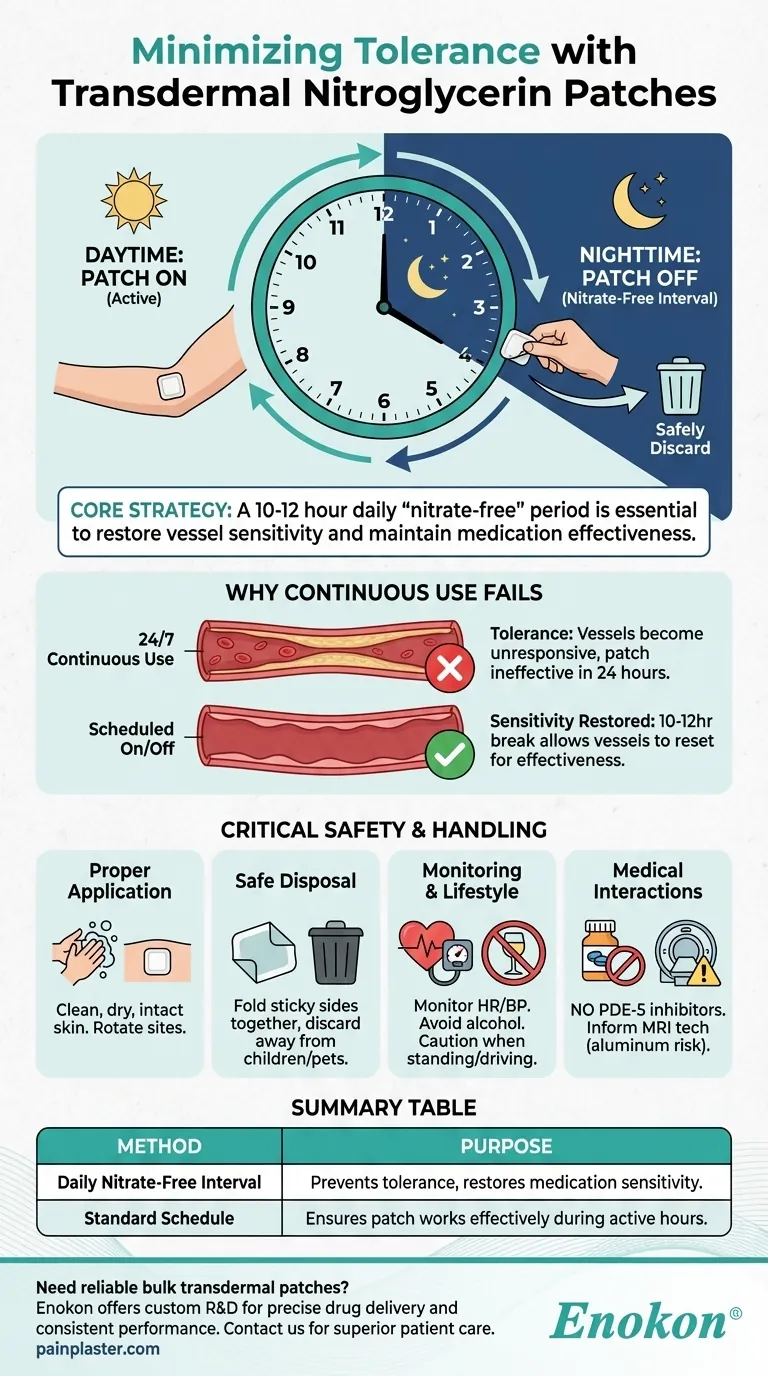
The core strategy to prevent tolerance to nitroglycerin is to ensure a daily nitrate-free interval of 10-12 hours. This scheduled "off" period allows your body's blood vessels to restore their sensitivity to the medication, ensuring it works effectively when you need it most.

The Core Problem: Understanding Nitroglycerin Tolerance
Why Continuous Use Leads to Ineffectiveness
When your body is exposed to nitroglycerin continuously, your blood vessels become less responsive to its effects.
This process is known as tolerance. Controlled medical trials have shown that with 24-hour continuous use, the patch can lose its effectiveness completely within the first day of therapy.
The "Nitrate-Free Interval" Explained
To combat tolerance, a daily break from the medication is required. This is called the nitrate-free interval.
This period, typically lasting 10-12 hours overnight, acts as a reset. It allows your vascular system to regain its ability to respond to the medication's therapeutic effects.
The Standard Dosing Schedule
The established medical practice is to create this interval with a simple schedule.
You apply a new patch in the morning to provide protection against angina during your active hours and remove the old patch at night before you go to sleep.
Critical Safety and Handling Procedures
Proper Patch Application and Disposal
Always wash your hands before and after handling a nitroglycerin patch.
Apply the patch to a clean, dry, and intact area of skin, avoiding any areas with irritation, scars, or wounds. If a patch happens to fall off, simply discard it and apply a new one.
When you remove a used patch, fold it in half with the sticky sides together before safely discarding it out of the reach of children and pets.
Daily Monitoring and Lifestyle Adjustments
It is wise to monitor your heart rate and blood pressure regularly while using this medication.
Side effects can include dizziness or drowsiness. Avoid standing up quickly, and be cautious when driving or operating machinery until you know how the medication affects you. You should also avoid consuming alcohol, as it can worsen these side effects.
Critical Medical Interactions and Precautions
Never use nitroglycerin patches with PDE-5 inhibitors, a class of drugs that includes sildenafil (Viagra), tadalafil (Cialis), and vardenafil (Levitra). The combination can cause a severe and dangerous drop in blood pressure.
Before any MRI procedure, inform the technician that you are wearing a patch. Some patches contain aluminum, which can heat up during an MRI and cause skin burns.
Finally, do not stop using the patches suddenly without consulting your healthcare provider, as this can worsen your condition.
Understanding the Trade-offs
The Risk of Angina During the "Off" Period
A scheduled nitrate-free interval means you are not receiving the medication while you sleep. While this creates a theoretical risk of nighttime angina, this dosing strategy is the medical standard for ensuring long-term effectiveness.
Your physician may prescribe other fast-acting medications for any breakthrough chest pain.
Why "Continuous Protection" is a Misconception
The idea of wearing a patch 24/7 for constant protection is fundamentally flawed due to the rapid onset of tolerance.
A patch worn continuously quickly becomes an inactive placebo. The only way to ensure the medication works is to adhere to the daily "on" and "off" cycle.
How to Ensure Your Treatment is Effective
By following a structured routine, you can ensure your nitroglycerin therapy remains both safe and effective.
- If your primary focus is preventing chest pain during daily activities: Strictly adhere to the "on/off" schedule by applying a new patch each morning and removing it at night.
- If your primary focus is ensuring safety: Always inform all your healthcare providers, including pharmacists and MRI technicians, about your patch and never combine it with PDE-5 inhibitors.
By understanding and implementing this daily cycle, you take active control of your treatment and ensure your medication remains a reliable ally.
Summary Table:
| Method | Key Action | Purpose |
|---|---|---|
| Daily Nitrate-Free Interval | Remove patch at night, apply new one in morning. | Prevents tolerance, restores medication sensitivity. |
| Standard Schedule | 14 hours on, 10 hours off. | Ensures patch works effectively during active hours. |
Need a reliable, consistent supply of transdermal patches for your patients or product line?
As Enokon, a bulk manufacturer of reliable transdermal patches and pain plasters, we understand the critical importance of precise drug delivery and consistent performance for healthcare and pharma brands. Our technical expertise supports custom R&D to develop patches that meet specific therapeutic needs, ensuring patient safety and treatment efficacy.
Let us help you deliver superior patient care. Contact our experts today to discuss your custom transdermal patch requirements.
Visual Guide
Related Products
- Silicone Scar Sheets Patch Transdermal Drug Patch
- Far Infrared Heat Pain Relief Patches Transdermal Patches
- Menthol Gel Pain Relief Patch
- Icy Hot Menthol Medicine Pain Relief Patch
- Mugwort Wormwood Pain Relief Patch for Neck Pain
People Also Ask
- What role does a silicone-based transdermal delivery system play in Parkinson's? Enhancing Early-Stage Patient Care
- How is the long-term skin tolerance of silicone-based transdermal patches evaluated in clinical settings? R&D and Safety
- Why is a polarizing microscope used to evaluate the long-term stability of transdermal drug patches? Ensure Efficacy.
- What are common adverse effects of transdermal drug delivery? Risks & Prevention Tips
- What are the advantages of transdermal drug patches? Optimize Medication Delivery with Patches



















