
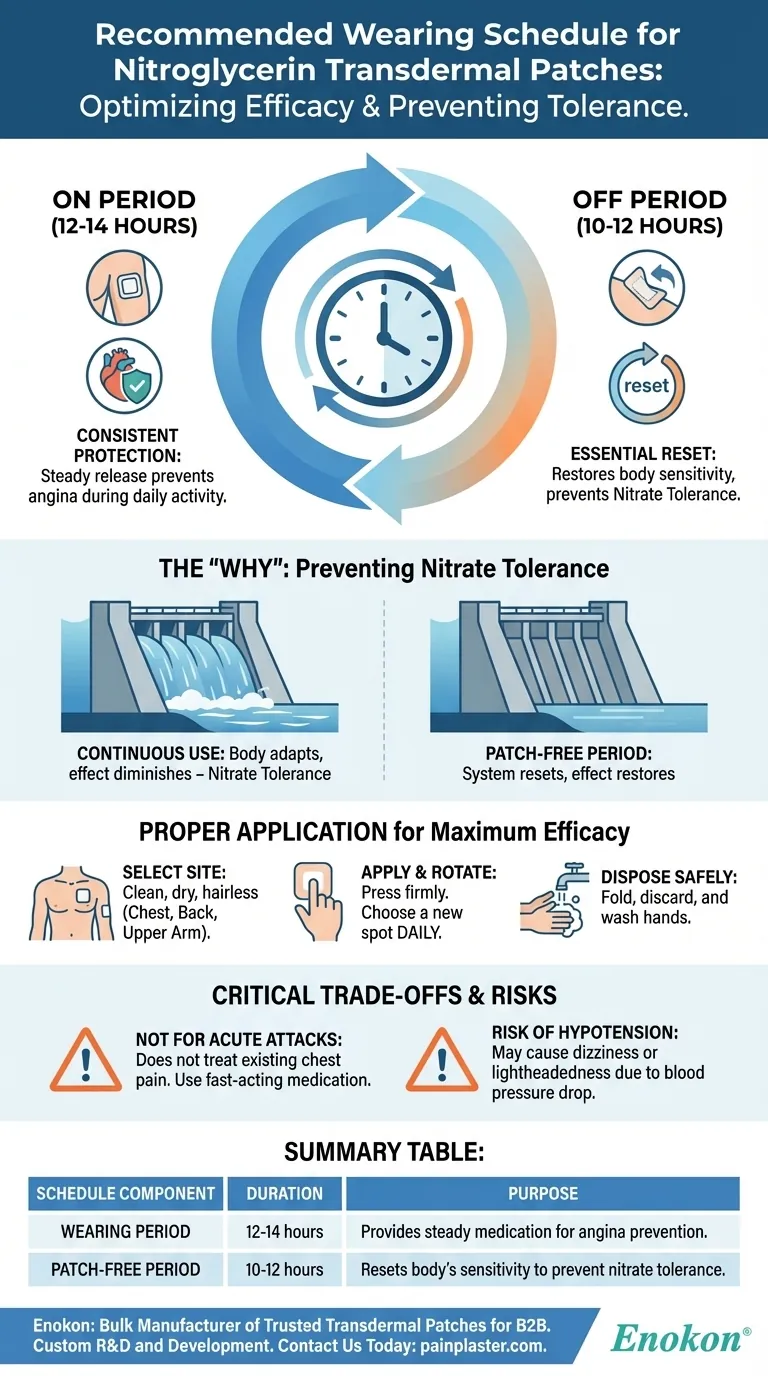
For a nitroglycerin transdermal patch, the standard wearing schedule is a critical balance between effectiveness and tolerance. You will typically wear one patch for 12 to 14 hours per day, followed by a mandatory "patch-free" period of 10 to 12 hours before applying a new one. This on/off cycle is essential for the medication to work properly.
The core principle of the nitroglycerin patch schedule is not just about delivering the drug, but about preventing your body from becoming accustomed to it. The required 10-12 hour daily break is what ensures the medication remains effective for preventing angina over the long term.

The "Why" Behind the On/Off Schedule
Understanding the rationale for this specific schedule is key to using the patch safely and effectively. It's designed to overcome a natural biological response called nitrate tolerance.
Preventing Nitrate Tolerance
Your body is highly adaptive. If it is exposed to nitroglycerin continuously, it begins to respond less and less to the medication's effects.
This phenomenon is known as nitrate tolerance. The drug essentially becomes less effective at preventing chest pain.
The "On" Period: Your Window of Protection
The 12 to 14 hours when you wear the patch is your therapeutic window. During this time, the patch steadily releases nitroglycerin into your bloodstream.
This provides consistent protection against angina attacks, which are often triggered by physical exertion or stress.
The "Off" Period: The Necessary Reset
The 10 to 12 hour patch-free interval is the most crucial part of the schedule. This break allows your body's sensitivity to nitroglycerin to be restored.
By "resetting" the system daily, you ensure that when you apply a new patch, it will be just as effective as the last.
Proper Application for Maximum Efficacy
How and where you apply the patch significantly impacts its performance. Following a consistent routine is essential for steady medication delivery.
Choosing the Right Site
Always apply the patch to a clean, dry, and hairless area of skin. Clipping hair is acceptable, but do not shave the area as it can cause irritation.
The best locations are the upper body, such as the chest, back, or the outer part of the upper arm. Avoid applying it below the elbows or knees.
The Importance of Site Rotation
To prevent skin irritation, you must choose a different spot each day. Rotating the application site ensures that no single area of skin becomes overly sensitive or damaged.
Application and Removal Technique
Press the patch firmly onto the skin with the palm of your hand for several seconds, making sure the edges are sealed.
Never wear more than one patch at a time. When removing an old patch, fold it in half with the sticky sides together and discard it safely. Always wash your hands after handling a patch.
Understanding the Critical Trade-offs and Risks
While highly effective for prevention, the nitroglycerin patch has specific limitations and potential side effects you must be aware of.
It Is Not for Acute Angina Attacks
This is the most critical point to understand. The patch works too slowly to treat an angina attack that is already in progress.
Its sole purpose is the prevention of future attacks. You must have a separate, fast-acting medication prescribed by your doctor for acute chest pain.
The Risk of Hypotension
Nitroglycerin works by widening blood vessels, which can lead to a significant drop in blood pressure (hypotension).
This can cause dizziness or lightheadedness, especially when standing up. The risk is often higher in older patients.
Managing the Nitrate-Free Interval
For some individuals, there is a possibility of experiencing increased angina during the 10-12 hour patch-free period.
It is vital not to alter your prescribed schedule to avoid this. Discuss any concerns with your doctor, who can manage your overall treatment plan.
Making the Right Choice for Your Treatment
Adhering to the prescribed regimen is non-negotiable for safety and effectiveness. Your goals should align with the medication's intended use.
- If your primary focus is consistent angina prevention: Strictly follow the 12-14 hours on, 10-12 hours off schedule without fail to maintain the drug's effectiveness.
- If you are concerned about side effects: Always rotate application sites to prevent skin irritation and be mindful of any dizziness, which could signal low blood pressure.
- If you experience sudden chest pain: Remember the patch is not a rescue medication and immediately use the fast-acting nitroglycerin prescribed by your doctor for an acute attack.
Ultimately, your adherence to this precise schedule is what empowers the medication to protect you effectively.
Summary Table:
| Schedule Component | Duration | Purpose |
|---|---|---|
| Wearing Period | 12-14 hours | Provides steady medication for angina prevention |
| Patch-Free Period | 10-12 hours | Resets body's sensitivity to prevent nitrate tolerance |
Need a reliable supply of nitroglycerin transdermal patches? As Enokon, a bulk manufacturer of trusted transdermal patches for pharmaceutical distributors and brands, we combine rigorous quality control with deep technical expertise. We can support your needs with custom R&D and development to ensure a consistent, effective product for your patients. Contact our team today to discuss your requirements.
Visual Guide
Related Products
- Icy Hot Menthol Medicine Pain Relief Patch
- Menthol Gel Pain Relief Patch
- Far Infrared Heat Pain Relief Patches Transdermal Patches
- Silicone Scar Sheets Patch Transdermal Drug Patch
- Mugwort Wormwood Pain Relief Patch for Neck Pain
People Also Ask
- What are the common side effects of pain relief patches? Risks & Safety Tips
- What factors should be considered when choosing between pills and patches for pain relief? A Guide to Personalized Pain Management
- What are the key components of a pain relief patch? Unlock the Science of Targeted Pain Relief
- Can the pain relief patch be used with oral pain relief products? Avoid Dangerous Drug Interactions
- What is the shelf-life of the pain relief patch? Ensure Potency and Safety for Your Patients



















