
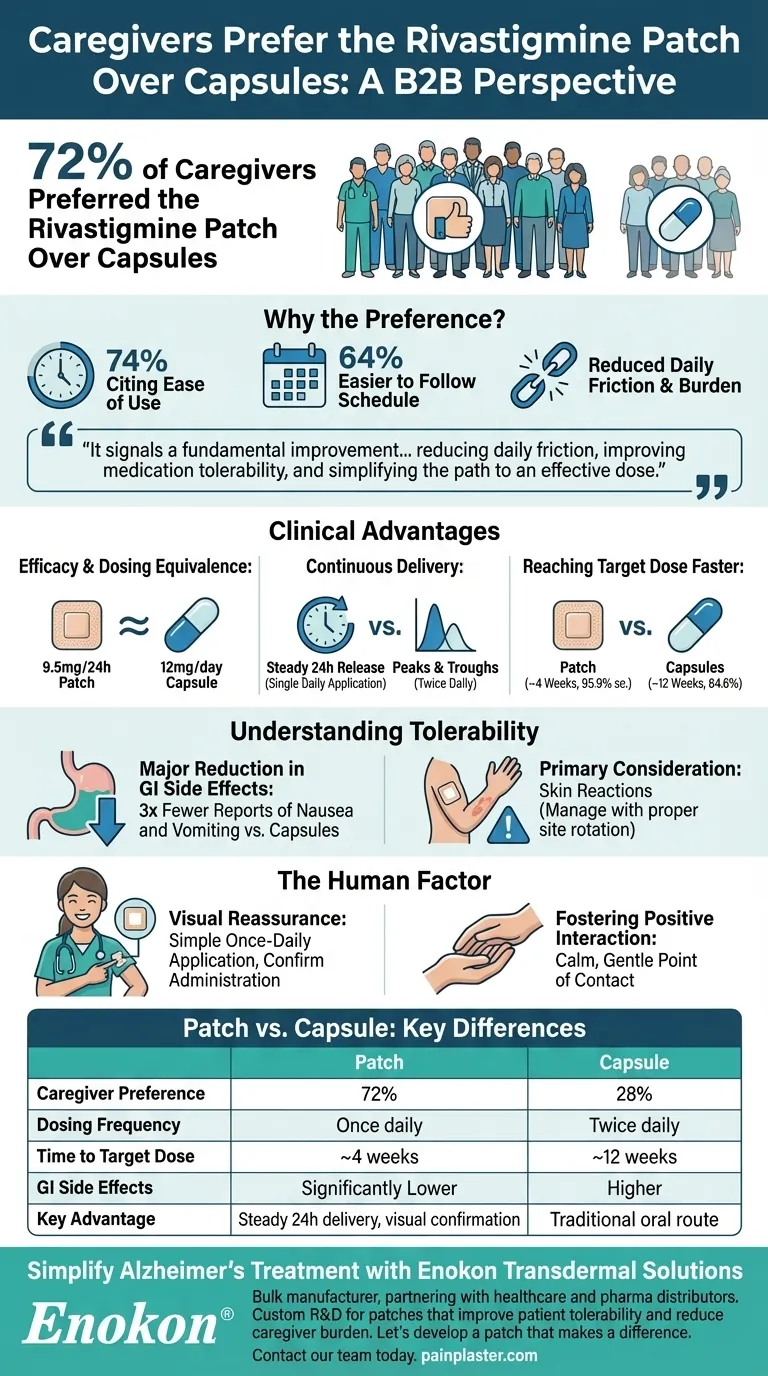
In clinical trials, a significant majority—72% of caregivers—preferred the rivastigmine patch over the oral capsule formulation. This strong preference was driven by the patch's simplicity, with 74% citing its ease of use and 64% noting how much easier it was to follow the medication schedule.
The overwhelming caregiver preference for the rivastigmine patch is not merely about convenience. It signals a fundamental improvement in managing Alzheimer's treatment by reducing daily friction, improving medication tolerability, and simplifying the path to an effective dose.

A Deeper Look at the Clinical Advantages
The preference for the patch is rooted in tangible clinical benefits that directly impact both the patient and the person managing their care. The data reveals a therapy that is not only easier to administer but also gentler on the patient.
Efficacy and Dosing Equivalence
The patch was designed to deliver a comparable therapeutic effect to the highest recommended oral doses. Clinical studies confirm that the 9.5 mg/24-hour patch provides drug exposure equivalent to 12 mg/day capsules, and the 4.6 mg/24h patch is comparable to 6 mg/day capsules.
The Power of Continuous Delivery
Unlike the twice-daily oral capsule, the transdermal patch provides continuous, steady drug release over 24 hours with a single daily application. This delivery system avoids the peaks and troughs in plasma concentration seen with oral dosing.
Reaching the Target Dose Faster
This steady delivery allows for a more efficient titration schedule. Patients on the patch can reach their target therapeutic dose in as little as 4 weeks, compared to the 12 weeks often required for the oral formulation. Consequently, a much higher percentage of patients on the patch successfully reach their target dose (95.9%) versus those on capsules (64.6%).
Understanding the Trade-offs and Tolerability
A medication's effectiveness is often linked to its side effect profile. For a chronic condition like Alzheimer's, tolerability is paramount for long-term adherence.
A Major Reduction in GI Side Effects
One of the most significant advantages of the patch is its improved gastrointestinal (GI) tolerability. By bypassing the digestive system for initial absorption, the patch causes three times fewer reports of nausea and vomiting compared to the capsules. This directly reduces patient discomfort and the associated caregiver stress.
The Primary Consideration: Skin Reactions
While GI side effects are minimized, the most common issue with any transdermal patch is the potential for application site skin reactions. Proper site rotation and skin care are important considerations to mitigate redness or irritation, a trade-off for the systemic benefits.
The Human Factor: Reducing Caregiver Burden
Managing medications for a person with cognitive impairment can be a major source of daily stress. The patch's design directly addresses these challenges.
Visual Reassurance and Simplicity
The simple act of applying a patch once a day removes the complexity of a twice-daily pill schedule. A caregiver can visually confirm the medication has been administered, eliminating doubt and potential conflict with the patient.
Fostering a Positive Interaction
Applying a patch can be a calm, gentle point of contact. This can transform the act of medication administration from a potential struggle over swallowing pills into a more positive and reassuring daily interaction.
Making the Right Choice for Your Patient
The decision between the patch and capsule formulation should be guided by the patient's specific needs and the caregiver's capacity.
- If your primary focus is simplifying the daily medication routine: The once-daily patch is demonstrably easier for caregivers to manage and track.
- If your patient experiences significant gastrointestinal side effects with oral medications: The patch offers a proven way to achieve therapeutic benefits while significantly reducing nausea and vomiting.
- If your goal is to reach an effective dose efficiently: The patch allows for a faster and more successful titration schedule compared to the oral capsules.
Ultimately, the high caregiver preference for the patch highlights its ability to deliver comparable efficacy with a lower daily burden, a critical advantage in the marathon of long-term dementia care.
Summary Table:
| Feature | Rivastigmine Patch | Oral Capsules |
|---|---|---|
| Caregiver Preference | 72% | 28% |
| Dosing Frequency | Once daily | Twice daily |
| Time to Target Dose | ~4 weeks | ~12 weeks |
| GI Side Effects (e.g., nausea) | Significantly Lower | Higher |
| Key Advantage | Steady 24-hour delivery, visual confirmation | Traditional oral route |
Simplify Alzheimer's treatment with reliable transdermal solutions from Enokon.
As a bulk manufacturer of transdermal patches and pain plasters, we partner with healthcare and pharma distributors and brands to deliver consistent, high-quality drug delivery systems. Our technical expertise supports custom R&D and development to create patches that improve patient tolerability and reduce caregiver burden, just like the rivastigmine patch.
Let's develop a patch that makes a difference. Contact our team today to discuss your project.
Visual Guide
Related Products
- Lidocaine Hydrogel Pain Relief Patch for Pain Relief
- Menthol Gel Pain Relief Patch
- Icy Hot Menthol Medicine Pain Relief Patch
- Far Infrared Pain Patch Relief Pain Reliever for Back
- Capsaicin Chili Medicated Pain Relief Patches
People Also Ask
- How does the aqueous base in a lidocaine patch contribute to drug delivery? Unlocking Sustained Pain Relief Technology
- What are the advantages of topical anesthetics over invasive Lidocaine infiltration? Discover Safer, Scalable Relief
- Which pain patch is most effective for arthritis? Find the Best Relief for Your Joint Pain
- How should lidocaine patches be applied for optimal use? Maximize Pain Relief with Proper Application
- Why are lidocaine patches preferred over oral medications? Targeted Relief & Scale Your Brand with OEM R&D Solutions



















