
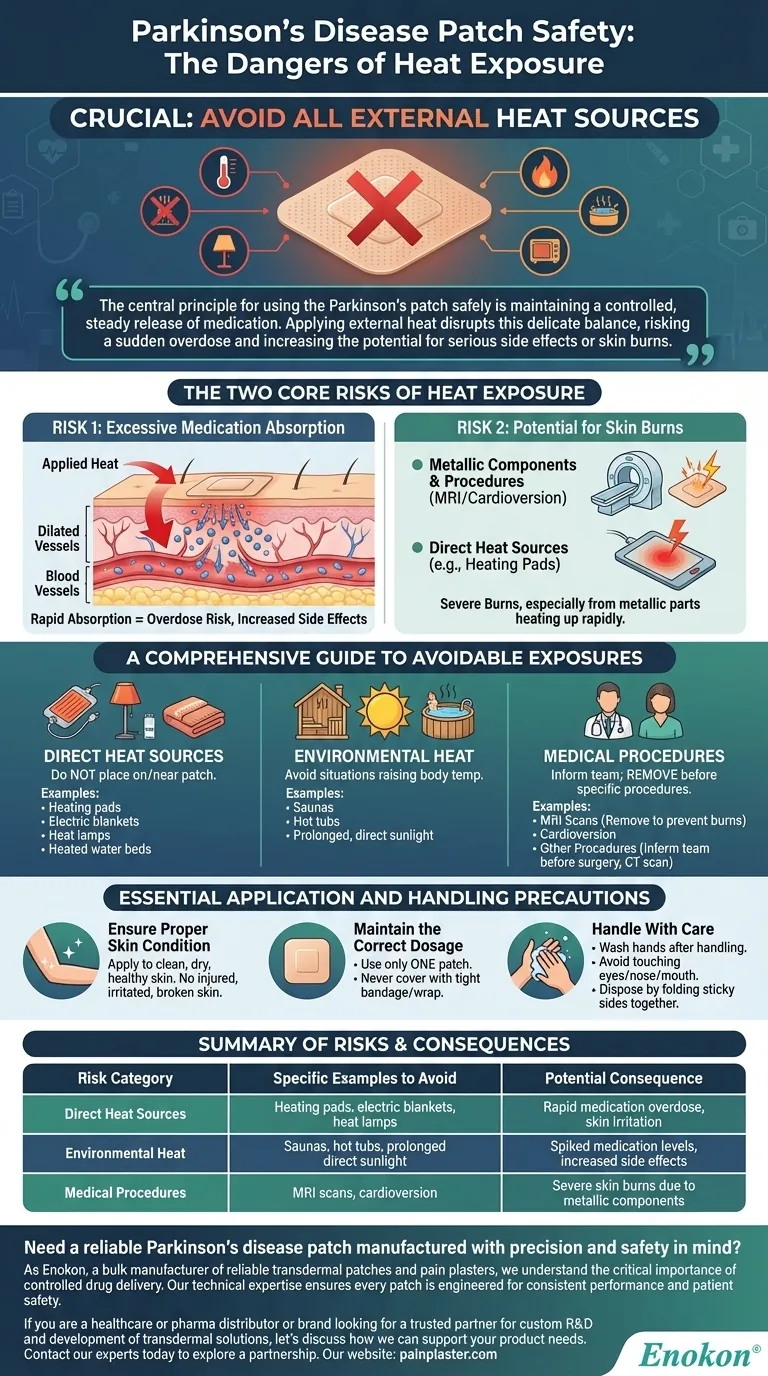
Crucially, you must avoid exposing the Parkinson's disease patch to any external heat source. This includes direct sources like heating pads, electric blankets, and heat lamps, as well as environmental heat from saunas, hot tubs, or prolonged, direct sunlight. Heat dramatically increases the rate at which the medication is absorbed into your body, which can be dangerous.
The central principle for using the Parkinson's patch safely is maintaining a controlled, steady release of medication. Applying external heat disrupts this delicate balance, risking a sudden overdose and increasing the potential for serious side effects or skin burns.
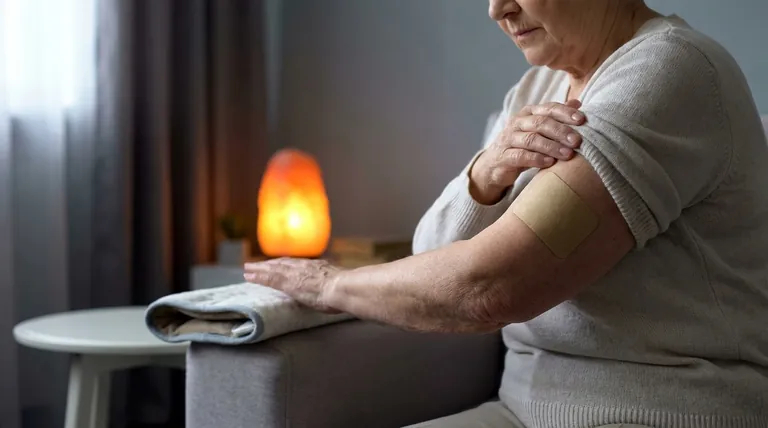
The Two Core Risks of Heat Exposure
Understanding why heat is dangerous is the key to managing the patch safely. The precautions are in place to prevent two distinct but equally serious problems.
Risk 1: Excessive Medication Absorption
A transdermal patch is engineered to deliver a precise dose of medication slowly and consistently through the skin over a 24-hour period.
Applying heat to the area fundamentally alters this process. Heat causes the blood vessels in your skin to dilate, which significantly increases blood flow near the surface.
This increased circulation and skin temperature accelerates how quickly the medication is absorbed, potentially delivering a much larger dose in a shorter time than intended. This can lead to overdose symptoms and a spike in medication side effects.
Risk 2: Potential for Skin Burns
The second major risk involves severe skin burns, particularly during specific medical procedures.
Some patches contain metallic components. During a Magnetic Resonance Imaging (MRI) or cardioversion procedure, the energy used can interact with these metals, causing the patch to heat up rapidly and lead to serious burns at the application site.
Direct heat sources like a misplaced heating pad can also simply cause thermal burns on the skin under the patch.
A Comprehensive Guide to Avoidable Exposures
To ensure your safety, you must be vigilant about avoiding specific heat sources and situations while wearing the patch.
Direct Heat Sources
These are items that generate their own heat. Do not place them on or near the patch.
- Heating pads
- Electric blankets
- Heat lamps
- Heated water beds
Environmental Heat
These situations raise your overall body temperature or expose the patch to intense ambient heat.
- Saunas
- Hot tubs
- Prolonged, direct sunlight
Medical Procedures
Certain medical tests and procedures pose a unique risk.
- MRI Scans: The patch must be removed before an MRI to prevent burns.
- Cardioversion: This procedure to restore normal heart rhythm also requires the patch to be removed.
- Other Procedures: Always inform your care team that you are using the patch before any surgery, CT scan, or other medical procedure.
Essential Application and Handling Precautions
Beyond heat, proper handling is critical for safety and effectiveness. Avoiding common mistakes is a key part of your treatment.
Ensure Proper Skin Condition
Only apply the patch to clean, dry, healthy skin. Do not apply it to skin that is injured, irritated, broken, or has a rash.
Maintain the Correct Dosage
Use only one patch at a time unless explicitly directed otherwise by your doctor. Never cover the patch with a bandage or tight wrapping, as this can trap heat and increase absorption.
Handle With Care
Always wash your hands after applying or removing a patch. Avoid touching your eyes, nose, or mouth after handling it. When you dispose of a used patch, fold it in half with the sticky sides together to seal in any remaining medication.
Key Actions for Safe Patch Use
Your approach to using the patch should be guided by your specific goals for safety and treatment efficacy.
- If your primary focus is preventing overdose: Strictly avoid all external heat sources like heating pads and hot tubs to maintain a steady, intended medication level.
- If your primary focus is ensuring safety during medical care: Always inform your entire healthcare team you are using the patch, especially before any MRI, surgery, or cardioversion procedure.
- If your primary focus is consistent daily treatment: Apply the patch to healthy, non-irritated skin and rotate the application site as directed by your doctor.
Proactively managing these factors empowers you to use your medication safely and effectively.
Summary Table:
| Risk Category | Specific Examples to Avoid | Potential Consequence |
|---|---|---|
| Direct Heat Sources | Heating pads, electric blankets, heat lamps | Rapid medication overdose, skin irritation |
| Environmental Heat | Saunas, hot tubs, prolonged direct sunlight | Spiked medication levels, increased side effects |
| Medical Procedures | MRI scans, cardioversion | Severe skin burns due to metallic components |
Need a reliable Parkinson's disease patch manufactured with precision and safety in mind?
As Enokon, a bulk manufacturer of reliable transdermal patches and pain plasters, we understand the critical importance of controlled drug delivery. Our technical expertise ensures every patch is engineered for consistent performance and patient safety.
If you are a healthcare or pharma distributor or brand looking for a trusted partner for custom R&D and development of transdermal solutions, let's discuss how we can support your product needs.
Contact our experts today to explore a partnership.
Visual Guide
Related Products
- Natural Herbal Patch for Motion Sickness and Car Sickness Relief
- Far Infrared Deep Heat Relief Patches Medicated Pain Relief Patches
- Lidocaine Hydrogel Pain Relief Patch for Pain Relief
- Far Infrared Pain Patch Relief Pain Reliever for Back
- Icy Hot Menthol Medicine Pain Relief Patch
People Also Ask
- How should the patch be stored? Essential Tips for Preserving Herbal Patch Efficacy
- What activities should be avoided while using this patch? Key Precautions for Safe & Effective Use
- What should be avoided when using the patch? Key Safety Tips for Herbal Patch Users
- What should be done if a patch falls off or a dose is missed? Quick Fixes & Safety Tips
- What are the pharmacological effects of multi-target herbal patches in relieving joint inflammation? Science-Backed OEM



















