
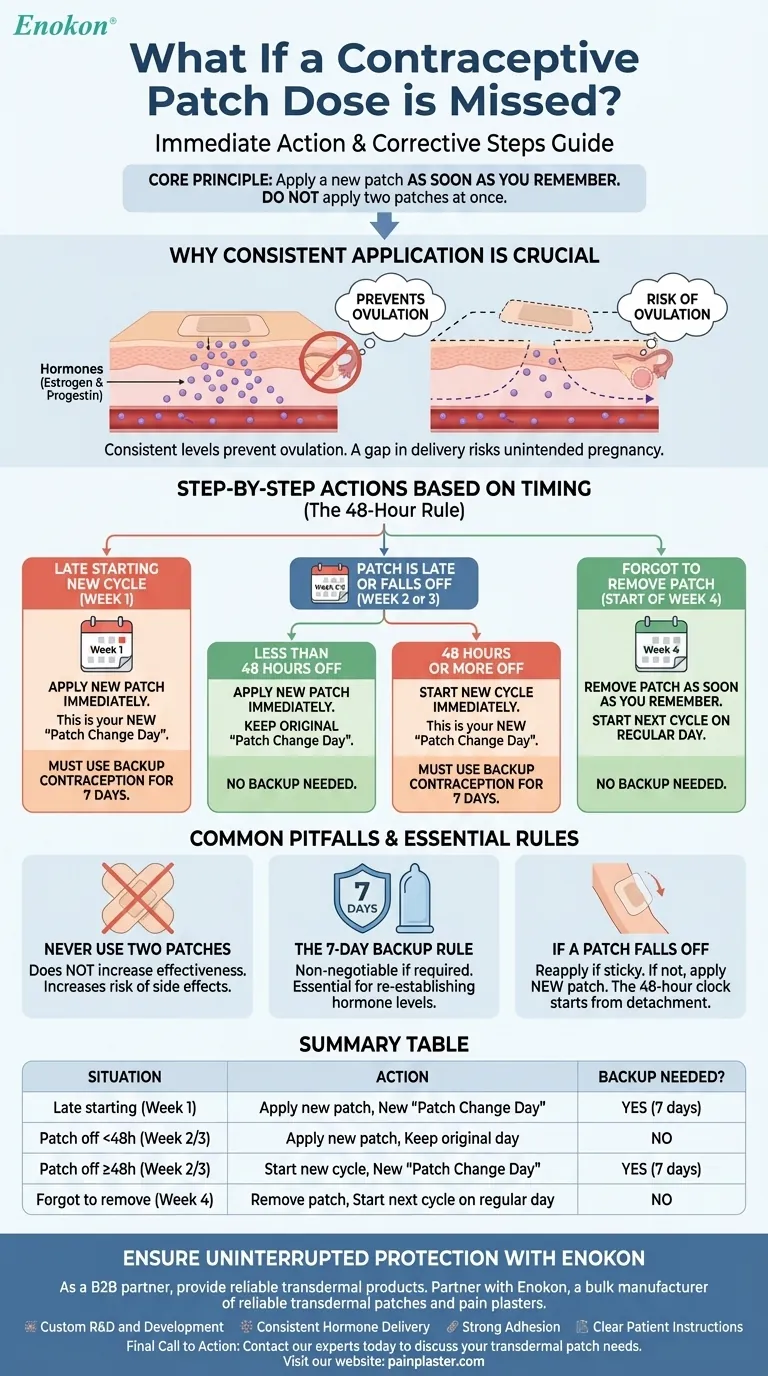
If you miss a dose of your contraceptive patch, the immediate action is to apply a new one as soon as you remember. It is critical that you do not apply two patches at once to make up for the missed dose. The most important factor in determining your next steps, including whether you need backup contraception, is how long the patch was off or how late you are in applying it.
Your primary goal after a missed dose is to re-establish a consistent level of hormones to prevent ovulation. The specific actions required, and especially the need for backup birth control, depend entirely on when in your cycle the miss occurred and for how long.

Why Consistent Application is Crucial
To understand what to do when you miss a dose, it helps to first understand how the patch works. This context explains why the timing of a mistake matters so much.
How the Patch Prevents Pregnancy
The contraceptive patch continuously releases a steady stream of hormones (estrogen and progestin) through your skin into your bloodstream.
This consistent hormone level primarily works by preventing your ovaries from releasing an egg (ovulation). A drop in these hormone levels can signal your body to begin the process of ovulation.
The Risk of a Missed Dose
Forgetting to apply a patch on time or having one fall off creates a gap in hormone delivery.
If this gap is long enough, your hormone levels can fall below the threshold needed to suppress ovulation, significantly increasing your risk of an unintended pregnancy.
Step-by-Step Actions Based on Timing
The correct response to a missed patch depends on where you are in your 4-week cycle. The "48-hour rule" is a critical guideline.
If You're Late Starting a New Cycle (Week 1)
This is the highest-risk time for a mistake because you are coming off the hormone-free week.
Apply a new patch as soon as you remember. This day is now your new "Patch Change Day" for the rest of the cycle. You must use a backup method of birth control, such as condoms, for the first 7 days of this new patch cycle.
If a Patch is Late or Falls Off (Week 2 or 3)
Your course of action depends on how long it has been since the patch came off or was due to be changed.
If it has been less than 48 hours: Apply a new patch immediately. You should continue to follow your original "Patch Change Day." No backup contraception is needed.
If it has been 48 hours or more: Stop your current cycle and start a new one immediately by applying a new patch. This day becomes your new "Patch Change Day." You must use backup contraception for the next 7 days because your protection has been compromised.
If You Forget to Remove the Patch (Start of Week 4)
This is the patch-free week. Forgetting to remove the patch at the end of Week 3 is the least risky error.
Simply remove the patch as soon as you remember. Then, start your next new patch cycle on your regularly scheduled "Patch Change Day." No backup birth control is required.
Common Pitfalls to Avoid
Navigating a mistake can be stressful. Adhering to these fundamental rules ensures you stay safe and protected.
Never Use Two Patches at Once
Applying an extra patch to "make up" for a missed dose does not increase its effectiveness.
It will, however, expose you to an unnecessarily high level of hormones, which can increase the risk of side effects like nausea, headaches, and blood clots. Always remove the old patch before applying a new one.
The 7-Day Backup Rule is Non-Negotiable
If your instructions require using backup contraception, it is essential to do so for a full seven consecutive days after applying the new patch.
This is how long it takes for the hormone levels in your body to re-establish a consistent state that reliably prevents ovulation.
What to Do if a Patch Falls Off
If a patch becomes loose or falls off completely, first try to reapply it if it's still sticky. If it won't stick, apply a brand new patch immediately.
The 48-hour clock starts from the moment the patch first fell off. Follow the same rules for Week 2 or 3 outlined above based on how long the patch was detached.
Making the Right Choice for Your Goal
When you realize you've made a mistake, take a calm breath and assess the situation based on these clear scenarios.
- If your patch has been off for less than 48 hours (in Week 2 or 3): Replace it immediately, stick to your original schedule, and know that your protection remains intact.
- If you are late starting your cycle OR your patch was off for 48 hours or more: Apply a new patch immediately, use backup birth control for 7 days, and set this as your new "Patch Change Day."
- If you simply forgot to remove your last patch before the patch-free week: Take it off when you remember and start your next cycle on your normal, originally scheduled day.
Understanding these simple rules empowers you to manage mishaps confidently and maintain effective protection.
Summary Table:
| Situation | Action | Backup Contraception Needed? |
|---|---|---|
| Late starting a new cycle (Week 1) | Apply new patch immediately. This becomes your new "Patch Change Day." | Yes, for 7 days |
| Patch off for <48 hours (Week 2 or 3) | Apply new patch immediately. Keep original "Patch Change Day." | No |
| Patch off for ≥48 hours (Week 2 or 3) | Apply new patch to start a new cycle. This becomes your new "Patch Change Day." | Yes, for 7 days |
| Forgot to remove patch (Start of Week 4) | Remove patch. Start next cycle on your regular "Patch Change Day." | No |
Ensure Your Patients' Contraceptive Protection is Uninterrupted
As a healthcare distributor or brand, providing reliable transdermal products is critical for patient safety and adherence. A missed dose can lead to a lapse in protection, underscoring the need for high-quality, dependable patches.
Partner with Enokon, a bulk manufacturer of reliable transdermal patches and pain plasters. We specialize in custom R&D and development to create contraceptive patches that offer consistent hormone delivery, strong adhesion, and clear patient instructions to minimize user error.
Benefit from our technical expertise to:
- Develop custom formulations tailored to your specific requirements.
- Ensure manufacturing consistency for reliable, batch-to-batch performance.
- Enhance patient compliance with user-friendly patch designs.
Let us help you supply products that healthcare providers and patients trust. Contact our experts today to discuss your transdermal patch needs.
Visual Guide
Related Products
- Heating Pain Relief Patches for Menstrual Cramps
- Prostate Pain Kidney Health Care Patch for Men
- Silicone Scar Sheets Patch Transdermal Drug Patch
- Lidocaine Hydrogel Pain Relief Patch for Pain Relief
- Menthol Gel Pain Relief Patch
People Also Ask
- What are the benefits of Period Pain Heat Patches? Drug-Free, On-the-Go Relief
- What are the key benefits of heating patches for elderly individuals? Relieve Pain & Improve Mobility
- What are the different types of heat patches? Find the Right Pain Relief for Your Needs
- What are the key differences between conventional heat patches and deep heat devices? Choosing the Right Pain Relief Solution
- What percentage of people with back pain use heat patches for relief? Discover the Popular Choice for Pain Management












