
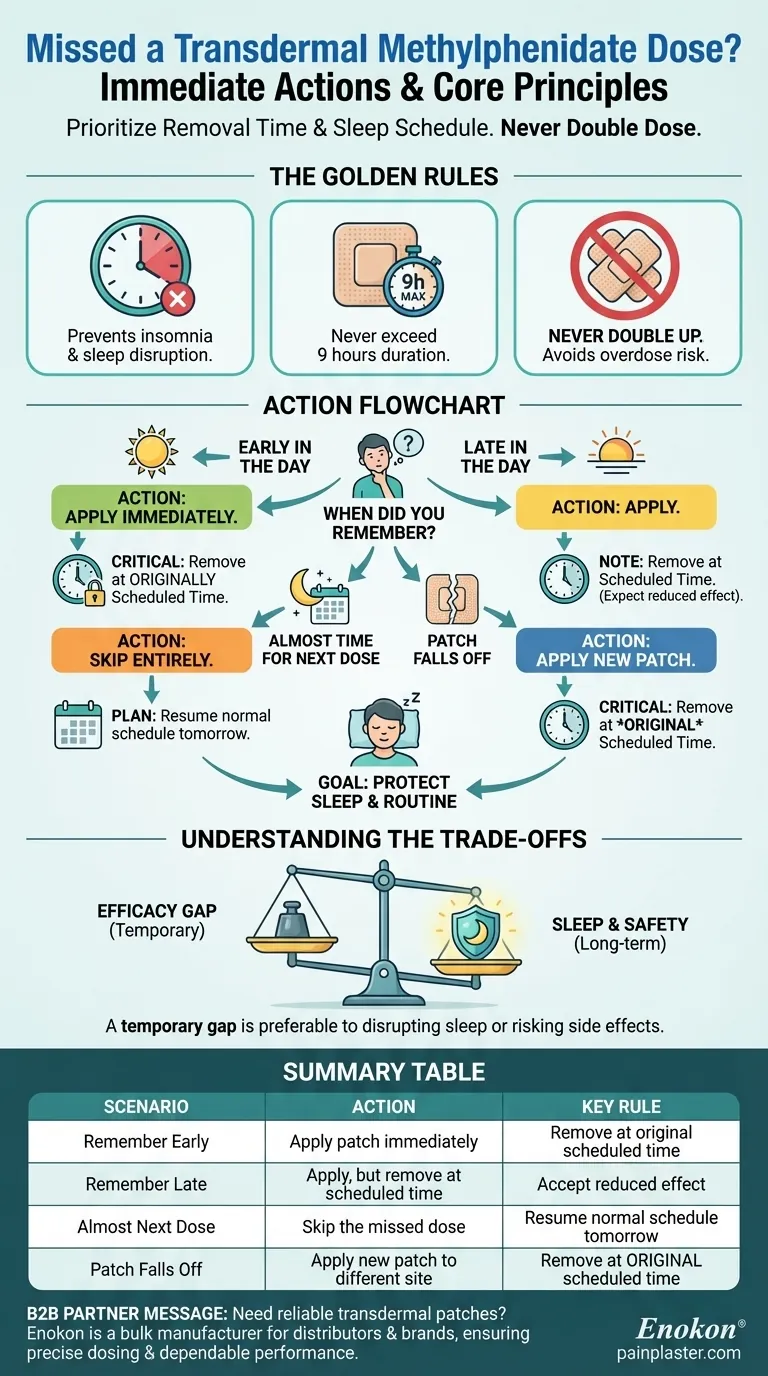
If you've missed a dose of your transdermal methylphenidate patch, the immediate action is to apply it as soon as you remember. However, it is critical that you still remove the patch at your originally scheduled time. This prevents the medication from interfering with your sleep and ensures you stay on your regular schedule. Never apply two patches or an extra dose to make up for the missed time.
The core principle for managing a missed methylphenidate patch is to prioritize your established removal time and sleep schedule above all else. A shorter duration of medication for one day is safer and preferable to disrupting your routine or experiencing significant side effects like insomnia.

The Guiding Principle: Time of Removal is Key
Understanding why the removal time is so important will empower you to make the right decision without confusion.
Why Removal Time Dictates the Rules
Methylphenidate is a central nervous system stimulant. Its effects are designed to wear off in the evening to allow for normal sleep patterns.
Wearing the patch later than usual extends the stimulant's effects into the night, which can directly cause difficulty falling asleep or staying asleep (insomnia). Sticking to your usual removal time is the primary strategy to prevent this.
The 9-Hour Maximum
Regardless of when you apply the patch, it should never be worn for more than 9 hours. This is the maximum recommended duration for a single patch to deliver the correct dose safely.
Prioritizing Your Regular Schedule
The goal after any mistake is to return to your normal, effective routine as quickly and safely as possible. Removing a late patch at the usual time, even if it means the patch was worn for fewer than 9 hours, is the best way to accomplish this.
Step-by-Step Actions for a Missed Dose
Your course of action depends on when you remember the missed dose.
If You Remember Early in the Day
This is the most straightforward scenario. Apply the patch as soon as you remember at a new application site. Make a clear note of your usual removal time and be sure to take it off then.
If It's Late in the Day
If you remember well into the afternoon or evening, you face a choice. You can still apply the patch, but you must commit to removing it at your usual time. This means you will receive a reduced therapeutic effect for that day.
If It's Almost Time for the Next Dose
If it is so late that you are approaching the time for your next day's scheduled dose, the safest course of action is to skip the missed dose entirely. Simply wait and apply your next patch at the regular time the following day.
If a Patch Falls Off
If an applied patch falls off, you may apply a new patch at a different site. However, the new patch must be removed at the same time the original patch was scheduled to be removed.
Understanding the Trade-offs and What to Avoid
Following these guidelines involves balancing medication efficacy with potential side effects. Knowing what not to do is as important as knowing what to do.
The Critical Rule: Never Double Up
Applying an extra patch to "make up" for a missed dose is dangerous. It can lead to an overdose of methylphenidate, significantly increasing the risk of serious side effects like rapid heart rate, high blood pressure, and severe agitation.
The Consequence of Late Removal: Insomnia
The most common and disruptive consequence of wearing a patch too late is insomnia. Protecting your sleep hygiene is crucial for managing your condition and overall well-being.
The Consequence of Skipping: A Gap in Efficacy
When you apply a patch late and remove it on time, or if you skip a dose entirely, you will experience a gap in the medication's therapeutic coverage. While not ideal, this is a necessary trade-off to maintain safety and your long-term schedule.
Making the Right Choice for Your Situation
Use these clear guidelines to determine your next step.
- If your primary focus is sticking to the schedule: Apply the patch as soon as you remember, but always remove it at the original, scheduled time.
- If your primary focus is protecting your sleep: If it's late in the afternoon or evening when you remember, skip the dose for the day and resume your normal schedule tomorrow.
- If your primary focus is safety: Never wear two patches at once or wear a single patch for longer than 9 hours.
Ultimately, consistency is the goal, but safely managing an occasional missed dose is a key part of a successful treatment plan.
Summary Table:
| Scenario | Action | Key Rule |
|---|---|---|
| Remember Early in Day | Apply patch immediately | Remove at original scheduled time |
| Remember Late in Day | Apply patch, but remove at scheduled time | Accept reduced effect for the day |
| Almost Time for Next Dose | Skip the missed dose | Resume normal schedule tomorrow |
| Patch Falls Off | Apply a new patch to a different site | Remove at the original scheduled time |
Need a reliable supply of transdermal patches for your patients?
As a bulk manufacturer of high-quality, consistent transdermal patches and pain plasters, Enokon provides healthcare distributors and pharmaceutical brands with the reliable products they need. Our technical expertise ensures precise dosing and dependable performance, supporting effective treatment plans.
Let's discuss your custom R&D and manufacturing needs. Contact our team today to learn how we can partner with you.
Visual Guide
Related Products
- Silicone Scar Sheets Patch Transdermal Drug Patch
- Menthol Gel Pain Relief Patch
- Far Infrared Heat Pain Relief Patches Transdermal Patches
- Icy Hot Menthol Medicine Pain Relief Patch
- Mugwort Wormwood Pain Relief Patch for Neck Pain
People Also Ask
- What role does a silicone-based transdermal delivery system play in Parkinson's? Enhancing Early-Stage Patient Care
- How is the long-term skin tolerance of silicone-based transdermal patches evaluated in clinical settings? R&D and Safety
- Why is a polarizing microscope used to evaluate the long-term stability of transdermal drug patches? Ensure Efficacy.
- What are common adverse effects of transdermal drug delivery? Risks & Prevention Tips
- What are the advantages of transdermal drug patches? Optimize Medication Delivery with Patches
















