
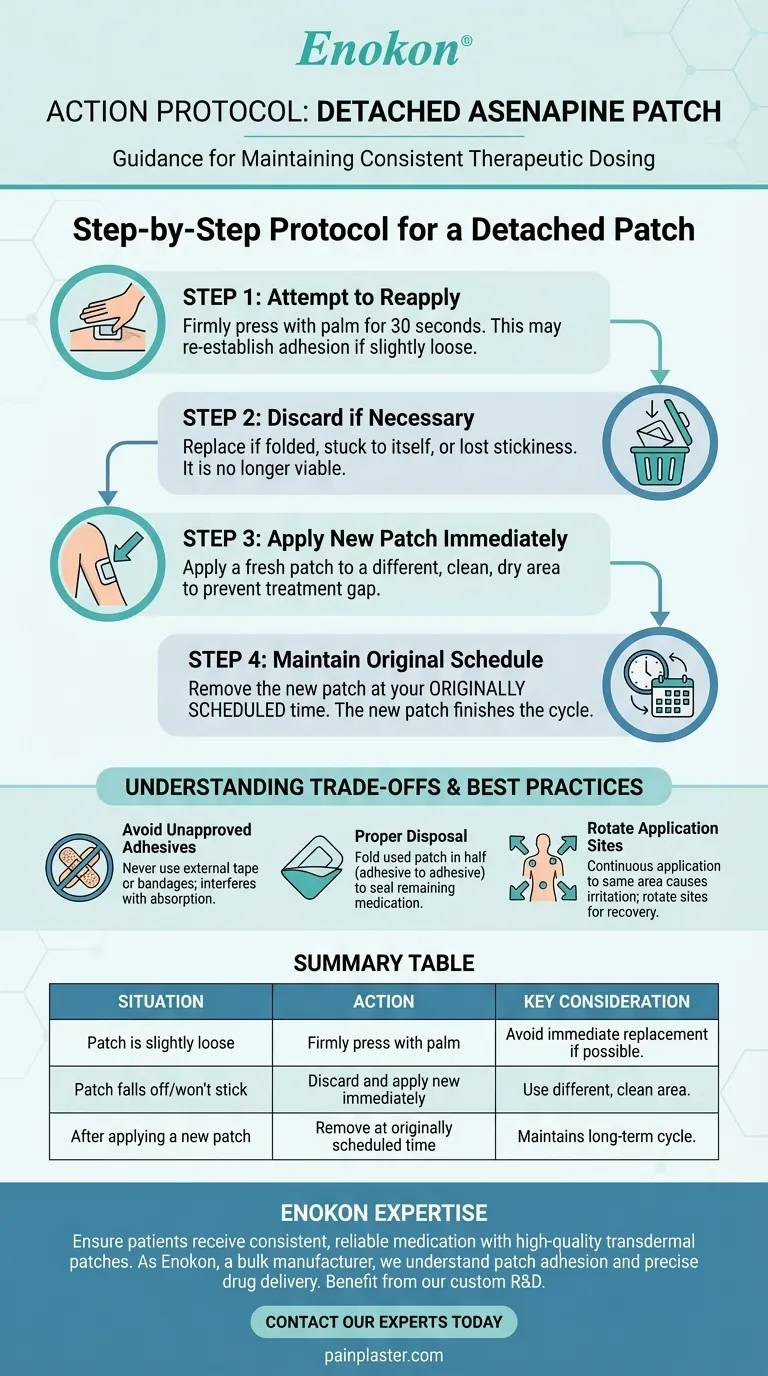
If your asenapine patch has loosened or fallen off, you should first try to firmly press it back into place with the palm of your hand. If it does not re-adhere completely, you must dispose of the old patch and immediately apply a new one to a different, clean area of skin. It is critical to remove this new patch at the same time you were originally scheduled to remove the first one.
The primary goal is to maintain a consistent therapeutic dose of your medication. Replacing a detached patch immediately—while strictly adhering to your original replacement schedule—prevents a gap in treatment without disrupting your long-term dosing cycle.
A Step-by-Step Protocol for a Detached Patch
When a transdermal patch detaches, it interrupts the steady delivery of medication. Following a clear protocol ensures your treatment remains on track.
Step 1: Attempt to Reapply
Before doing anything else, try to re-secure the patch. Place the palm of your hand over the patch and press firmly for about 30 seconds. This may be enough to re-establish adhesion if it has only loosened slightly.
Step 2: Discard the Old Patch When Necessary
You must replace the patch if it cannot be fully reattached. A patch is no longer viable if it has folded over on itself, stuck to another surface, or lost its stickiness.
Step 3: Apply a New Patch Immediately
If the old patch is unusable, apply a fresh patch right away to ensure there is no significant interruption in your medication.
Always choose a different application site for the new patch. Applying it to the same spot can cause skin irritation. Ensure the new area is clean, dry, and has minimal hair.
Step 4: Maintain Your Original Schedule
This is the most important step. The new patch is simply a substitute that finishes the original patch's 24-hour cycle.
For example, if you normally change your patch every morning at 9:00 AM and it falls off on Wednesday afternoon, you would apply a new one immediately. You would then still remove that replacement patch and apply another new one at your scheduled time on Thursday at 9:00 AM.
Understanding the Trade-offs and Best Practices
Handling your patch correctly is crucial for both safety and efficacy. Mismanaging a detached patch can lead to inconsistent dosing or skin irritation.
Avoid Using Unapproved Adhesives
Never use household tape, bandages, or other external adhesives to secure a patch. These materials are not designed for this purpose and can interfere with how the medication is absorbed through your skin.
Some patch systems may come with an approved adhesive cover; only use materials that are included with your prescription.
The Importance of Proper Disposal
Even a used patch contains a significant amount of active medication. To dispose of it safely, fold the patch in half so the adhesive sides stick together. This seals in the remaining medication.
Discard the folded patch in a place where it cannot be accessed by children or pets.
Why You Must Rotate Application Sites
Continuously applying patches to the same area of skin can lead to irritation, redness, or rashes. Rotating the location with each new patch gives your skin time to recover and ensures optimal adhesion and medication absorption.
Making the Right Choice for Your Goal
Navigating this issue is straightforward if you remember the core principle of maintaining treatment consistency.
- If your patch is only slightly loose at the edges: Try pressing it firmly back into place with your palm before considering replacement.
- If your patch has fallen off or will not re-adhere: Immediately replace it with a new patch on a different, clean patch of skin.
- For any patch you apply outside your normal schedule: Always remove it and apply the next one at your original, scheduled day and time.
Following these precise steps ensures your treatment remains consistent, effective, and safe.
Summary Table:
| Situation | Action | Key Consideration |
|---|---|---|
| Patch is slightly loose | Firmly press with palm for 30 seconds to re-adhere. | Avoid immediate replacement if possible. |
| Patch falls off/won't stick | Discard old patch and apply a new one immediately. | Use a different, clean, dry area of skin. |
| After applying a new patch | Remove it at your originally scheduled time. | Maintains your long-term dosing cycle. |
Ensure your patients receive consistent, reliable medication with high-quality transdermal patches. As Enokon, a bulk manufacturer of reliable transdermal patches and pain plasters for healthcare and pharma distributors and brands, we understand that patch adhesion and precise drug delivery are critical to treatment success. Benefit from our technical expertise for custom R&D and development to create patches that stay secure and perform as intended.
Contact our experts today to discuss your specific needs and how we can support your product development.
Visual Guide
Related Products
- Menthol Gel Pain Relief Patch
- Lidocaine Hydrogel Pain Relief Patch for Pain Relief
- Capsaicin Chili Medicated Pain Relief Patches
- Asthma Cough and Pain Relief Patch for Adults and Kids
- Icy Hot Menthol Medicine Pain Relief Patch
People Also Ask
- How do pain relief patches compare to other pain relief methods? Discover Targeted, Long-Lasting Relief
- How effective are pain relief patches for muscle pain? Target Localized Pain with Transdermal Delivery
- Who should consult a healthcare professional before using pain relief patches? Ensure Your Safety with Medical Advice
- Can pregnant women use pain relief patches? Your Essential Guide to Safe Pain Management
- What are the different types of pain relief patches available? Find the Right Solution for Your Pain



















