
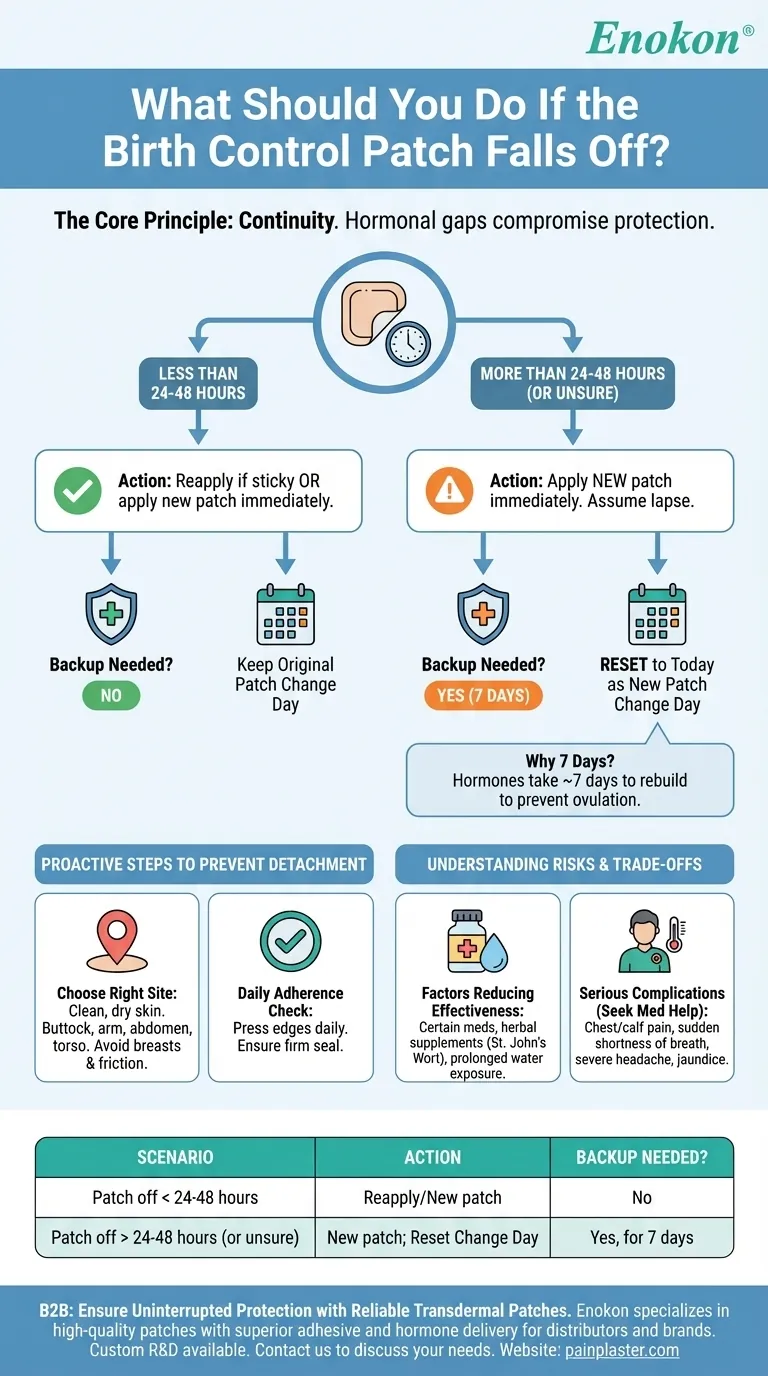
When your birth control patch falls off, the immediate action you must take depends entirely on how long it has been detached. If it has been off for less than a day (some brands allow up to 48 hours) and is still sticky, reapply it. If it won't stick, or if it has been detached for longer than that safe window, you must apply a brand new patch immediately and use a backup method of contraception for the next seven days.
The core principle is continuity. A detached patch creates a gap in the hormones your body receives, and the length of that gap determines whether your protection against pregnancy has been compromised.

The Critical Time Window: What to Do and When
Your response to a detached patch is dictated by a specific time frame. This window is the period during which the hormone levels in your system remain high enough to prevent ovulation.
If It's Been Less Than 24-48 Hours
If you notice the patch is loose or has completely fallen off, but it has been less than one full day (some guidelines specify up to 48 hours), your contraceptive protection is likely still intact.
First, try to reapply the same patch. Press down firmly for about 10 seconds to ensure the edges are secure. If it does not stick properly, discard it and apply a new patch immediately.
You do not need to use backup contraception in this scenario. Continue to change your patch on your normal "Patch Change Day."
If It's Been More Than 24-48 Hours (or You're Unsure)
If the patch has been off for more than a day, or if you are unsure how long it has been off, you must assume your protection against pregnancy has lapsed.
Apply a brand new patch as soon as you realize the issue. This day now becomes your new "Patch Change Day."
Most importantly, you must use a backup method of contraception, such as condoms, for the next seven consecutive days.
Why the 7-Day Backup Is Non-Negotiable
It takes approximately seven days for the hormones from a new patch to build up in your system to a level that reliably prevents your ovaries from releasing an egg (ovulation).
If there has been a significant interruption, that 7-day clock resets. Using a backup method during this first week is the only way to ensure you are protected while the patch's effectiveness is restored.
Proactive Steps to Prevent Patch Detachment
Ensuring your patch stays on is the best way to maintain its effectiveness and avoid the stress of a lapse in coverage. Simple, consistent habits make all the difference.
Choose the Right Application Site
Always apply the patch to skin that is clean, dry, and free of any lotions, oils, or powders.
Place it on your buttock, upper outer arm, lower abdomen, or upper torso—but never on your breasts. Avoid areas that will experience constant friction from clothing, like under a bra strap or waistband.
Perform a Daily Adherence Check
Make it a habit to glance at your patch once a day, perhaps when you get dressed or before a shower.
Check to ensure all four edges are sealed firmly against your skin. If you see an edge lifting, press it down firmly. This simple check can prevent a small problem from becoming a complete detachment.
Understanding the Risks and Trade-offs
While highly effective, the patch's reliability is entirely dependent on correct and consistent use. Understanding potential failure points is key to using it with confidence.
Factors That Can Reduce Effectiveness
Certain medications and herbal supplements (most notably St. John's Wort) can interfere with hormonal birth control. Always inform your doctor about all medications you are taking.
Additionally, while the patch is designed to stay on during swimming and showering, frequent or prolonged water exposure can sometimes weaken the adhesive.
When to Recognize Serious Complications
While rare, hormonal contraceptives carry a risk of serious side effects. Seek immediate medical attention if you experience any of the following symptoms:
- Sharp or crushing chest pain
- Sudden shortness of breath or coughing up blood
- Persistent pain in your calf
- Sudden changes in vision or severe headache
- Yellowing of the skin or eyes (jaundice) or severe abdominal pain
Your Action Plan for Patch Security
Your goal determines your immediate next step. Use this guide to make a clear, confident decision.
- If your patch just fell off (within the last day): Reapply it if sticky or replace it with a new one immediately; keep your original "Patch Change Day."
- If your patch has been off for more than a day (or you're unsure): Apply a new patch, use backup contraception for seven days, and this day becomes your new "Patch Change Day."
- If you want maximum peace of mind: Check your patch edges daily, be mindful of where you place it, and consider using condoms for dual protection against STIs and as a pregnancy failsafe.
By understanding these simple rules, you can manage any issue confidently and ensure your birth control remains effective.
Summary Table:
| Scenario | Action | Backup Contraception Needed? |
|---|---|---|
| Patch off for < 24-48 hours | Reapply if sticky or apply a new patch immediately | No |
| Patch off for > 24-48 hours (or unsure) | Apply a new patch immediately; this becomes your new "Patch Change Day" | Yes, for 7 days |
Ensure Uninterrupted Protection with Reliable Transdermal Patches
Facing issues with patch adhesion? Enokon specializes in manufacturing high-quality, reliable transdermal patches and pain plasters for healthcare and pharmaceutical distributors and brands. Our technical expertise ensures superior adhesive performance and consistent hormone delivery. Benefit from our custom R&D services to develop patches that stay secure and effective.
Contact us today to discuss your transdermal patch needs and enhance user safety and satisfaction.
Visual Guide
Related Products
- Prostate Pain Kidney Health Care Patch for Men
- Heating Pain Relief Patches for Menstrual Cramps
- Silicone Scar Sheets Patch Transdermal Drug Patch
- Menthol Gel Pain Relief Patch
- Icy Hot Menthol Medicine Pain Relief Patch
People Also Ask
- What are the key components of Chinese herbal pain patches? Discover the Science Behind Natural Pain Relief
- What are the main benefits of using Chinese pain patches? Holistic Relief for Musculoskeletal Pain
- What are Chinese pain patches used for? Natural Relief for Joint & Muscle Pain
- What should be avoided when using Chinese pain patches? Key Safety Tips for Effective Relief
- Are there any side effects associated with Chinese pain patches? Risks & Safety Tips








