
If your contraceptive patch falls off, your immediate next step depends entirely on how long it has been detached from your skin. If it has been less than 24 hours, you can often reapply or replace it without any change in your protection. However, if it has been off for more than 24 hours, you must apply a new patch and use a backup form of birth control, like condoms, for the next seven days to ensure you are protected against pregnancy.
A detached patch can create a gap in your hormonal protection. The core principle is to restore that protection as quickly as possible, with the 24-hour mark being the critical threshold that determines whether you need backup contraception.
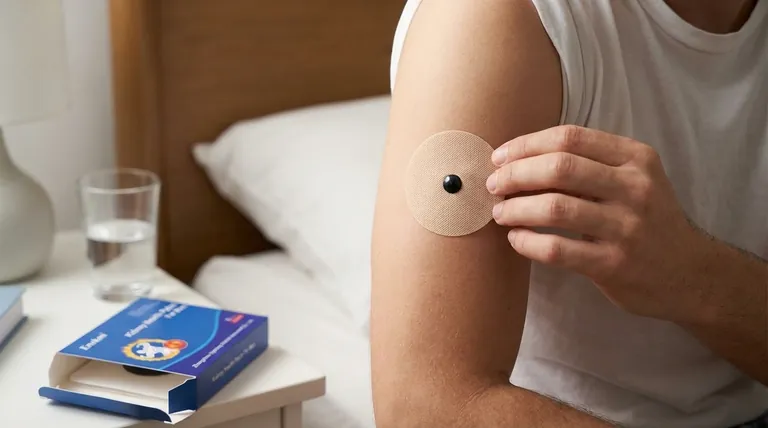
The Critical Time Window: Your First Assessment
The effectiveness of the contraceptive patch relies on the steady delivery of hormones through your skin. When it falls off, that delivery stops. Your actions should be guided by how long this hormonal gap has lasted.
If the Patch Was Off for LESS Than 24 Hours
This is the most straightforward scenario with the lowest risk.
First, try to reapply the original patch if it is still clean and sticky. Press it down firmly with the palm of your hand for about 10 seconds to ensure it adheres properly.
If the patch will not stick, discard it and immediately apply a brand-new patch.
In this situation, no backup contraception is needed. You should continue to follow your original schedule, changing your patch on your normal "patch change day."
If the Patch Was Off for MORE Than 24 Hours (or You're Unsure)
If you know the patch has been detached for more than a day, or if you aren't sure how long it has been off, you must assume your contraceptive protection has been compromised.
Apply a new patch as soon as you realize the old one is gone. Do not attempt to reapply the old one.
You must use a non-hormonal backup method of birth control, such as condoms, for the next 7 consecutive days. The hormones need this time to build back up to an effective level in your system.
Your "patch change day" schedule may need to be adjusted depending on where you are in your cycle.
Navigating Your Schedule After a Detached Patch
Restoring protection isn't just about putting on a new patch; it's also about getting your weekly cycle back on track correctly.
For Weeks 1 and 2
If your patch comes off for more than 24 hours during the first or second week of your cycle, apply a new patch immediately.
You will keep your original "patch change day." For example, if your change day is Sunday, but you replaced the patch on a Tuesday, you will still remove that patch and apply a new one on the upcoming Sunday.
Remember to use backup contraception for seven days after applying the new patch.
The Special Case: Week 3
Week 3 requires a different approach to prevent the risk of ovulation during the patch-free week.
If your patch falls off for more than 24 hours during your third week, apply a new patch immediately. Then, you will skip your upcoming patch-free week entirely.
This means you will wear this new patch for the remainder of the week, remove it on your change day, and immediately apply a new patch to start a new four-week cycle. You will not have a withdrawal bleed that month, but this is the safest way to maintain contraceptive efficacy.
Understanding the Trade-offs and Best Practices
Avoiding common mistakes is just as important as knowing the right steps to take. Incorrectly handling a detached patch is a primary reason for method failure.
Do Not "Fix" a Non-Sticky Patch
Never use standard medical tape, adhesive bandages, or glue to try to secure a patch that has lost its stickiness. These can interfere with hormone absorption and make the patch ineffective. If it won't stick on its own, replace it.
Always Use a New Location
When applying a new patch after one has fallen off, place it on a different area of approved skin (such as the buttock, abdomen, upper arm, or upper torso). Using the same spot repeatedly can cause skin irritation.
Never Wear More Than One Patch
Do not apply an extra patch to "make up for" lost time. Wearing more than one patch at a time can expose you to an unnecessarily high level of hormones, increasing the risk of side effects without increasing contraceptive protection.
Making the Right Choice for Your Goal
Your primary goal is to maintain continuous protection from unintended pregnancy. Your action plan depends entirely on timing.
- If your patch was off for less than 24 hours: Reapply it if sticky or replace it with a new one immediately, and continue your cycle as normal with no backup needed.
- If your patch was off for more than 24 hours (in Week 1 or 2): Apply a new patch, use backup birth control for 7 days, and keep your original patch change day.
- If your patch was off for more than 24 hours (in Week 3): Apply a new patch, use backup birth control for 7 days, and skip your patch-free week to start a new cycle immediately.
- If you are ever in doubt: Assume the patch has been off for more than 24 hours, use condoms, and consult your pharmacist or doctor for advice tailored to your situation.
Acting decisively based on these clear timeframes is the key to maintaining control over your contraceptive protection.
Summary Table:
| Situation | Action | Backup Contraception Needed? |
|---|---|---|
| Off for < 24 hours | Reapply if sticky, or apply a new patch. | No |
| Off for > 24 hours (Weeks 1 & 2) | Apply a new patch immediately. | Yes, for 7 days |
| Off for > 24 hours (Week 3) | Apply a new patch and skip the patch-free week. | Yes, for 7 days |
| Unsure of time off | Assume >24 hours, apply new patch, use backup. | Yes, for 7 days |
Need a reliable contraceptive patch that stays securely in place?
As Enokon, a bulk manufacturer of reliable transdermal patches for leading healthcare and pharmaceutical brands, we understand that adhesion is critical for user safety and product efficacy. Our technical expertise ensures patches are designed for optimal wear and consistent hormone delivery.
Partner with us to develop or source high-quality transdermal patches that your customers can trust.
Contact our experts today to discuss custom R&D and development for your brand's needs.
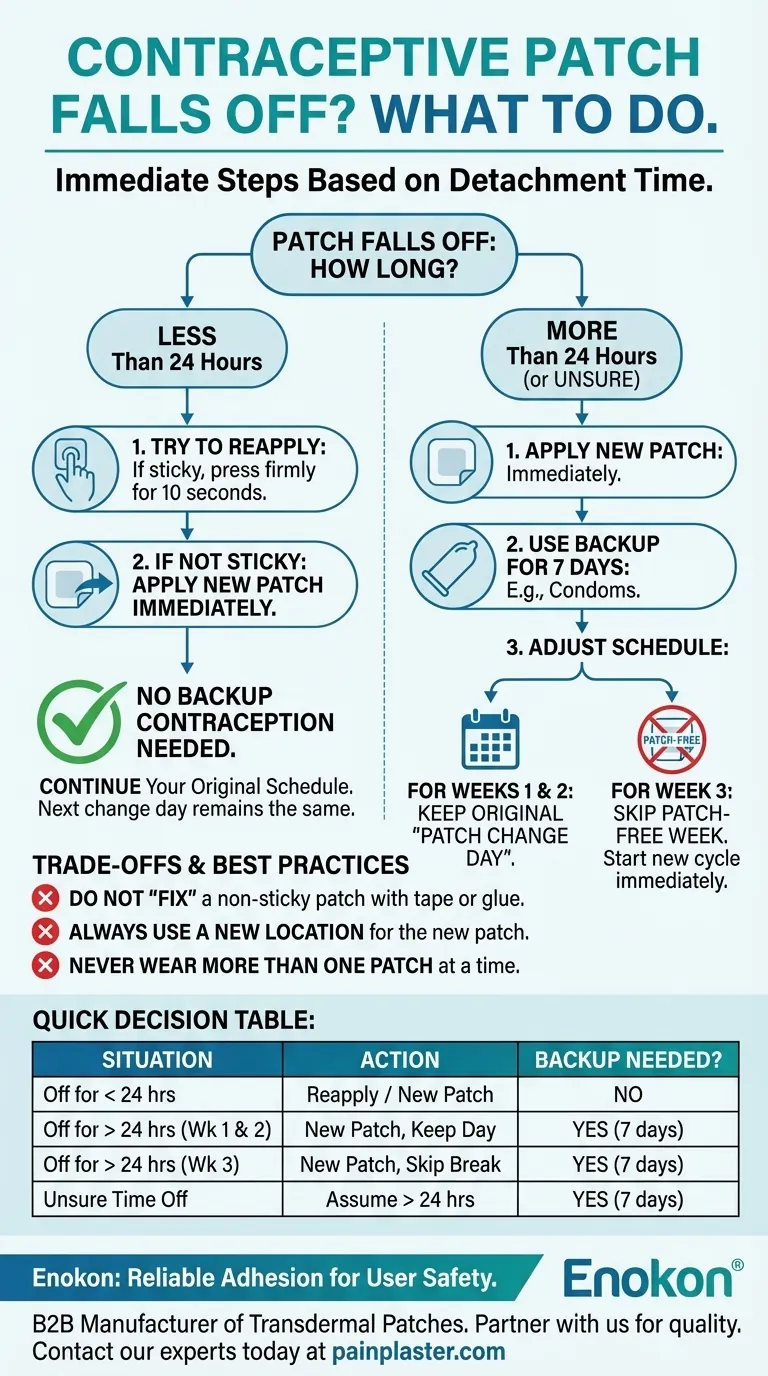
Visual Guide
Related Products
- Heating Pain Relief Patches for Menstrual Cramps
- Prostate Pain Kidney Health Care Patch for Men
- Silicone Scar Sheets Patch Transdermal Drug Patch
- Lidocaine Hydrogel Pain Relief Patch for Pain Relief
- Menthol Gel Pain Relief Patch
People Also Ask
- What are the benefits of Period Pain Heat Patches? Drug-Free, On-the-Go Relief
- What are the key benefits of heating patches for elderly individuals? Relieve Pain & Improve Mobility
- What are the key differences between conventional heat patches and deep heat devices? Choosing the Right Pain Relief Solution
- Can heat patches be used for fresh injuries? Avoid This Common Mistake for Faster Recovery
- What are the different types of heat patches? Find the Right Pain Relief for Your Needs













