
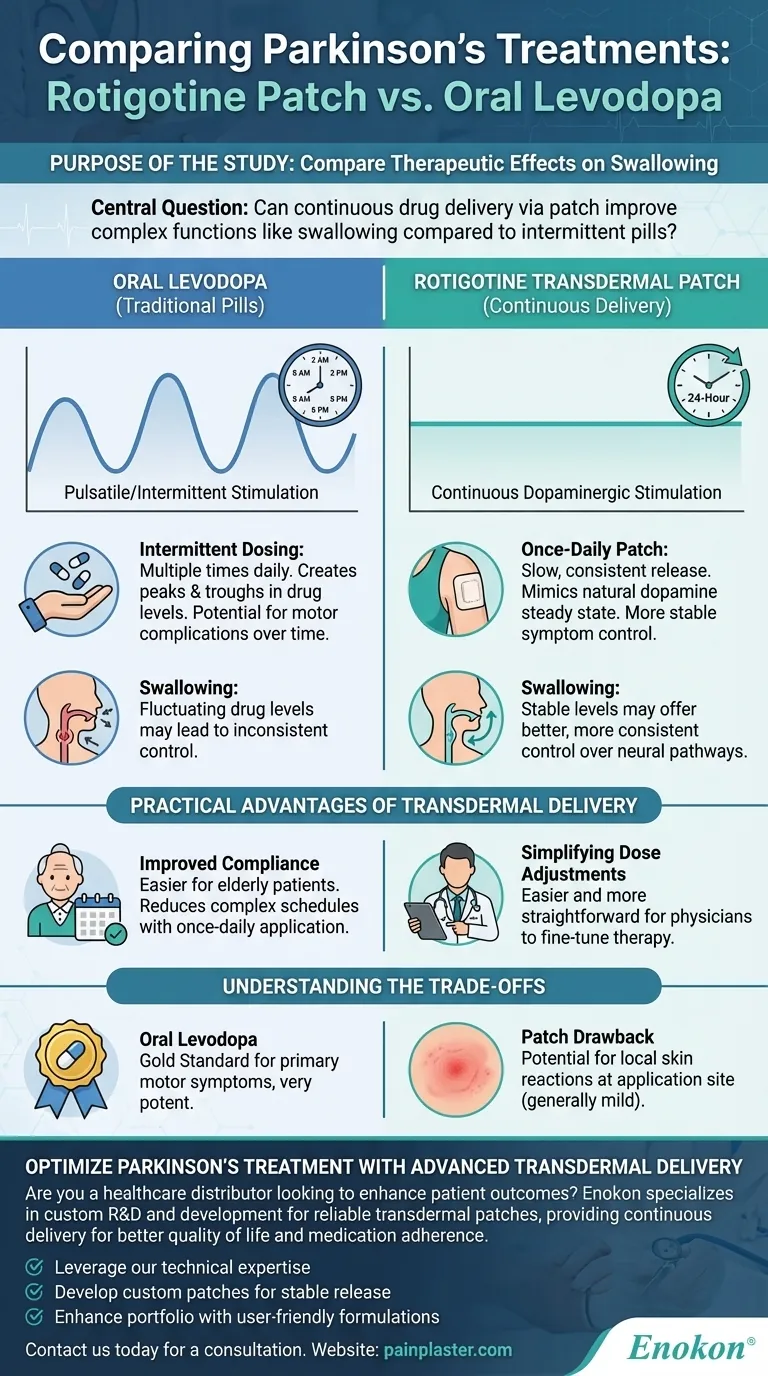
The primary purpose of the study was to compare the therapeutic effects of the rotigotine transdermal patch against traditional oral levodopa on the swallowing functions of patients with Parkinson's disease. The central scientific question was whether the continuous dopaminergic stimulation provided by a skin patch could offer unique benefits over the intermittent stimulation from oral pills.
This investigation goes beyond a simple drug comparison. It explores a fundamental treatment philosophy: whether a steady, continuous delivery of medication (from a patch) provides more stable and effective symptom control for a complex function like swallowing compared to the fluctuating drug levels caused by oral doses.
The Core Scientific Question: Continuous vs. Intermittent Stimulation
The choice between a transdermal patch and an oral pill represents two distinct approaches to managing dopamine levels in the brain, which is the central challenge in treating Parkinson's disease.
The Effect of Oral Levodopa
Oral medications like levodopa are taken multiple times a day. This creates a cycle of peaks and troughs in the drug's concentration in the bloodstream, a phenomenon known as pulsatile or intermittent stimulation. While effective, these fluctuations can contribute to motor complications over time.
The Rationale for a Transdermal Patch
The rotigotine transdermal patch is designed to release medication slowly and consistently through the skin over a 24-hour period. This provides continuous dopaminergic stimulation, mimicking the brain's natural, steady release of dopamine more closely.
Why This Matters for Swallowing
Swallowing (dysphagia) is a complex motor and non-motor function often impaired in Parkinson's. The hypothesis is that the stable drug levels from a patch might provide more consistent control over the neural pathways governing this action, potentially leading to better outcomes than the fluctuating levels from oral medication.
Beyond Stimulation: The Practical Advantages of Transdermal Delivery
The study's focus also implicitly touches on the practical realities of managing a chronic neurological condition, where the method of drug delivery can be as important as the drug itself.
Improving Patient Compliance
For elderly patients or those with complex medication schedules, a once-daily patch is often far easier to manage than pills that must be taken three times a day. This improved convenience can significantly increase treatment adherence, which is critical for long-term outcomes.
Simplifying Dose Adjustments
Physicians note that adjusting dosage can be more straightforward with a patch system compared to oral medications. This allows for more precise and manageable therapeutic fine-tuning.
The Physician's Perspective
Research shows that clinicians prescribe the rotigotine patch for two main reasons: the unique properties of the active drug (rotigotine) and, overwhelmingly, the benefits of its pharmaceutical form (the patch). This highlights the recognized value of the delivery system in clinical practice.
Understanding the Trade-offs
While the patch offers clear benefits in delivery mechanism and convenience, it's essential to consider the complete clinical picture.
Oral Levodopa is the Gold Standard
Oral levodopa remains one of the most potent and effective treatments for the primary motor symptoms of Parkinson's disease. The goal of a study like this is not necessarily to replace it, but to understand where alternative strategies like rotigotine may offer specific advantages.
Potential for Skin Irritation
A common drawback of any transdermal patch is the potential for local skin reactions at the application site. While generally mild, this can be a limiting factor for some patients.
Cost and Accessibility
Newer drug formulations and delivery systems can often be more expensive than older, established oral medications. Patient access may be influenced by insurance coverage and cost considerations.
Making the Right Choice for Your Goal
This study's purpose informs how we think about different treatment strategies based on specific patient needs.
- If your primary focus is on stabilizing motor control and reducing "off" periods: The principle of continuous dopaminergic stimulation, as delivered by the patch, is a key therapeutic strategy.
- If your primary focus is improving treatment adherence for a patient with a complex regimen: The convenience of a once-daily transdermal patch offers a significant practical advantage.
- If your primary focus is specifically on swallowing function: This research directly compares how a continuous versus an intermittent delivery system impacts this critical non-motor symptom.
Ultimately, understanding the method of drug delivery is as crucial as understanding the medication itself for optimizing patient care in Parkinson's disease.
Summary Table:
| Treatment Method | Delivery Mechanism | Key Consideration |
|---|---|---|
| Rotigotine Transdermal Patch | Continuous 24-hour release through the skin | Provides stable dopamine levels; may improve complex functions like swallowing |
| Oral Levodopa | Intermittent dosing (multiple times per day) | Potent for motor symptoms but causes peaks and troughs in drug levels |
Optimize Your Parkinson's Treatment with Advanced Transdermal Delivery
Are you a healthcare distributor or pharmaceutical brand looking to enhance patient outcomes through innovative drug delivery systems? This study highlights the critical advantage of continuous dopaminergic stimulation for managing complex symptoms like swallowing dysfunction.
At Enokon, we are a bulk manufacturer of reliable transdermal patches and pain plasters. We specialize in custom R&D and development to create tailored solutions that address specific clinical needs, such as improving medication adherence and providing stable drug release.
Partner with us to:
- Leverage our technical expertise in transdermal technology for your product line.
- Develop custom patches that offer continuous delivery, improving patient quality of life.
- Enhance your portfolio with formulations designed for ease of use and consistent therapeutic effects.
Contact us today to discuss how our transdermal solutions can meet your needs. Reach out via our contact form for a consultation.
Visual Guide
Related Products
- Far Infrared Heat Pain Relief Patches Transdermal Patches
- Silicone Scar Sheets Patch Transdermal Drug Patch
- Icy Hot Menthol Medicine Pain Relief Patch
- Menthol Gel Pain Relief Patch
- Mugwort Wormwood Pain Relief Patch for Neck Pain
People Also Ask
- Why is the selection of matrix materials critical when developing customized transdermal patches? Optimize Efficacy
- What are the physical impacts of external heat exposure on the performance and safety of transdermal patches? - Guide
- What role does a skin tolerance scoring system play in the safety evaluation of transdermal patches? Key Safety Metrics
- What are the clinical advantages of local transdermal delivery systems? Unlock Safer, More Effective Pain Relief Solutions
- How does high-purity far-infrared ceramic powder contribute to the efficacy of far-infrared physical therapy patches?






