
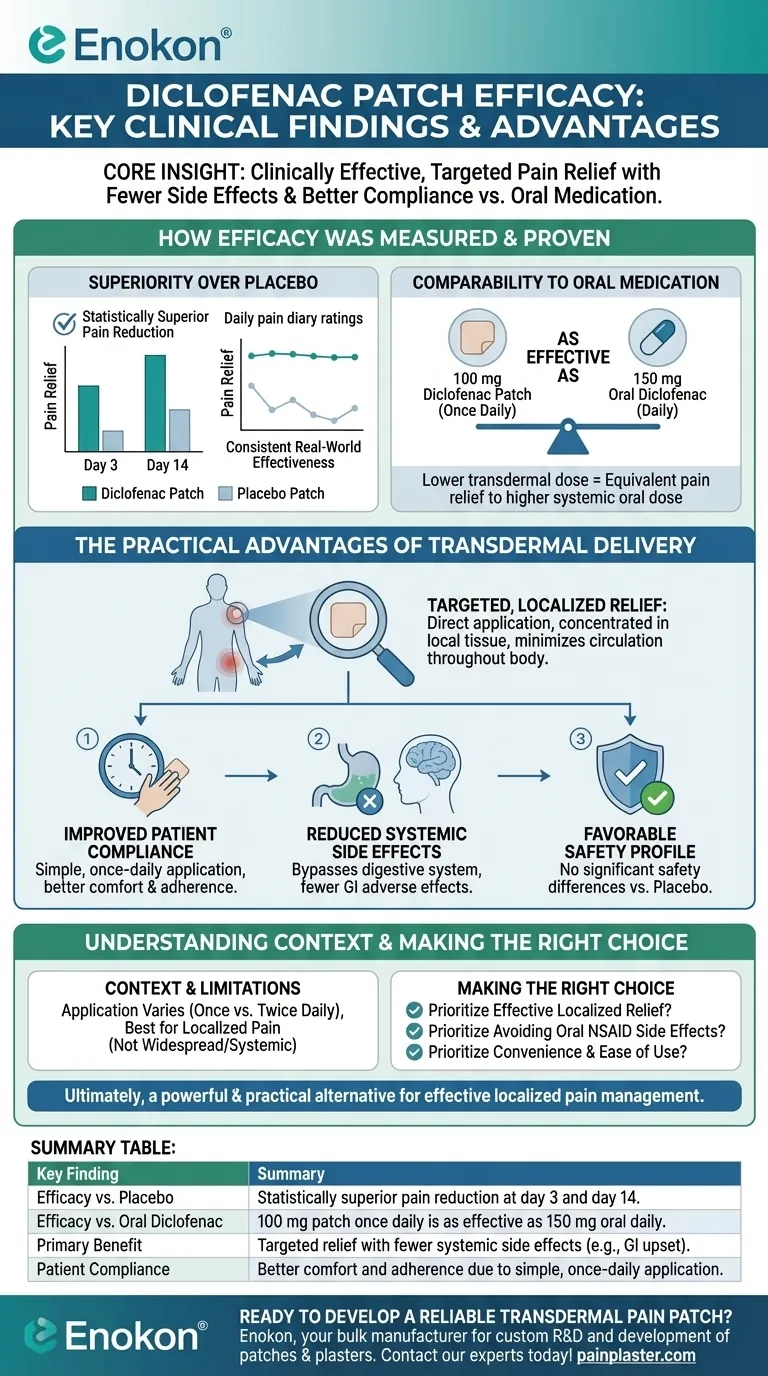
To be clear, the key findings show that the diclofenac patch is a clinically effective treatment for localized pain. Studies confirm it is statistically superior to a placebo in reducing pain and is comparable in efficacy to oral diclofenac, but with the added benefits of better patient compliance and fewer adverse effects.
The core insight is that the diclofenac patch provides targeted pain relief equivalent to its oral medication counterpart, but with a significantly more favorable profile regarding side effects and ease of use.
How Efficacy Was Measured and Proven
To understand the value of the diclofenac patch, it's essential to look at how its effectiveness was tested. The findings consistently point to it being a viable and potent option for localized pain management.
Superiority Over Placebo
In clinical trials, the diclofenac patch demonstrated a statistically significant advantage over a placebo patch.
Patients using the active patch reported greater pain relief at specific checkpoints, including day 3 and day 14 of treatment.
Furthermore, daily pain diary ratings from patients consistently favored the diclofenac patch, confirming its real-world effectiveness over the course of treatment.
Comparability to Oral Medication
One of the most compelling findings comes from a direct comparison with the standard oral form of the medication.
A study on post-extraction analgesia found that a 100 mg transdermal diclofenac patch applied once daily was as effective as 150 mg of oral diclofenac taken daily.
This demonstrates that a lower dose delivered through the skin can achieve the same level of pain relief as a higher systemic dose taken by mouth.
The Practical Advantages of a Transdermal Patch
The patch's efficacy is only part of the story. Its method of delivery—transdermally, through the skin—offers several distinct benefits that are crucial for patient care.
Targeted, Localized Relief
The patch is applied directly to the skin overlying the painful site, delivering the active ingredient precisely where it is needed most.
This targeted approach concentrates the medication in the local tissue, minimizing its circulation throughout the rest of the body.
Improved Patient Compliance
Patients reported better comfort and compliance with the patch, largely due to its simple, often once-a-day, application schedule.
This contrasts sharply with oral medications that may require multiple doses throughout the day, making the patch a more convenient and easier regimen to follow.
Reduced Systemic Side Effects
By delivering diclofenac through the skin, the patch bypasses the digestive system. This results in fewer systemic adverse effects commonly associated with oral NSAIDs, such as gastrointestinal upset.
Crucially, studies noted no significant safety differences between the diclofenac patch and a placebo, underscoring its favorable safety profile.
Understanding the Context and Trade-offs
While the findings are positive, an objective assessment requires understanding the specific context and limitations of this treatment method.
Application Varies by Condition
The prescribed use can differ based on the injury. Some studies evaluated a once-daily application for post-surgical pain, while others used a twice-daily regimen for acute injuries over a 14-day period.
This highlights that the treatment protocol is tailored to the specific medical need.
Best for Localized, Not Widespread, Pain
The patch is designed for localized pain, such as that from a sprain, strain, or specific surgical site.
It is not an appropriate treatment for widespread or systemic pain conditions where a medication needs to circulate throughout the body.
Making the Right Choice for Your Pain Management
Based on the clinical evidence, you can decide if the diclofenac patch aligns with your pain management priorities.
- If your primary focus is effective relief for a specific, localized injury: The diclofenac patch is a clinically proven option that is statistically superior to a placebo.
- If your primary focus is avoiding the side effects of oral NSAIDs: The patch provides a comparable level of pain relief to oral diclofenac but with fewer systemic adverse effects.
- If your primary focus is convenience and ease of use: The simple, once-daily application of the patch often leads to better patient comfort and compliance than multi-dose oral medications.
Ultimately, the diclofenac patch stands as a powerful and practical alternative for managing localized pain effectively.
Summary Table:
| Key Finding | Summary |
|---|---|
| Efficacy vs. Placebo | Statistically superior pain reduction at day 3 and day 14. |
| Efficacy vs. Oral Diclofenac | 100 mg patch once daily is as effective as 150 mg oral daily. |
| Primary Benefit | Targeted relief with fewer systemic side effects (e.g., GI upset). |
| Patient Compliance | Better comfort and adherence due to simple, once-daily application. |
Ready to develop a reliable, clinically effective transdermal pain patch?
As Enokon, a bulk manufacturer of reliable transdermal patches and pain plasters, we provide healthcare and pharma distributors and brands with the technical expertise for custom R&D and development. Benefit from our experience to create a product that offers targeted relief and superior patient compliance.
Contact our experts today to discuss your project needs.
Visual Guide
Related Products
- Menthol Gel Pain Relief Patch
- Lidocaine Hydrogel Pain Relief Patch for Pain Relief
- Herbal Medicated Anti Diarrhea Patch for Digestive Relief
- Cooling Fever Patches Color Change Cold Fever Patch
- Icy Hot Menthol Medicine Pain Relief Patch
People Also Ask
- How effective are pain relief patches for muscle pain? Target Localized Pain with Transdermal Delivery
- How do pain relief patches compare to other pain relief methods? Discover Targeted, Long-Lasting Relief
- Who should consult a healthcare professional before using pain relief patches? Ensure Your Safety with Medical Advice
- How do drug loading and permeation enhancers ensure patch efficacy? Achieve Superior Clinical-Grade Pain Relief.
- What are some common applications of pain relief patches? Effective Relief for Muscle & Joint Pain



















