
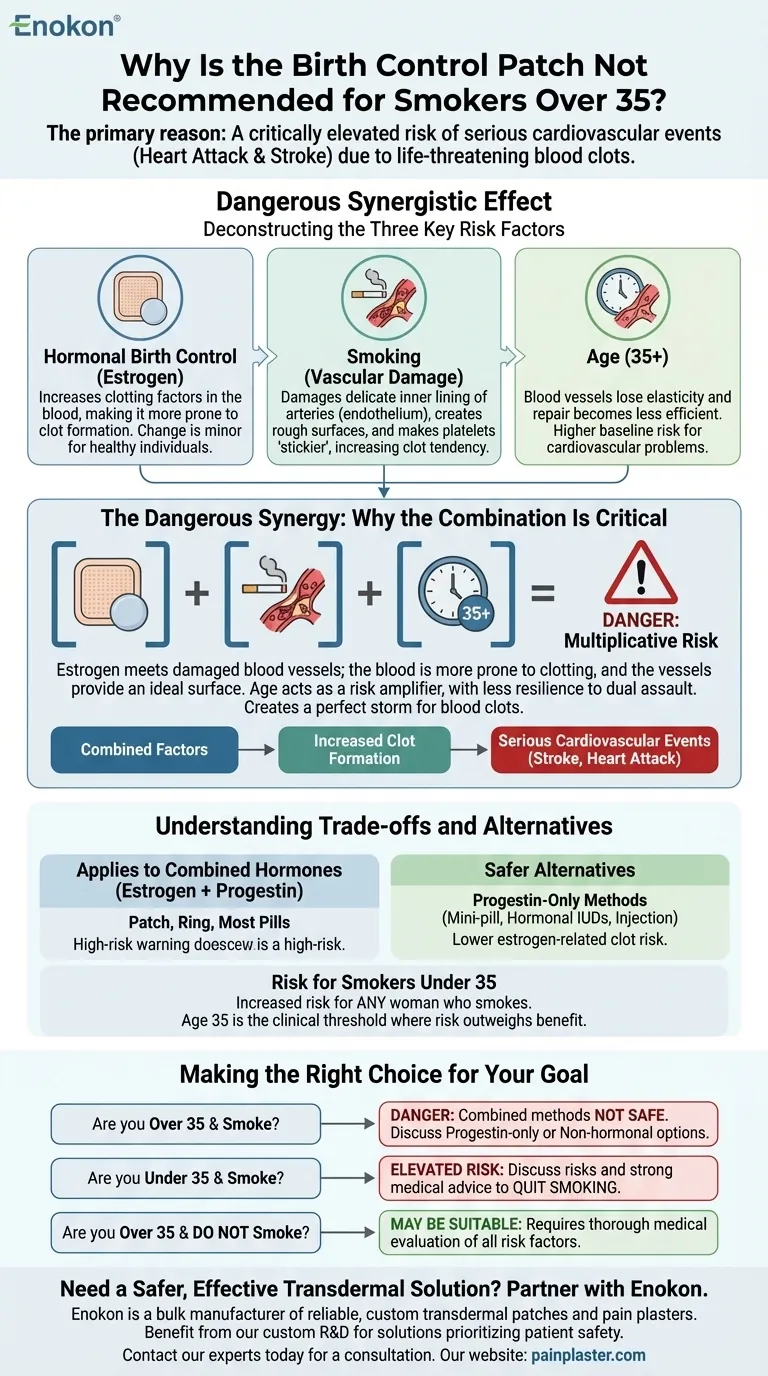
The primary reason the birth control patch is not recommended for women over 35 who smoke is due to a critically elevated risk of serious cardiovascular events. This combination of factors significantly increases the likelihood of developing life-threatening blood clots, which can lead to a heart attack or stroke.
The core issue is not one single factor, but a dangerous synergistic effect. Hormonal birth control, smoking, and age each independently stress the cardiovascular system; when combined, they multiply the risk to a level that is medically unacceptable.

Deconstructing the Three Key Risk Factors
To understand the warning, you must first understand how each component contributes to the overall danger. Each element creates a distinct challenge for your vascular system.
How Hormonal Birth Control Affects the Body
The birth control patch contains the hormone estrogen.
Estrogen, while essential for the contraceptive's function, can slightly alter blood chemistry. It increases the concentration of certain clotting factors, making the blood more prone to forming clots.
For most healthy individuals, this change is minor and poses a very low risk.
The Impact of Smoking on Your Vascular System
Smoking directly attacks the health of your blood vessels.
The chemicals in cigarette smoke damage the delicate inner lining of your arteries, called the endothelium. This damage creates rough surfaces where clots are more likely to form.
Smoking also makes blood platelets "stickier," further increasing the tendency to clot.
The Role of Age in Cardiovascular Health
Age is an independent and non-modifiable risk factor for cardiovascular disease.
After the age of 35, blood vessels naturally begin to lose some of their elasticity. The body's ability to repair vascular damage also becomes less efficient.
This creates a higher baseline risk for cardiovascular problems, even in the absence of other factors.
The Dangerous Synergy: Why the Combination Is Critical
The true danger lies in how these three factors interact and amplify one another. The risk is not additive (1+1+1=3) but multiplicative (1x1x1=DANGER).
Estrogen Meets Damaged Blood Vessels
When the pro-clotting effects of estrogen are introduced into a system with blood vessels already damaged by smoking, the risk of a clot forming is magnified dramatically.
It creates a perfect storm: the blood is more prone to clotting, and the vessels provide an ideal surface for a clot to start.
Age as a Risk Amplifier
The natural, age-related decline in vascular health after 35 means the body has less resilience.
It cannot as easily cope with the dual assault from smoking-induced vessel damage and estrogen-induced clotting tendencies. This makes a serious cardiovascular event, like a stroke or heart attack, far more probable.
Understanding the Trade-offs and Alternatives
This specific warning is not a blanket condemnation of all hormonal birth control but a crucial safety guideline based on a specific risk profile.
This Warning Applies to Combined Hormones
The highest level of risk is associated with methods containing both estrogen and progestin, known as combined hormonal contraceptives. This includes the patch, the ring, and most birth control pills.
Methods that contain only progestin (like the mini-pill, hormonal IUDs, or the contraceptive injection) do not carry the same estrogen-related blood clot risk and are often considered safer alternatives for this group.
The Risk for Smokers Under 35
While the risk is highest for women over 35, any woman who smokes has an increased risk when using combined hormonal birth control.
The age of 35 is used as a clinical threshold where the risk-benefit analysis decisively shifts, making the potential danger outweigh the contraceptive benefit.
The Need for Full Medical Disclosure
It is absolutely vital to be honest with your doctor about your smoking habits, age, and any other health conditions.
Factors like high blood pressure, a history of migraines with aura, or a family history of clotting disorders can also influence which contraceptive methods are safe for you.
Making the Right Choice for Your Goal
Navigating contraceptive options requires a clear understanding of your personal health profile. Your primary goal should be to find a method that is both effective for you and carries the lowest possible risk.
- If you are over 35 and smoke: Combined hormonal methods like the patch are not safe, and you should immediately discuss progestin-only or non-hormonal options with your doctor.
- If you are under 35 and smoke: You must have an open conversation with your provider about the elevated risks of combined methods and the strong medical advice to quit smoking.
- If you are over 35 and do not smoke: The patch may be a suitable option, but only after a thorough medical evaluation of other risk factors like blood pressure, weight, and personal health history.
Understanding these interconnected risks is the first step toward making a safe and informed decision about your health in partnership with your healthcare provider.
Summary Table:
| Risk Factor | Effect on the Body | Combined Impact |
|---|---|---|
| Estrogen (Patch) | Increases clotting factors in the blood. | Creates a perfect storm for clot formation. |
| Smoking | Damages blood vessels, making them rough and sticky. | Multiplies the risk of serious cardiovascular events. |
| Age (35+) | Reduces blood vessel elasticity and repair ability. | Amplifies the body's vulnerability to other risk factors. |
Need a Safer, Effective Transdermal Solution? Partner with Enokon.
If you are a healthcare or pharmaceutical distributor or brand developing products for sensitive patient populations, managing risk is paramount. Enokon is a bulk manufacturer of reliable, custom transdermal patches and pain plasters. Our technical expertise ensures your products are developed with precision, safety, and efficacy in mind.
Benefit from our custom R&D to create solutions that prioritize patient safety. Let's discuss your project requirements.
Contact our experts today for a consultation
Visual Guide
Related Products
- Prostate Pain Kidney Health Care Patch for Men
- Heating Pain Relief Patches for Menstrual Cramps
- Silicone Scar Sheets Patch Transdermal Drug Patch
- Menthol Gel Pain Relief Patch
- Icy Hot Menthol Medicine Pain Relief Patch
People Also Ask
- What are the key components of Chinese herbal pain patches? Discover the Science Behind Natural Pain Relief
- What are Chinese pain patches used for? Natural Relief for Joint & Muscle Pain
- What should be avoided when using Chinese pain patches? Key Safety Tips for Effective Relief
- What are the main benefits of using Chinese pain patches? Holistic Relief for Musculoskeletal Pain
- What role do Chinese pain patches play in arthritis relief? Discover Natural Pain Management Solutions








