The Psychology of a Simple Sticker
Pain management is often a noisy process. It’s the alarm on your phone for the next pill, the glass of water, the worry about an upset stomach. It’s a constant, active negotiation with your own body.
What if relief could be silent?
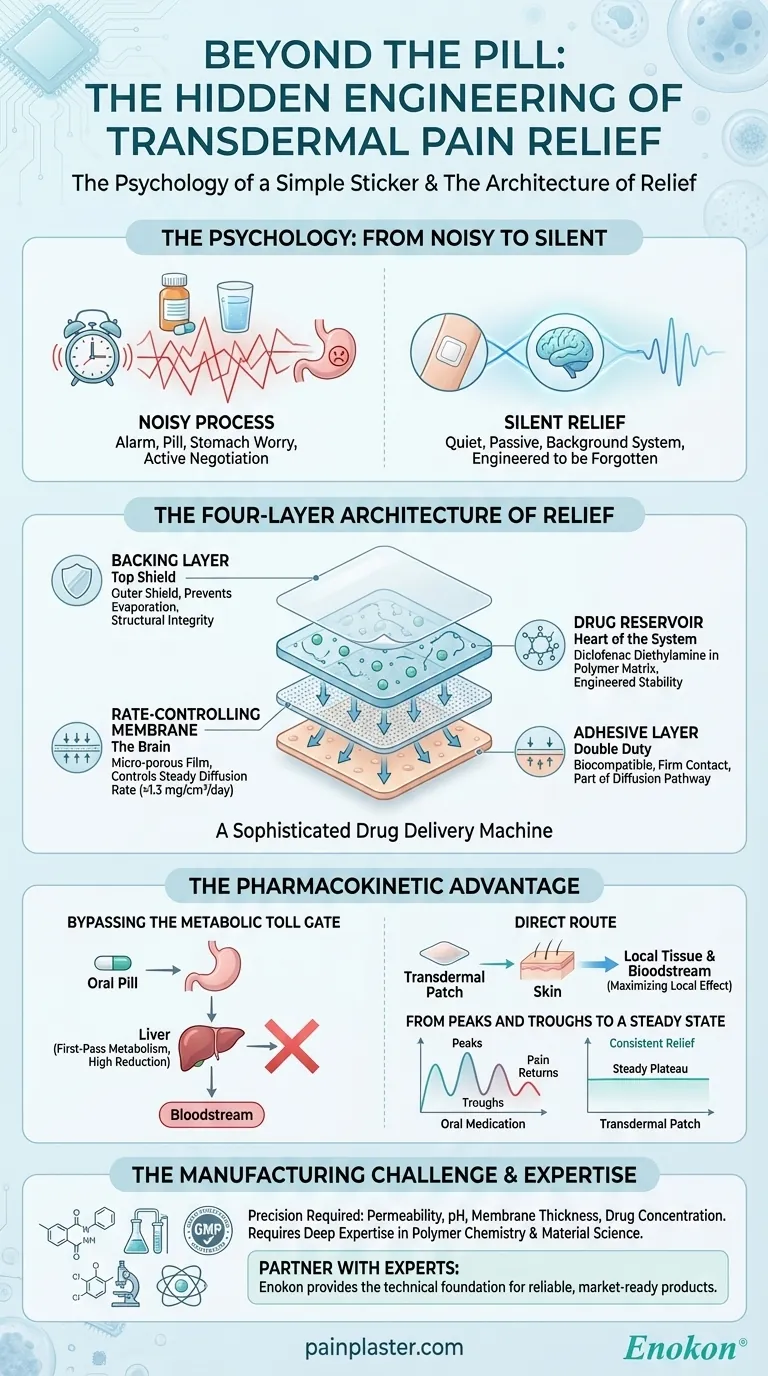
The transdermal patch, specifically one delivering a non-steroidal anti-inflammatory drug (NSAID) like Diclofenac, represents a profound shift in this dynamic. It's not just a different way to take medicine; it's a different psychological experience. It’s a quiet, passive system that works in the background, engineered to be forgotten.
A System, Not Just a Drug
To the user, it’s a simple sticker. To an engineer, it’s a sophisticated, multi-layered drug delivery machine.
The skin’s primary job is to be a barrier. The stratum corneum, its outermost layer, is brilliantly designed to keep things out. A transdermal patch, therefore, isn’t just a carrier for a drug; it is an elegant solution to the complex biological problem of getting a specific molecule past a highly effective security system.
This solution is built on a precise architecture.
The Four-Layer Architecture of Relief
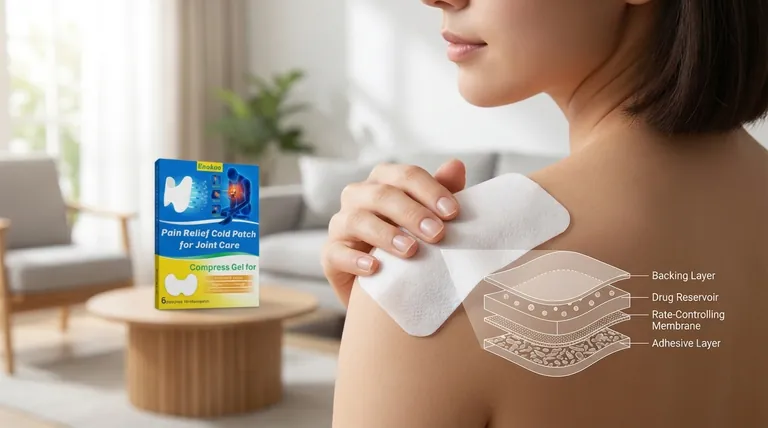
Every effective transdermal patch is a carefully laminated structure, where each layer serves a distinct purpose:
- The Backing Layer: This is the outer shield. Typically a thin polyester or polyethylene film, it prevents the drug from evaporating or leaking, protects the system from the environment, and provides structural integrity.
- The Drug Reservoir: This is the heart of the system. It’s not just a puddle of medicine, but Diclofenac Diethylamine suspended in a polymer matrix. This matrix—often acrylic or silicone-based—holds the drug and is engineered for stability and predictable behavior.
- The Rate-Controlling Membrane: This is the brain. A micro-porous polymeric film that sits between the reservoir and the skin. Its job is to ensure the drug diffuses at a steady, controlled rate (e.g., ≈1.3 mg/cm²/day), preventing initial dose dumping and ensuring consistent relief over 24 hours.
- The Adhesive Layer: This layer does double duty. It must be biocompatible to avoid skin irritation while maintaining firm contact for the entire wear period. Crucially, it's also part of the diffusion pathway, contributing to the controlled release of the drug.
The Pharmacokinetic Advantage: A Gentler Approach
The true genius of this system lies in what it avoids.
Bypassing the Metabolic Toll Gate
When you swallow a pill, the drug travels to the stomach and then the liver. The liver’s "first-pass metabolism" acts like a toll gate, breaking down a significant portion of the drug before it ever reaches the bloodstream. This reduces efficacy and puts a metabolic load on the organ.
The transdermal patch takes a direct route. By diffusing through the skin, the drug enters the local tissue and bloodstream directly, bypassing the liver and maximizing its local effect where the pain is.
From Peaks and Troughs to a Steady State
Oral medication creates peaks and troughs in drug concentration. You feel relief as the level peaks, and the pain returns as it falls, prompting the next dose.
A patch replaces this rollercoaster with a calm, steady plateau. By maintaining stable plasma concentrations, it provides consistent, uninterrupted relief. This stability is not just a clinical benefit; it allows the patient to disengage from the process of pain management.
The Manufacturing Challenge: From Blueprint to Reliable Relief
This elegance is entirely dependent on manufacturing precision.
The choice of the Diethylamine salt form of Diclofenac isn't arbitrary; it's selected to enhance skin permeability. The inclusion of penetration enhancers like propylene glycol is a calculated chemical decision to help guide the drug through the skin's layers. The pH is adjusted to be compatible with the skin.
Each of these variables must be perfectly controlled. A small deviation in the thickness of the rate-controlling membrane or the concentration of the drug in the polymer matrix can render a patch ineffective or unsafe.
For pharmaceutical brands and healthcare distributors, this presents a significant challenge. The design is one thing; reliably producing millions of identical, high-performance patches is another. It requires deep expertise in polymer chemistry, material science, and GMP-certified manufacturing processes. This is where a specialist partner becomes essential. As a bulk manufacturer with extensive R&D capabilities, Enokon provides the technical foundation needed to turn a complex formulation into a reliable, market-ready product that patients can trust.
Ultimately, the transdermal patch is a piece of quiet engineering. It's a testament to the idea that the most sophisticated solutions are often the ones that feel the simplest.
To ensure your brand's pain relief products are built on a foundation of precision and expertise, Contact Our Experts.
Visual Guide
Related Products
- Far Infrared Heat Pain Relief Patches Transdermal Patches
- Icy Hot Menthol Medicine Pain Relief Patch
- Mugwort Wormwood Pain Relief Patch for Neck Pain
- Menthol Gel Pain Relief Patch
- Silicone Scar Sheets Patch Transdermal Drug Patch
Related Articles
- Engineering Certainty: The Invisible Architecture of a Gold-Standard Clinical Trial
- The Silent Workhorse: How Transdermal Patches Rewrote the Rules of Pain Management
- Beyond the Pill: The Silent Engineering of Safer Pain Relief
- Beyond Efficacy: The Psychology of Adherence in Topical Pain Relief
- Beyond the Molecule: The Behavioral Science of the Simple Pain Patch