
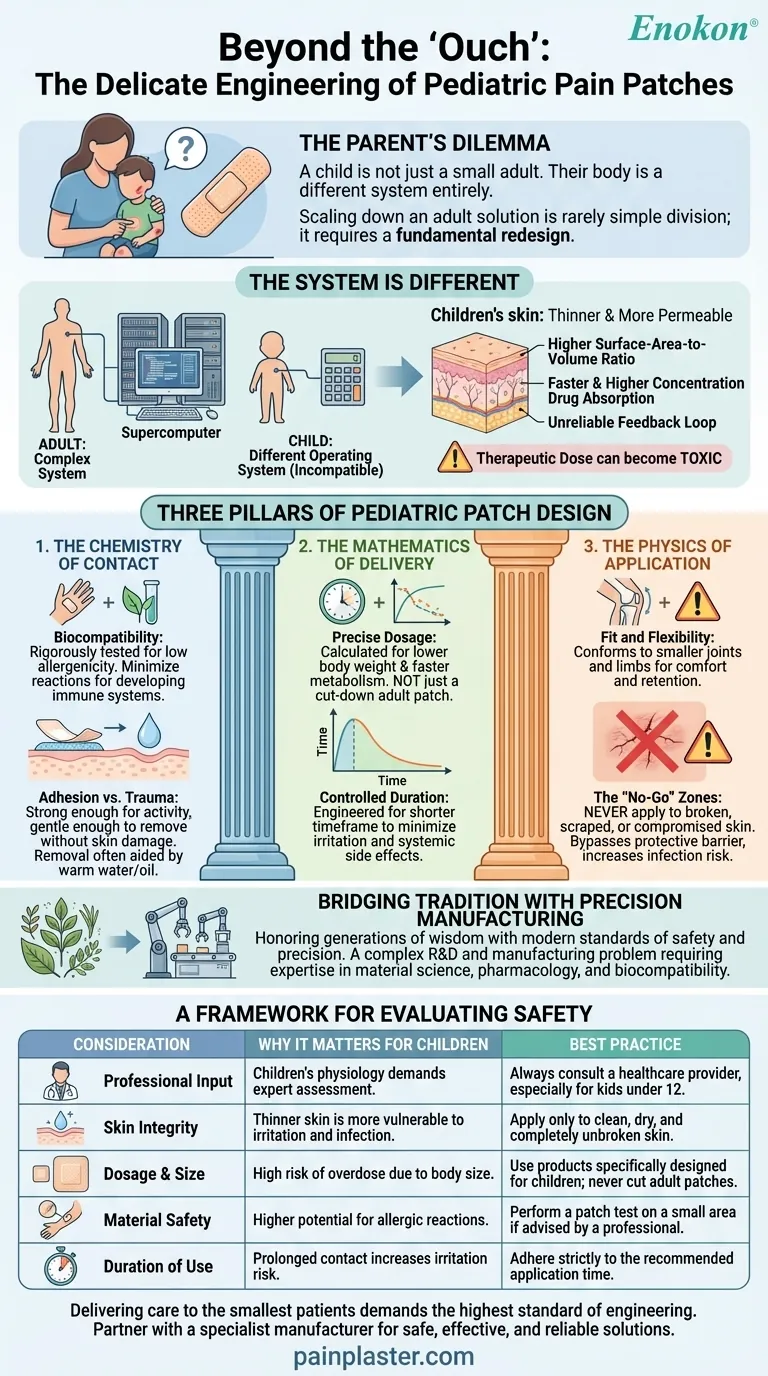
The Parent's Dilemma
A child takes a tumble on the playground. A minor sprain, a swollen ankle. The parent’s instinct is to soothe the pain quickly.
In the medicine cabinet sits a familiar remedy: a pain-relief plaster. It works wonders for adult aches. But as the parent holds it, a moment of hesitation sinks in. A child is not just a small adult. Their body is a different system entirely.
This moment of doubt reveals a deep truth in medicine and engineering: scaling down a solution is rarely a matter of simple division. It requires a fundamental redesign.
The System is Different
Applying an adult transdermal patch to a child is like running software designed for a supercomputer on a simple calculator. The operating systems are incompatible.
Children's skin is thinner and more permeable. Their surface-area-to-volume ratio is significantly higher. This means that a dose delivered through the skin can enter their bloodstream more rapidly and in a higher concentration, turning a therapeutic dose into a toxic one.
The feedback loop is also less reliable. An adult can clearly articulate discomfort or an allergic reaction. A young child may not be able to, making vigilant monitoring essential.
Three Pillars of Pediatric Patch Design
Creating a transdermal patch that is both safe and effective for a child is a sophisticated engineering challenge. It rests on three critical pillars.
1. The Chemistry of Contact
The first challenge is the interface: the point where the patch meets the skin.
- Biocompatibility: Children's developing immune systems are more prone to react to foreign substances. The adhesives and active ingredients in a patch must be rigorously tested for low allergenicity. A mild irritant for an adult can cause significant redness, itching, or even blistering on a child.
- Adhesion vs. Trauma: The adhesive must be strong enough to stay in place on an active child but gentle enough to be removed without tearing their delicate skin. The physics of removal—often aided by warm water or oil—becomes a critical part of the usage instructions.
2. The Mathematics of Delivery
The core function of a transdermal patch is controlled drug delivery. For children, the margin for error is razor-thin.
- Precise Dosage: The patch isn't just a carrier; it's a time-release mechanism. The amount of active ingredient and its rate of absorption must be calculated specifically for a child's lower body weight and faster metabolism. Cutting an adult patch in half is a dangerous guess, not a solution.
- Controlled Duration: Prolonged exposure increases the risk of both skin irritation and systemic side effects. The patch must be engineered to deliver its therapeutic payload within a specific, shorter timeframe suitable for a child.
3. The Physics of Application
A patch is a physical object applied to a dynamic surface. Its design must account for the realities of a child's life.
- Fit and Flexibility: A small, flexible patch that conforms to a child’s smaller joints and limbs is more likely to stay on and remain comfortable.
- The "No-Go" Zones: The most fundamental rule is that patches must never be applied to broken, scraped, or otherwise compromised skin. This creates a direct and uncontrolled pathway for ingredients into the body, bypassing the skin's protective barrier and dramatically increasing the risk of infection.
Bridging Tradition with Precision Manufacturing
Many traditional remedies, like herbal plasters, are based on generations of wisdom. The challenge for modern healthcare is to honor that heritage while meeting today's rigorous standards of safety and precision.
This is not a task for parents to figure out through trial and error. It is a complex R&D and manufacturing problem. It requires expertise in material science, pharmacology, and biocompatibility to create a product that is reliable, safe, and precisely dosed for its intended user.
For healthcare brands and pharmaceutical distributors, the goal is to provide caregivers with solutions that remove the guesswork and the anxiety. This means partnering with manufacturers who understand the delicate engineering required for pediatric applications.
Here is a simple framework for evaluating safety, whether you are a caregiver or a product developer.
| Consideration | Why It Matters for Children | Best Practice |
|---|---|---|
| Professional Input | Children's physiology demands expert assessment. | Always consult a healthcare provider, especially for kids under 12. |
| Skin Integrity | Thinner skin is more vulnerable to irritation and infection. | Apply only to clean, dry, and completely unbroken skin. |
| Dosage & Size | High risk of overdose due to body size. | Use products specifically designed for children; never cut adult patches. |
| Material Safety | Higher potential for allergic reactions. | Perform a patch test on a small area if advised by a professional. |
| Duration of Use | Prolonged contact increases irritation risk. | Adhere strictly to the recommended application time (usually a few hours). |
Delivering care to the smallest patients demands the highest standard of engineering. The peace of mind of a parent and the well-being of a child depend on getting it right. For brands and distributors committed to providing safe, effective, and reliable transdermal solutions, partnering with a specialist manufacturer is the first step. Contact Our Experts
Visual Guide
Related Products
- Silicone Scar Sheets Patch Transdermal Drug Patch
- Far Infrared Heat Pain Relief Patches Transdermal Patches
- Icy Hot Menthol Medicine Pain Relief Patch
- Menthol Gel Pain Relief Patch
- Mugwort Wormwood Pain Relief Patch for Neck Pain
Related Articles
- Beyond the Adhesive: The Unseen Engineering of Safe Transdermal Drug Delivery
- Beyond the Counter: The Hidden Engineering of Trust in Pain Management
- Beyond the Pill: The Silent Engineering of Safer Pain Relief
- The Paradox of the Patch: Deconstructing the Science of Skin-Contact Safety
- The Adhesion Paradox: Engineering Transdermal Patches for Real-World Human Behavior
















