
The Forgotten Ritual of Medication
Consider the daily routine of a patient managing chronic pain. A handful of pills at breakfast, another before bed. Each dose is a physical reminder of their condition, a potential trigger for stomach upset, and a recurring task on a long to-do list.
Forgetting a dose means a potential return of pain. Taking it can mean nausea or other gastrointestinal discomfort. This is the delicate, often frustrating, balance of oral medication.
From a systems perspective, this method is inefficient. It introduces variables—food intake, digestive health, memory—that can compromise the outcome. There is a more elegant solution, one that works silently in the background.
Bypassing the Biological Tollbooth
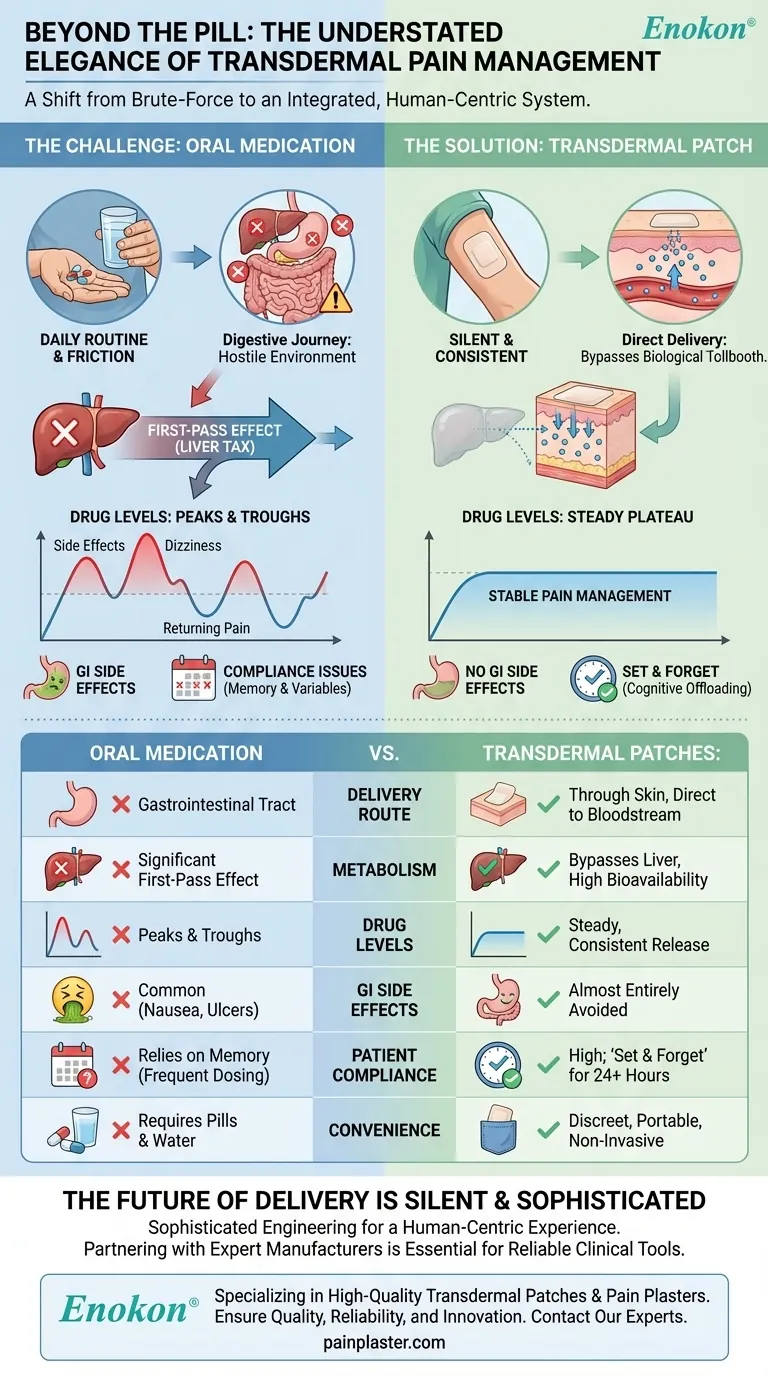
When a drug is swallowed, it begins a perilous journey through the digestive system—a hostile environment of acids and enzymes. The biggest hurdle, however, is the liver.
The First-Pass Effect: A Tax on Efficacy
Before an oral medication can reach the bloodstream to do its job, it must pass through the liver. This "first-pass metabolism" acts like a biological tax, breaking down a significant portion of the active ingredient before it ever has a chance to work. The prescribed dose is often inflated to compensate for this loss.
Transdermal patches bypass this entire process. By delivering medication directly through the skin into the bloodstream, they ensure a much higher percentage of the active drug reaches its target. This isn't just more efficient; it's more precise.
A Truce with the Digestive System
The most immediate benefit for many patients is the avoidance of gastrointestinal side effects. Oral pain relievers are notorious for causing stomach irritation, nausea, and even ulcers. For patients with sensitive stomachs or those on multiple medications, this can be a deal-breaker.
A patch eliminates this direct conflict, delivering relief without waging war on the digestive tract.
The Psychology of Consistency
Human behavior is driven by a desire to reduce friction. The simpler the system, the more likely we are to comply with it.
From Peaks to Plateaus
Oral medications create a "peak and trough" cycle. A spike in drug concentration after the pill is absorbed, followed by a steady decline until the next dose. This rollercoaster can cause a cycle of side effects (like dizziness at the peak) and returning pain (in the trough).
A transdermal patch smooths this curve into a plateau. It releases its payload slowly and consistently over hours or even days. This steady-state delivery provides more stable pain management and minimizes the disruptive side effects of concentration spikes.
The Power of "Set and Forget"
The most effective system is often the one that demands the least from us. The "set it and forget it" nature of a transdermal patch isn't just about convenience; it's about cognitive offloading.
For an elderly patient, a busy professional, or anyone with a complex care regimen, removing the need to remember multiple daily doses is a profound relief. It reduces the mental friction that is a primary cause of non-compliance. Adherence improves not because the patient is more disciplined, but because the system is better designed.
The Engineering of an Elegant Solution
There is an understated elegance to the transdermal patch. It solves a complex pharmacological problem with a solution that is silent, non-invasive, and simple from the patient's perspective. But behind this simplicity lies sophisticated engineering.
This is where the challenge meets manufacturing reality. Creating a patch that adheres comfortably, releases its active ingredient at a precise rate, and is gentle on the skin requires deep expertise in formulation chemistry, materials science, and quality control.
For healthcare brands and distributors, this isn't a minor detail—it's the core of the product's value. Partnering with a specialist manufacturer is essential to turn a promising concept into a reliable clinical tool. As a bulk manufacturer with dedicated R&D capabilities, Enokon specializes in producing high-quality transdermal patches and pain plasters, ensuring that the final product is as reliable and effective as the science behind it.
Oral Medication vs. Transdermal Patches: A Summary
| Feature | Oral Medication | Transdermal Patch |
|---|---|---|
| Delivery Route | Via gastrointestinal tract | Through the skin, directly to the bloodstream |
| Metabolism | Subject to significant first-pass effect in the liver | Bypasses the liver, increasing bioavailability |
| Drug Levels | Creates peaks and troughs | Provides steady, consistent release |
| GI Side Effects | Common (nausea, irritation, ulcers) | Almost entirely avoided |
| Patient Compliance | Relies on memory for frequent dosing | High; "set and forget" for 24+ hours |
| Convenience | Requires carrying pills and water | Discreet, portable, and non-invasive |
The Future of Delivery is Silent
The transdermal patch represents a fundamental shift in how we think about administering medicine. It moves away from the brute-force approach of the pill and toward a more integrated, intelligent, and human-centric system. It acknowledges that the best medical intervention is often the one the patient barely notices.
For healthcare distributors and pharmaceutical brands looking to provide a more effective and patient-friendly solution for pain management, harnessing this elegant technology is the clear path forward. To ensure quality, reliability, and innovation in your product line, Contact Our Experts.
Visual Guide
Related Products
- Far Infrared Heat Pain Relief Patches Transdermal Patches
- Silicone Scar Sheets Patch Transdermal Drug Patch
- Icy Hot Menthol Medicine Pain Relief Patch
- Menthol Gel Pain Relief Patch
- Mugwort Wormwood Pain Relief Patch for Neck Pain
Related Articles
- Engineering Certainty: The Invisible Architecture of a Gold-Standard Clinical Trial
- The Silent Workhorse: How Transdermal Patches Rewrote the Rules of Pain Management
- Beyond the Pill: The Silent Engineering of Safer Pain Relief
- Beyond Efficacy: The Psychology of Adherence in Topical Pain Relief
- Beyond the Molecule: The Behavioral Science of the Simple Pain Patch



















