The Illusion of Simplicity
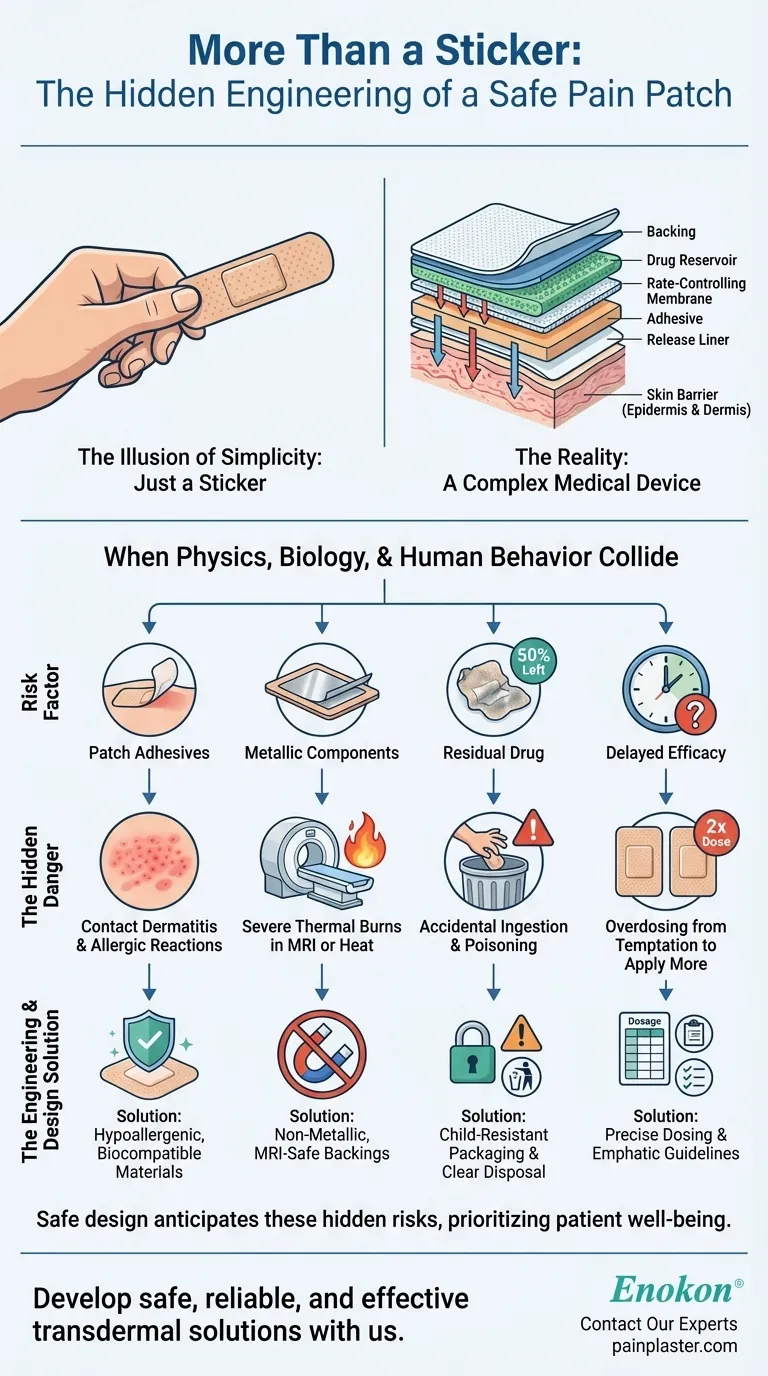
We reach for a pain patch because it feels simple. It’s a sticker. We peel, apply, and expect localized relief without the systemic journey of a pill. It’s a minor marvel of modern medicine, a self-contained drug delivery system that promises convenience.
But this perception of simplicity is a cognitive trap. We treat a transdermal patch like a sophisticated band-aid, forgetting that it is, in fact, a sophisticated medical device. This psychological gap between perception and reality is where most risks are born.
When Physics and Biology Collide
The engineering challenge of a pain patch is immense. It must adhere to skin that flexes, sweats, and sheds. It must deliver a precise dose of an active ingredient through the skin barrier over hours. And it must do all this without causing harm.
When this delicate balance is compromised, the consequences can be severe.
The Adhesive's Dilemma: Stickiness vs. Skin
The first point of contact is the adhesive. Its job is to maintain perfect contact for drug delivery.
- The Problem: An overly aggressive adhesive or reactive ingredients (like menthol or lidocaine) can trigger contact dermatitis, redness, and blistering. This risk is amplified on compromised or broken skin, where the barrier is already weak.
- The Engineering Solution: The goal is not just adhesion, but biocompatibility. This involves selecting hypoallergenic polymers and ensuring the formulation is gentle enough for prolonged contact, a critical consideration for users with sensitive skin or chronic conditions.
The Hidden Conductor: Metallic Backings and Thermal Burns
Some patches contain a thin metallic layer, often aluminum, to control drug release or simply for structural integrity. In most scenarios, this is harmless.
But place that patch near a powerful magnetic field, like in an MRI machine, and the metal can heat up rapidly. The result is a severe thermal burn at the application site. It's a classic case of an unforeseen interaction between a simple product and a complex environment. The same risk exists, to a lesser degree, with prolonged exposure to heating pads or direct sun.
The Reservoir Effect: A Patch's Lingering Danger
A used pain patch is not inert. After hours of use, it can still contain up to 50% of its original active drug payload. It remains a potent pharmacological reservoir.
This creates a serious risk of accidental poisoning. A child might find a discarded patch in the trash and put it in their mouth. A pet might chew on it. The consequences, especially with active ingredients like high-concentration lidocaine, can range from seizures to cardiac arrest.
This isn't a user error; it's a design challenge that demands better disposal instructions and child-resistant packaging.
Designing for Human Behavior
The ultimate test of a medical product is not how it performs in a lab, but how it performs in the chaotic real world, shaped by human psychology.
- The Urge for "More": Pain relief from a patch isn't instantaneous. This time lag can tempt a user, desperate for relief, to apply a second patch, unwittingly doubling the dose.
- The Vulnerable User: The skin of an elderly person is thinner and more fragile. A patient with eczema has a compromised skin barrier. In both cases, drug absorption can be faster and less predictable, increasing the risk of systemic toxicity.
A truly safe product anticipates these behaviors and conditions.
| Risk Factor | The Hidden Danger | The Engineering & Design Solution |
|---|---|---|
| Patch Adhesives | Contact dermatitis, allergic reactions. | Use of hypoallergenic, biocompatible materials. |
| Metallic Components | Severe thermal burns during MRI scans or heat exposure. | Formulations with non-metallic backings. |
| Residual Drug | Accidental ingestion and poisoning, especially in children. | Clear disposal instructions & child-resistant packaging. |
| Delayed Efficacy | User temptation to over-apply, leading to overdose. | Precise dosing and clear, emphatic usage guidelines. |
A pain patch is a testament to engineering where pharmacology, material science, and human psychology must seamlessly intersect. Creating a product that is both effective and safe requires a deep commitment to anticipating and designing around these hidden risks. It means choosing non-metallic materials, formulating with hypoallergenic adhesives, and ensuring every aspect of the patch, from its construction to its packaging, prioritizes patient safety above all else.
At Enokon, we build patches for healthcare brands and distributors with this philosophy at our core. We address these systemic risks at the development stage, manufacturing reliable, non-metallic, and hypoallergenic patches that you can trust.
If you're looking to develop a transdermal solution that puts safety and efficacy first, Contact Our Experts.
Visual Guide
Related Products
- Far Infrared Pain Patch Relief Pain Reliever for Back
- Far Infrared Knee Pain Patch Heat Patches for Pain Relief
- Mugwort Wormwood Pain Relief Patch for Neck Pain
- Icy Hot Menthol Medicine Pain Relief Patch
- Far Infrared Deep Heat Relief Patches Medicated Pain Relief Patches
Related Articles
- Beyond Efficacy: The Psychology of Adherence in Topical Pain Relief
- The Architecture of Relief: Deconstructing the Modern Pain Patch
- The Unseen Calculus of a Simple Pain Patch
- Beyond the Molecule: The Behavioral Science of the Simple Pain Patch
- Beyond Pain Relief: The Compounding Returns of Restored Mobility



















