
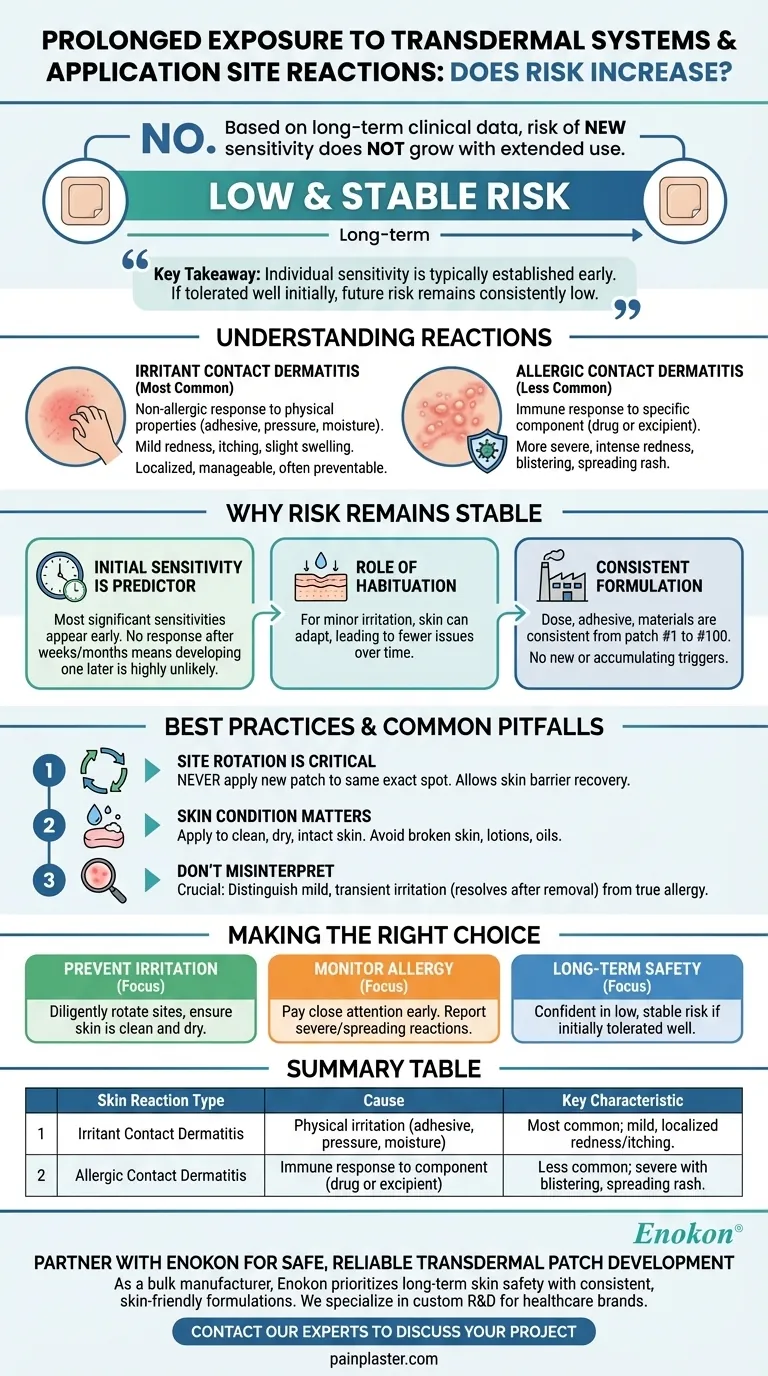
Based on long-term clinical data, prolonged exposure to transdermal systems does not increase the incidence or frequency of application site reactions. While some individuals may experience a reaction, the risk of developing a new sensitivity does not grow simply because you have been using the system for an extended period.
The key takeaway is that an individual's sensitivity to a transdermal patch is typically established early on. If you tolerate a system well in the initial weeks or months, studies show your risk of a future reaction remains consistently low over the long term.

Understanding Application Site Reactions
To understand why long-term risk doesn't increase, it's important to first distinguish between the different types of skin reactions that can occur. These reactions are almost always localized to the patch area.
Irritant Contact Dermatitis
This is the most common type of reaction. It's a non-allergic response caused by the physical properties of the patch, such as the adhesive, pressure, or moisture being trapped against the skin.
Symptoms are typically mild and may include redness, itching, or slight swelling directly under the patch. This type of reaction is manageable and often preventable.
Allergic Contact Dermatitis
This is a true allergic reaction and is far less common. It is an immune system response to a specific component in the patch, which could be the drug itself but is more often an adhesive or another inactive ingredient (excipient).
Symptoms of an allergic reaction are often more severe, potentially including intense redness, blistering, and a rash that can spread beyond the patch's borders.
Why the Risk Remains Stable Over Time
The finding that reaction rates do not increase is based on how our skin adapts and how these products are designed. The initial period of use is the most predictive of long-term success.
Initial Sensitivity is the Key Predictor
Most significant sensitivities, especially true allergies, will become apparent relatively early in the course of treatment. The body's immune system typically declares its response within the first several exposures.
If a user shows no allergic tendency after weeks or months, developing one years later is highly unlikely, as the exposure itself is not changing.
The Role of Habituation
For minor irritant reactions, the skin can sometimes become habituated or accustomed to the presence of the patch. The barrier function of the skin in that area may adapt, leading to fewer issues over time, not more.
Consistent Product Formulation
Transdermal systems are manufactured with a high degree of consistency. The dose, adhesive compounds, and other materials you are exposed to with patch #1 are the same as with patch #100, meaning there is no new or accumulating trigger over time.
Best Practices and Common Pitfalls
While the long-term risk of developing a new reaction is low, managing the skin to prevent common irritation is critical for comfort and adherence to therapy.
The Critical Importance of Site Rotation
The single most effective strategy for preventing irritation is site rotation. Never apply a new patch to the same exact spot as the previous one.
Following the manufacturer's instructions for rotating application sites allows the skin barrier in each area to fully recover, which significantly minimizes the risk of cumulative irritation.
Skin Condition Matters
Always apply a patch to clean, dry, and intact skin. Applying a patch over broken skin, lotions, or oils can increase the likelihood of a reaction and may affect drug absorption.
Misinterpreting Irritation as Allergy
It's crucial not to mistake mild, transient redness from irritation for a true allergy. Mild irritation often resolves on its own after the patch is removed and the site is rotated. A true allergy is a reason to consult your physician about discontinuing the specific system.
Making the Right Choice for Your Goal
Your approach to using a transdermal system should be guided by careful observation and proper skin care from the very beginning.
- If your primary focus is preventing irritation: Be diligent about rotating application sites and ensuring skin is clean and completely dry before applying a new patch.
- If your primary focus is monitoring for allergy: Pay close attention to your skin during the first few weeks of therapy. Report any severe, spreading, or blistering reactions to your healthcare provider immediately.
- If your primary focus is long-term safety: You can be confident that if you tolerate the patch well initially, the data shows your risk of developing a new skin reaction later on does not increase.
Ultimately, successful long-term use of a transdermal system is overwhelmingly likely for those who do not show sensitivity early in their treatment.
Summary Table:
| Skin Reaction Type | Cause | Key Characteristic |
|---|---|---|
| Irritant Contact Dermatitis | Physical irritation from adhesive, pressure, or moisture. | Most common; mild, localized redness/itching. |
| Allergic Contact Dermatitis | Immune response to a patch component (drug or excipient). | Less common; can be severe with blistering, spreading rash. |
Partner with Enokon for Safe, Reliable Transdermal Patch Development
As a bulk manufacturer of high-quality transdermal patches and pain plasters, Enokon understands that long-term skin safety is paramount for patient adherence and product success. Our technical expertise ensures your patches are designed with consistent, skin-friendly formulations from the start.
We specialize in custom R&D and development for healthcare and pharmaceutical distributors and brands. Let us help you create a product that patients can trust for the long term.
Contact our experts today to discuss your custom transdermal patch project.
Visual Guide
Related Products
- Far Infrared Heat Pain Relief Patches Transdermal Patches
- Silicone Scar Sheets Patch Transdermal Drug Patch
- Icy Hot Menthol Medicine Pain Relief Patch
- Menthol Gel Pain Relief Patch
- Mugwort Wormwood Pain Relief Patch for Neck Pain
People Also Ask
- Why is the selection of matrix materials critical when developing customized transdermal patches? Optimize Efficacy
- What are the physical impacts of external heat exposure on the performance and safety of transdermal patches? - Guide
- What are the clinical advantages of local transdermal delivery systems? Unlock Safer, More Effective Pain Relief Solutions
- What role does a skin tolerance scoring system play in the safety evaluation of transdermal patches? Key Safety Metrics
- How does high-purity far-infrared ceramic powder contribute to the efficacy of far-infrared physical therapy patches?



















