
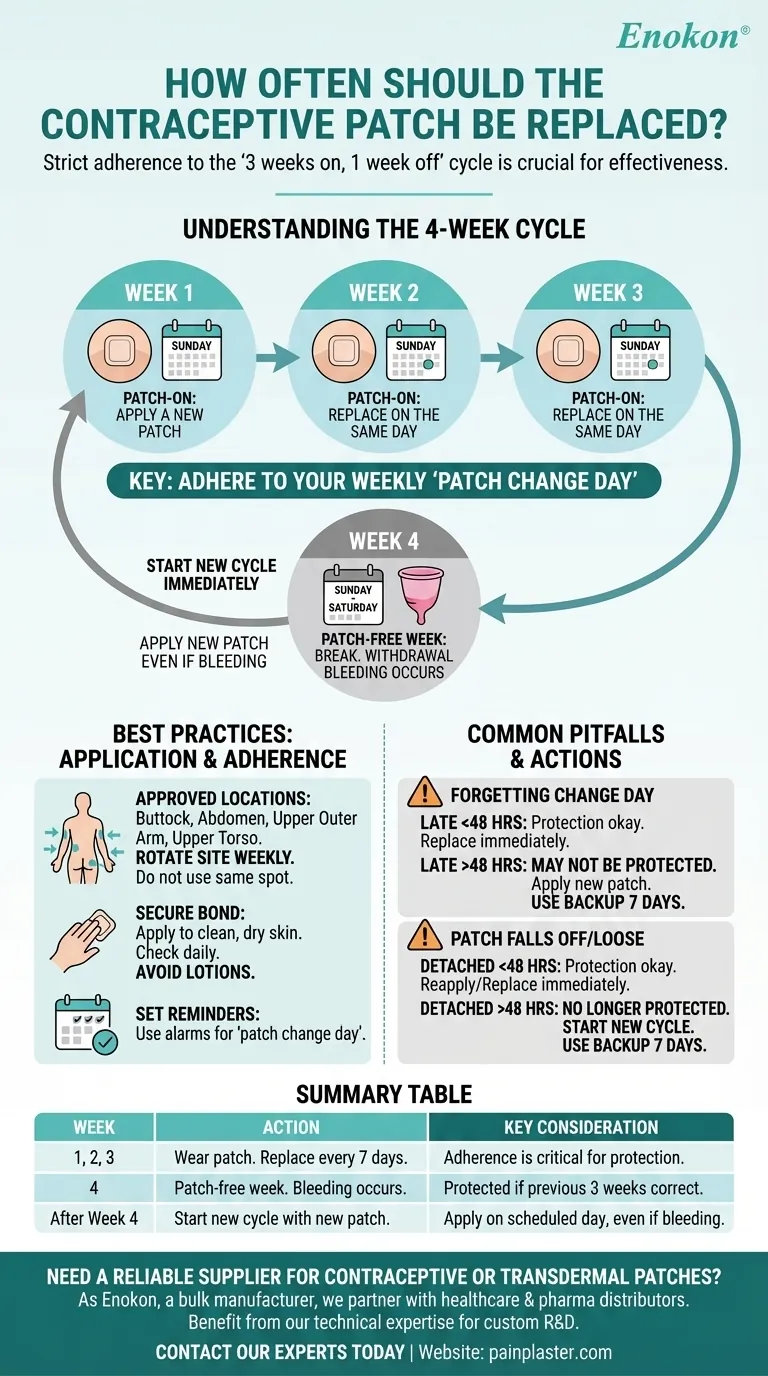
To ensure continuous protection, the contraceptive patch must be worn for exactly seven days and replaced with a new one on the same day each week. This weekly schedule is maintained for three consecutive weeks, followed by a seven-day "patch-free" week, during which a menstrual period typically occurs.
The contraceptive patch operates on a simple but strict "3 weeks on, 1 week off" cycle. Adhering to your designated weekly "patch change day" is the single most critical factor for ensuring its effectiveness as a birth control method.
Understanding the 4-Week Cycle
The patch's design is based on a 28-day (4-week) schedule that aligns with a typical menstrual cycle. Correctly following this rhythm is essential for preventing pregnancy.
Week 1, 2, and 3: The "Patch-On" Weeks
For the first three weeks of your cycle, you will wear a patch. You will apply a new patch on the same designated day each week.
For example, if you apply your first patch on a Sunday, you will replace it the following Sunday, and again on the Sunday after that.
Week 4: The "Patch-Free" Week
The fourth week is a break from the patch. You do not wear a patch during these seven days.
This patch-free interval allows for withdrawal bleeding, which is similar to a menstrual period. You are still protected from pregnancy during this week as long as you have used the patch correctly for the previous three weeks.
Starting the Next Cycle
A new 4-week cycle begins immediately after your patch-free week ends. You must apply a new patch on your designated "patch change day," even if you are still bleeding.
Delaying the start of a new patch can significantly reduce its effectiveness and increase your risk of pregnancy.
Best Practices for Application and Adherence
Where and how you apply the patch is just as important as when you apply it. Proper application ensures the hormones are absorbed correctly and the patch stays in place.
Choosing and Rotating the Location
The patch should be applied to clean, dry, and intact skin on the buttock, abdomen, upper outer arm, or upper torso. Never apply it to your breasts or to skin that is red, irritated, or cut.
To prevent skin irritation, you must rotate the application site each week. Do not apply a new patch to the exact same spot of skin you used for the previous patch.
Ensuring a Secure Bond
Check your patch daily to make sure it is sticking securely, especially around the edges. Avoid using lotions, creams, or oils on the skin where you plan to apply the patch, as this can prevent it from adhering properly.
Common Pitfalls to Avoid
Mistakes can happen, but understanding how to react is key to maintaining protection.
Forgetting Your "Patch Change Day"
Forgetting to change your patch on time is a common issue. If you are late changing your patch by less than 48 hours, your contraceptive protection is usually not affected.
If it has been more than 48 hours since your scheduled change, you may not be protected from pregnancy. You should apply a new patch immediately and use a backup method of birth control (like condoms) for the next seven days.
If a Patch Becomes Loose or Falls Off
Similarly, if a patch falls off or is loose for less than 48 hours, you can reapply it or replace it with a new one immediately without needing backup contraception.
If it has been detached for more than 48 hours, you are no longer protected. You must start a new 4-week cycle with a new patch and use a backup birth control method for the first week.
Making the Right Choice for Your Goal
- If your primary focus is maximum effectiveness: Set a recurring weekly alarm or calendar reminder for your "patch change day" to ensure you never miss it.
- If your primary focus is avoiding skin irritation: Always rotate your patch location between the four approved areas and never use the exact same spot two weeks in a row.
- If you are ever unsure after a mistake: Immediately consult your patient information leaflet or contact your doctor or pharmacist for precise instructions on how to proceed.
Consistently following this simple weekly routine is the most important factor in making the contraceptive patch a reliable and effective birth control method.
Summary Table:
| Week | Action | Key Consideration |
|---|---|---|
| 1, 2, 3 | Wear a patch. Replace every 7 days on the same day. | Adherence to the schedule is critical for protection. |
| 4 | Patch-free week. Withdrawal bleeding occurs. | You are still protected if the previous 3 weeks were correct. |
| After Week 4 | Start a new cycle with a new patch. | Apply on your scheduled day, even if bleeding continues. |
Need a reliable supplier for contraceptive or other transdermal patches?
As Enokon, a bulk manufacturer of reliable transdermal patches and pain plasters, we partner with healthcare and pharma distributors and brands. Benefit from our technical expertise for custom R&D and development to create high-quality, effective products your customers can trust.
Contact our experts today to discuss your manufacturing needs.
Visual Guide
Related Products
- Heating Pain Relief Patches for Menstrual Cramps
- Prostate Pain Kidney Health Care Patch for Men
- Silicone Scar Sheets Patch Transdermal Drug Patch
- Lidocaine Hydrogel Pain Relief Patch for Pain Relief
- Menthol Gel Pain Relief Patch
People Also Ask
- What are the benefits of Period Pain Heat Patches? Drug-Free, On-the-Go Relief
- What are the key benefits of heating patches for elderly individuals? Relieve Pain & Improve Mobility
- What are the different types of heat patches? Find the Right Pain Relief for Your Needs
- What are the key differences between conventional heat patches and deep heat devices? Choosing the Right Pain Relief Solution
- What percentage of people with back pain use heat patches for relief? Discover the Popular Choice for Pain Management













