
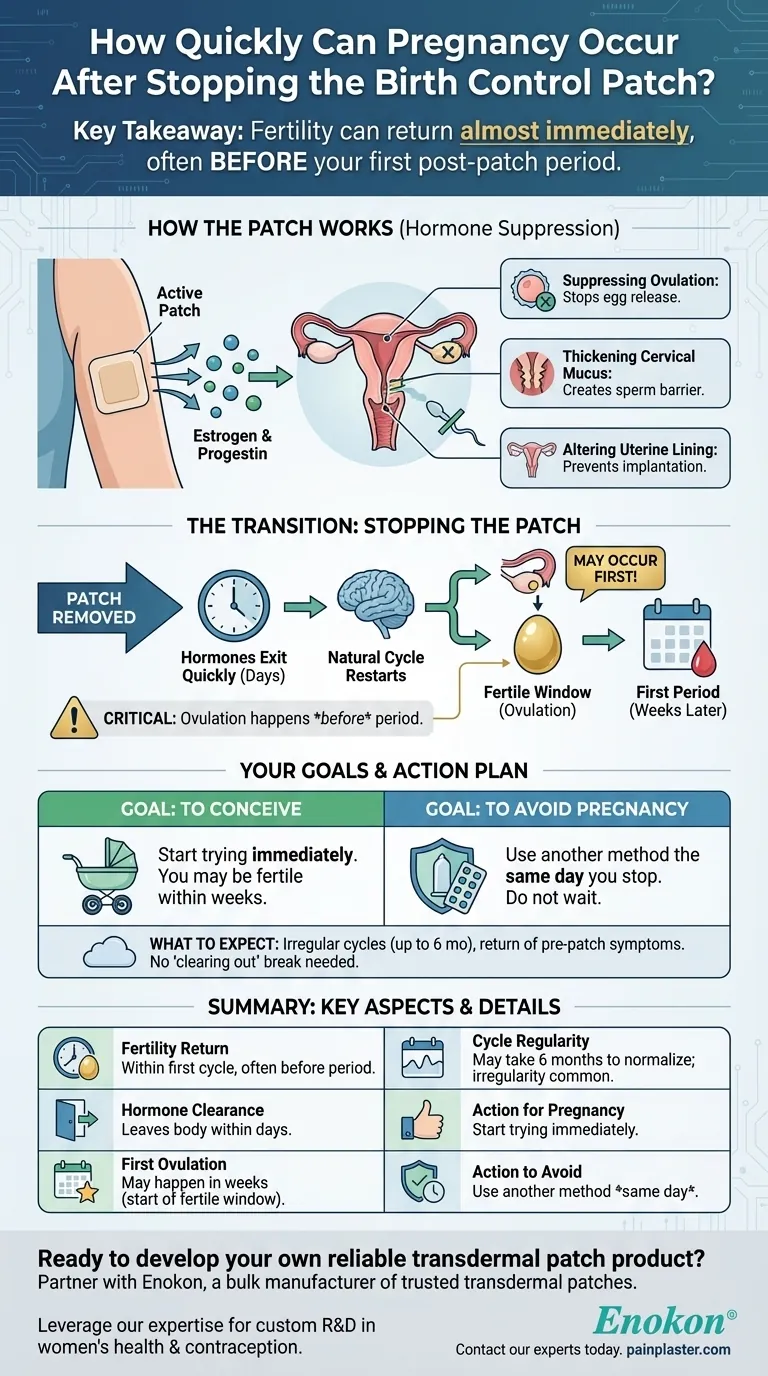
You can become pregnant almost immediately after you stop using the birth control patch. The hormones that prevent pregnancy leave your system very quickly, allowing your natural fertility to return, often before you even have your first regular period.
The critical takeaway is that your fertility can return within the first cycle after removing the patch. Do not wait for your period to normalize before using another contraceptive if you want to avoid pregnancy.

How the Patch Works to Prevent Pregnancy
To understand why fertility returns so quickly, it's important to first understand how the patch works. It releases a steady dose of two hormones—estrogen and progestin—that prevent pregnancy in three distinct ways.
Suppressing Ovulation
The primary function of these hormones is to stop your ovaries from releasing an egg each month. Without an egg, fertilization is impossible.
Thickening Cervical Mucus
The hormones also cause the mucus around your cervix to thicken. This creates a physical barrier that makes it difficult for sperm to travel into the uterus to reach an egg, if one were released.
Altering the Uterine Lining
As a final backup, the hormones can change the lining of your uterus (the endometrium). This makes it less receptive to a fertilized egg, preventing it from implanting and developing.
What Happens When You Stop Using the Patch
Once you stop applying a new patch, the synthetic hormones are no longer being supplied to your body. Your system immediately begins to return to its natural state.
Hormones Exit Quickly
The hormones from the patch do not build up in your system over the long term. They are processed and cleared from your body within days, which is why the patch must be replaced weekly to remain effective.
Your Natural Cycle Restarts
With the synthetic hormones gone, your brain begins signaling your ovaries to restart their normal function. This process of preparing and releasing an egg (ovulation) can begin very soon.
Fertility Returns Before Your First Period
This is the most crucial concept to understand. Ovulation occurs before your period. You can become pregnant during this first ovulation window, which may happen weeks before you experience your first post-patch menstrual bleed.
Common Pitfalls and What to Expect
Transitioning off the patch is straightforward, but it helps to be aware of how your body may adjust.
Irregular Cycles are Common
While many people resume a normal cycle within one or two months, it can sometimes take up to six months for your periods to become regular. This is more common if your cycles were irregular before you started using the patch.
Pre-Patch Symptoms May Return
The patch often helps regulate periods and can improve issues like acne. When you stop using it, you may notice a return to your body's "pre-patch" state, which could include heavier periods or skin breakouts.
The Myth of "Clearing Out"
There is no medical need to take a "break" from the patch to let hormones "clear out" before trying to conceive. Your fertility is ready as soon as your natural cycle resumes.
Making the Right Choice for Your Goal
Your next step depends entirely on your personal goal for stopping the patch.
- If your primary focus is to become pregnant: You can begin trying to conceive immediately, as you may be fertile within the first few weeks after stopping.
- If your primary focus is to avoid pregnancy: You must have another birth control method ready to use the very same day you discontinue the patch.
Understanding that your fertility returns immediately is the key to successfully managing your transition off the birth control patch.
Summary Table:
| Key Aspect | Details |
|---|---|
| Fertility Return | Can occur within the first cycle, often before your first period. |
| Hormone Clearance | Synthetic hormones leave the body within days of patch removal. |
| First Ovulation | May happen within weeks, marking the start of your fertile window. |
| Cycle Regularity | Periods may take up to 6 months to normalize; irregularity is common. |
| Action for Pregnancy | You can start trying to conceive immediately after stopping. |
| Action to Avoid Pregnancy | Use another contraceptive method the same day you stop the patch. |
Ready to develop your own reliable transdermal patch product?
As Enokon, a bulk manufacturer of trusted transadermal patches and pain plasters, we partner with healthcare and pharmaceutical distributors and brands. If you are planning a product line in women's health, contraception, or hormone therapy, leverage our technical expertise for custom R&D and development. We ensure high-quality, consistent delivery systems for your specific needs.
Contact our experts today to discuss your project and how we can bring your transdermal product to market efficiently.
Visual Guide
Related Products
- Prostate Pain Kidney Health Care Patch for Men
- Heating Pain Relief Patches for Menstrual Cramps
- Silicone Scar Sheets Patch Transdermal Drug Patch
- Menthol Gel Pain Relief Patch
- Icy Hot Menthol Medicine Pain Relief Patch
People Also Ask
- What are the key components of Chinese herbal pain patches? Discover the Science Behind Natural Pain Relief
- What role do Chinese pain patches play in arthritis relief? Discover Natural Pain Management Solutions
- What should be avoided when using Chinese pain patches? Key Safety Tips for Effective Relief
- What are Chinese pain patches used for? Natural Relief for Joint & Muscle Pain
- What are some popular Chinese pain patches and their uses? Discover Top Herbal Solutions for Pain Relief








