
In short, you can get pregnant almost immediately after you stop using the birth control patch. Your body’s fertility can return very quickly, often before your menstrual cycle has returned to a predictable pattern. For this reason, you should consider yourself fertile as soon as you remove your last patch.
The most critical thing to understand is that the return of your fertility and the return of your regular period are two different events. Fertility can return almost instantly, while your cycle may take one to two months, or even longer, to become regular again.
How Your Body Readjusts After the Patch
The birth control patch works by releasing a steady dose of hormones (estrogen and progestin) that primarily prevent your ovaries from releasing an egg, a process known as ovulation. When you stop using it, this external hormone supply is cut off, allowing your natural cycle to restart.
The Immediate Return of Fertility
Once you remove the last patch and the synthetic hormones begin to clear from your system, your body can signal the start of a new cycle. This means your brain can start the process that leads to ovulation.
This restart can happen very quickly. It is entirely possible to ovulate and become pregnant within the first few weeks after stopping the patch.
The Lag in Your Menstrual Cycle
While fertility returns rapidly, it may take your body some time to re-establish a regular, predictable menstrual cycle.
Most people find their period returns to its normal pattern within one or two cycles. However, it's not uncommon to experience irregular periods—or no period at all—for up to six months, especially if your cycles were irregular before you started using the patch.
Other Changes to Expect
As your body transitions back to its natural hormonal state, you might notice other changes. Periods may become heavier or less regular than they were on the patch, and conditions like acne, which may have been controlled by the hormones, might reappear.
The Critical Misconception to Avoid
The most common and significant mistake is assuming you are not fertile until your period becomes regular. This belief can easily lead to an unintended pregnancy.
Ovulation Always Precedes a Period
Your menstrual period occurs roughly two weeks after you ovulate (if the egg is not fertilized).
Therefore, by the time you get your first natural period after stopping the patch, you have already been fertile for about two weeks. You can get pregnant during that very first cycle.
Irregular Cycles Do Not Equal Infertility
An irregular bleeding pattern simply means the timing of your ovulation is unpredictable. It does not mean you aren't ovulating. You can still conceive even if your cycles are not yet following a consistent monthly schedule.
Making the Right Choice for Your Goal
Your next steps depend entirely on your personal reproductive goals.
- If your primary focus is to become pregnant: You can start trying to conceive immediately. It can be helpful to begin tracking your cycle with ovulation predictor kits to identify your fertile window, as your first few cycles may be unpredictable.
- If your primary focus is to avoid pregnancy: You must start using another form of birth control the very same day you stop using the patch. Do not wait for your period to return, as you could become pregnant during this gap.
Understanding that your body is ready to conceive right away empowers you to confidently plan your next steps.
Summary Table:
| Event After Stopping Patch | Typical Timeline | Key Takeaway |
|---|---|---|
| Return of Fertility (Ovulation) | Within the first few weeks | Pregnancy is possible immediately. Do not wait for a regular period. |
| Return of First Natural Period | 1-2 cycles (can take longer) | Your period returns after you have already ovulated. |
| Cycle Regularity | 1-6 months to re-establish | Irregular cycles do not mean you are infertile. |
Ready to Confidently Manage Your Reproductive Health?
If you are a healthcare distributor or brand looking for reliable, high-quality transdermal solutions, partner with Enokon.
As a bulk manufacturer of transdermal patches and pain plasters, we combine technical expertise with custom R&D to develop products that meet your specific needs. Whether you're expanding your product line or developing a new solution, our team is here to support you from concept to delivery.
Let's discuss how we can help you bring effective, trusted products to market.
Contact our experts today to explore partnership opportunities.
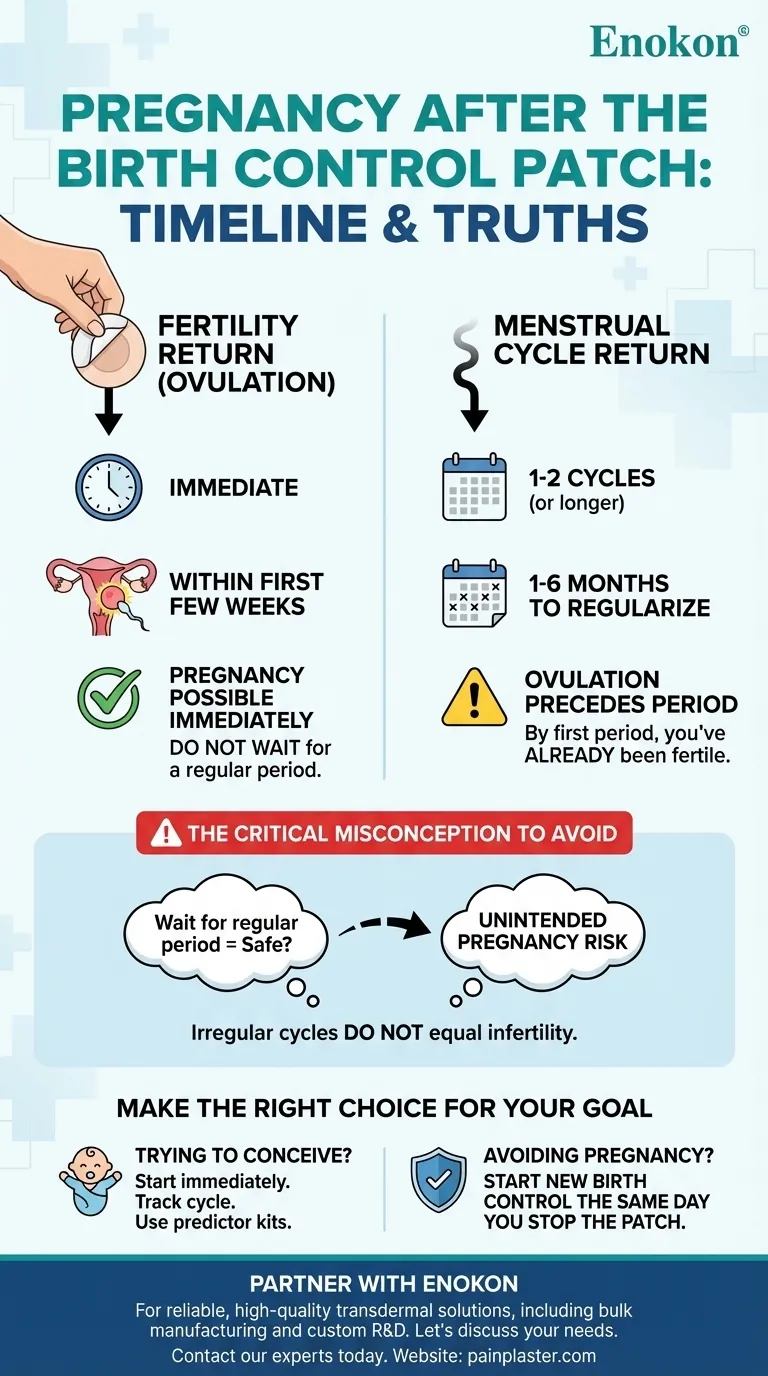
Visual Guide
Related Products
- Prostate Pain Kidney Health Care Patch for Men
- Heating Pain Relief Patches for Menstrual Cramps
- Silicone Scar Sheets Patch Transdermal Drug Patch
- Menthol Gel Pain Relief Patch
- Icy Hot Menthol Medicine Pain Relief Patch
People Also Ask
- What are the key components of Chinese herbal pain patches? Discover the Science Behind Natural Pain Relief
- How can Chinese pain patches help with back pain? Natural Relief & Healing Benefits
- What complementary practices enhance the effectiveness of Chinese pain patches? Boost Relief with Holistic Care
- What are the main benefits of using Chinese pain patches? Holistic Relief for Musculoskeletal Pain
- What are some popular Chinese pain patches and their uses? Discover Top Herbal Solutions for Pain Relief








