
The short answer is there are many different generic transdermal medications, not just one. For example, clonidine is available as an extended-release transdermal film in strengths like 0.1 mg/24 hr, while methylphenidate comes as a transdermal system (patch) in strengths like 10 mg/9 hr. The generic name identifies the active drug, and the dosage form describes how it is delivered through the skin.
The critical insight is that transdermal medication labels are not just about the total amount of a drug; they describe the rate of delivery over a specific time. Understanding this distinction is key to interpreting their dosage form and strength correctly.
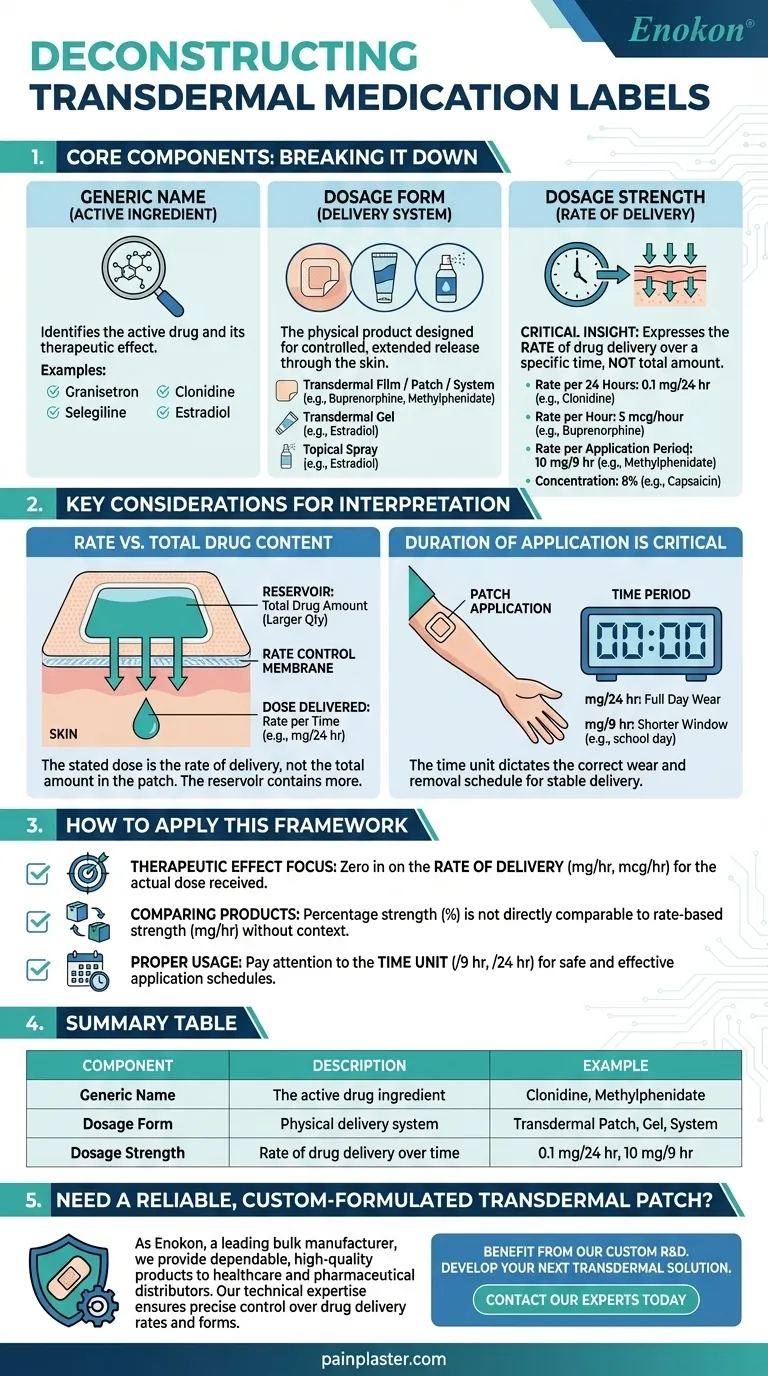
Deconstructing Transdermal Medication Labels
To fully grasp what a transdermal medication is, we need to break down its three core components: the generic name, the dosage form, and the dosage strength.
The Generic Name: The Active Ingredient
The generic name simply identifies the active drug in the medication. This is the chemical that produces the therapeutic effect.
Examples from your references include granisetron, selegiline, clonidine, and estradiol.
Common Dosage Forms: How the Drug is Delivered
The dosage form describes the physical product that delivers the drug through the skin. While there are several types, they are all designed for controlled, extended release.
- Transdermal Film / Patch / System: These terms are often used interchangeably. They refer to an adhesive patch that sticks to the skin and releases a pre-set amount of medication over many hours. Examples include buprenorphine patches and methylphenidate transdermal systems.
- Transdermal Gel: This is a topical gel that is applied to the skin. The drug is absorbed over time. Estradiol is available in this form.
- Topical Spray: A less common form where the medication is sprayed onto the skin for absorption, such as with certain estradiol products.
Decoding Dosage Strengths: The Rate of Delivery
This is the most critical and often misunderstood part of the label. The strength of a transdermal product is usually expressed as a rate, not a total amount.
- Rate per 24 Hours (mg/24 hr): This is very common and indicates the milligrams of drug delivered over a full day. Clonidine (0.1 mg/24 hr) is a clear example.
- Rate per Hour (mcg/hour): Used for more potent drugs measured in micrograms. Buprenorphine (5 mcg/hour) follows this convention.
- Rate per Application Period (mg/9 hr): Some patches are not meant to be worn for a full day. Methylphenidate (10 mg/9 hr) is designed to deliver its dose over a 9-hour period.
- Concentration (%): For gels and some patches, the strength is given as a percentage of the active ingredient. Capsaicin patches (8%) and estradiol gels (0.06%) use this format.
Understanding the Key Considerations
Choosing or interpreting a transdermal medication involves understanding nuances that go beyond the basic label.
Rate of Release vs. Total Drug Content
A common point of confusion is thinking the dosage strength is the total amount of drug in the patch. This is incorrect.
A transdermal patch contains a much larger total amount of the drug in its reservoir than what is listed as the dose. The dose (e.g., 0.1 mg/24 hr) only refers to the rate at which the drug is designed to pass through your skin and into your bloodstream.
Duration of Application is Critical
The time period specified in the dosage is not arbitrary. It dictates how long the patch will deliver the medication at a stable rate.
A patch labeled "mg/24 hr" is designed for a full day's wear, while one labeled "mg/9 hr" is specifically intended for a shorter application to match a therapeutic window, like the school or work day.
Why Form Factor Matters
The choice between a patch, gel, or spray is a clinical decision based on the drug's properties and the patient's needs.
Patches offer unparalleled convenience and steady-state delivery, but may cause skin irritation. Gels can offer more dosing flexibility but require precise application and can be messy.
How to Apply This to Your Prescription
When looking at a transdermal medication, use this framework to understand exactly what it does.
- If your primary focus is the therapeutic effect: Zero in on the rate of delivery (e.g.,
mg/24 hrormcg/hour), as this tells you the actual dose your body is receiving over time. - If you are comparing different products: Be aware that a percentage-based strength (like a gel) is not directly comparable to a rate-based strength (like a patch) without further clinical context.
- If your goal is proper usage: Pay close attention to the time unit (
/9 hr,/24 hr, etc.), as this dictates the correct application and removal schedule for safety and efficacy.
Ultimately, understanding how to read the label is the first step in using these advanced medications safely and effectively.
Summary Table:
| Component | Description | Example |
|---|---|---|
| Generic Name | The active drug ingredient | Clonidine, Methylphenidate |
| Dosage Form | Physical delivery system | Transdermal Patch, Gel, System |
| Dosage Strength | Rate of drug delivery over time | 0.1 mg/24 hr, 10 mg/9 hr |
Need a reliable, custom-formulated transdermal patch?
As Enokon, a leading bulk manufacturer of transdermal patches and pain plasters, we provide healthcare and pharmaceutical distributors with dependable, high-quality products. Our technical expertise ensures precise control over drug delivery rates and dosage forms, tailored to your specific therapeutic needs.
Benefit from our custom R&D to develop your next transdermal solution. Contact our experts today to discuss your project.
Visual Guide
Related Products
- Silicone Scar Sheets Patch Transdermal Drug Patch
- Far Infrared Heat Pain Relief Patches Transdermal Patches
- Menthol Gel Pain Relief Patch
- Icy Hot Menthol Medicine Pain Relief Patch
- Mugwort Wormwood Pain Relief Patch for Neck Pain
People Also Ask
- What role does a silicone-based transdermal delivery system play in Parkinson's? Enhancing Early-Stage Patient Care
- How is the long-term skin tolerance of silicone-based transdermal patches evaluated in clinical settings? R&D and Safety
- Why is a polarizing microscope used to evaluate the long-term stability of transdermal drug patches? Ensure Efficacy.
- What are common adverse effects of transdermal drug delivery? Risks & Prevention Tips
- What are the advantages of transdermal drug patches? Optimize Medication Delivery with Patches










