
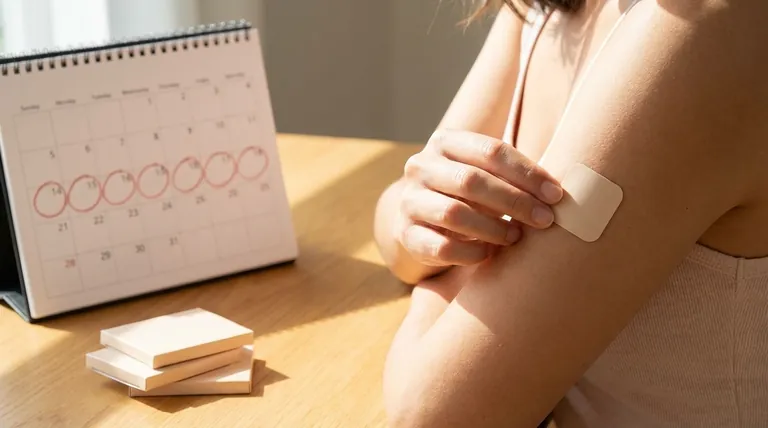
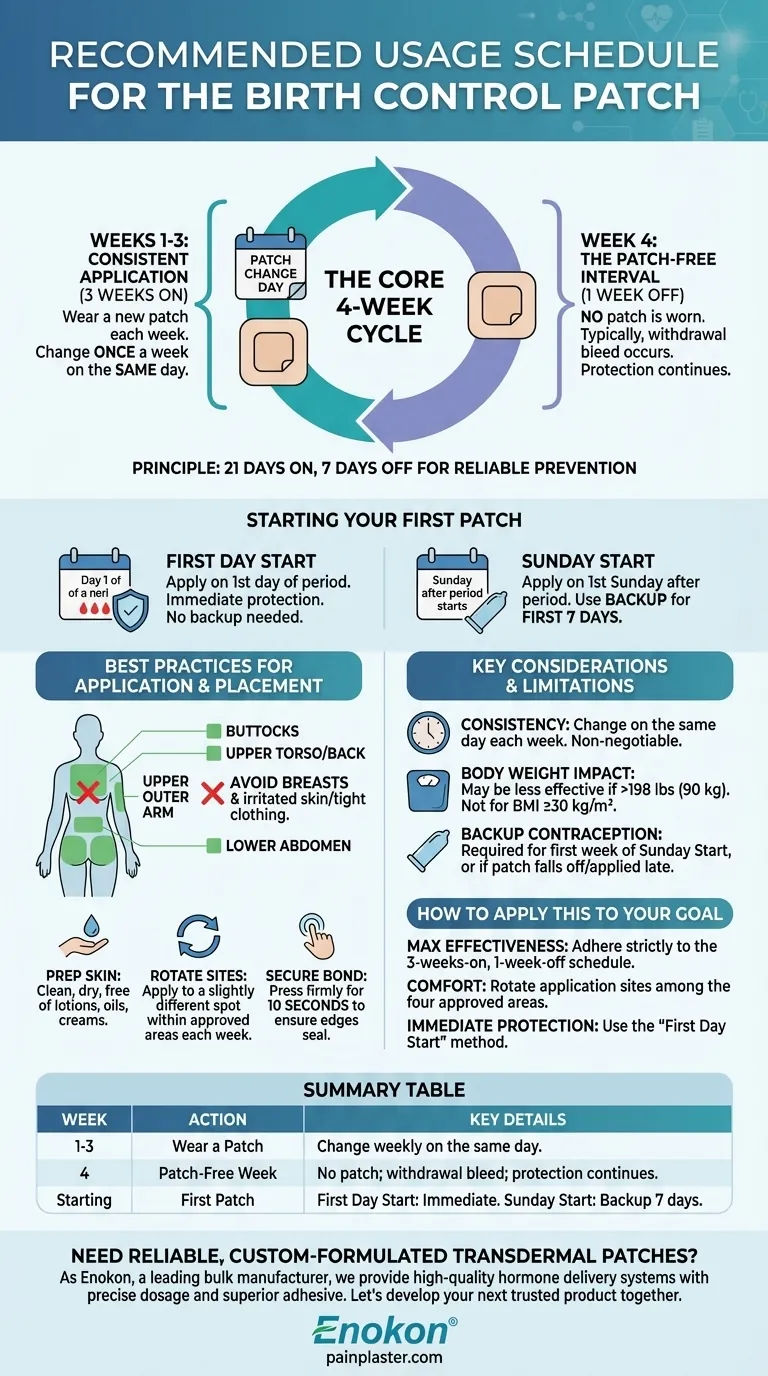
The standard birth control patch schedule is designed around a four-week (28-day) cycle. You will wear a new patch each week for three consecutive weeks, followed by one week where you do not wear a patch at all. This patch-free week is when you will typically have your withdrawal bleed, or period.
The effectiveness of the birth control patch hinges on a simple but strict principle: maintaining a consistent cycle of 21 days with the patch on, followed by 7 days with the patch off. This regular schedule is what ensures reliable pregnancy prevention.
The Core 4-Week Cycle Explained
Understanding the rhythm of the patch schedule is the first step to using it correctly. The entire system is built to mimic a natural hormonal cycle while preventing ovulation.
Weeks 1-3: Consistent Application
For the first three weeks of your cycle, you will wear a hormonal patch. You must change this patch once a week, on the same designated day.
For example, if you apply your first patch on a Sunday, that becomes your "Patch Change Day." You will remove the old patch and apply a new one every Sunday for three straight weeks.
Week 4: The Patch-Free Interval
The fourth week is your patch-free week. You do not wear a patch during these seven days.
This break in hormone delivery allows for a withdrawal bleed, which is similar to a period. You are still protected from pregnancy during this week, provided you have used the patch correctly for the preceding three weeks and start your next patch on time.
Starting Your First Patch
There are two primary methods for starting the patch, which affects when you are first protected.
A "First Day Start" means you apply your very first patch on the first day of your menstrual period. This method provides immediate contraceptive protection, and no backup method is needed.
A "Sunday Start" means you apply your first patch on the first Sunday after your period begins. If you choose this method, you must use a backup form of birth control (like a condom) for the first 7 days.
Best Practices for Application and Placement
How and where you apply the patch is just as important as when you apply it. Proper application ensures the hormones are absorbed correctly into your body.
Preparing the Skin
The patch must be applied to skin that is clean, dry, and free of any lotions, oils, or creams. These substances can interfere with the adhesive and prevent the patch from sticking securely.
Choosing the Right Location
You can apply the patch to your buttocks, upper outer arm, lower abdomen, or upper torso/back.
It is critical to avoid placing the patch on your breasts. You should also avoid areas where the skin is irritated or where tight clothing might rub against the patch.
Rotating Application Sites
To prevent potential skin irritation, it's recommended to apply each new patch to a slightly different spot within an approved area. For example, if you used the right buttock one week, use the left one the next.
Ensuring a Secure Bond
After applying a new patch, press down firmly on it with the palm of your hand for at least 10 seconds. This ensures the edges are sealed and the patch is securely attached to your skin.
Understanding Key Considerations and Limitations
While convenient, the patch's effectiveness depends on correct use and an awareness of its limitations.
The Importance of Consistency
Changing your patch on the same day each week is non-negotiable. This consistency maintains the stable level of hormones in your bloodstream required to prevent pregnancy.
Impact of Body Weight
The patch may be less effective for certain individuals. The references indicate it may not be as effective in women who weigh more than 198 lbs (90 kg) and should not be used by those with a BMI of 30 kg/m2 or more.
The Need for Backup Contraception
Remember, backup contraception is required for the first week of use if you opt for a "Sunday Start." Always consult your healthcare provider about when backup methods may be necessary, such as if a patch falls off or is applied late.
How to Apply This to Your Goal
Your primary goal will determine your most important focus when using the birth control patch.
- If your primary focus is maximum effectiveness: The single most important action is to establish a "Patch Change Day" and adhere to the 3-weeks-on, 1-week-off schedule without fail.
- If your primary focus is comfort and avoiding skin irritation: Your priority should be to rotate the application site each week among the four approved body areas.
- If your primary focus is ensuring immediate protection from day one: You must use the "First Day Start" method by applying your very first patch on the first day of your menstrual period.
Correct and consistent use is the foundation of the patch's reliability as a contraceptive method.
Summary Table:
| Week | Action | Key Details |
|---|---|---|
| 1-3 | Wear a Patch | Change the patch once a week on the same day. |
| 4 | Patch-Free Week | No patch is worn; withdrawal bleed occurs. Protection continues. |
| Starting | First Patch | First Day Start: Immediate protection. Sunday Start: Use backup for 7 days. |
Need reliable, custom-formulated transdermal patches?
As Enokon, a leading bulk manufacturer of medical patches, we provide pharmaceutical distributors and brands with high-quality, consistent hormone delivery systems. Our technical expertise ensures your product meets the highest standards for adhesive performance and precise dosage.
Let's develop your next trusted product together. Contact our experts today to discuss custom R&D and manufacturing solutions.
Visual Guide
Related Products
- Prostate Pain Kidney Health Care Patch for Men
- Heating Pain Relief Patches for Menstrual Cramps
- Silicone Scar Sheets Patch Transdermal Drug Patch
- Menthol Gel Pain Relief Patch
- Icy Hot Menthol Medicine Pain Relief Patch
People Also Ask
- What are the key components of Chinese herbal pain patches? Discover the Science Behind Natural Pain Relief
- What are Chinese pain patches used for? Natural Relief for Joint & Muscle Pain
- What complementary practices enhance the effectiveness of Chinese pain patches? Boost Relief with Holistic Care
- What are the main benefits of using Chinese pain patches? Holistic Relief for Musculoskeletal Pain
- Are there any side effects associated with Chinese pain patches? Risks & Safety Tips








