
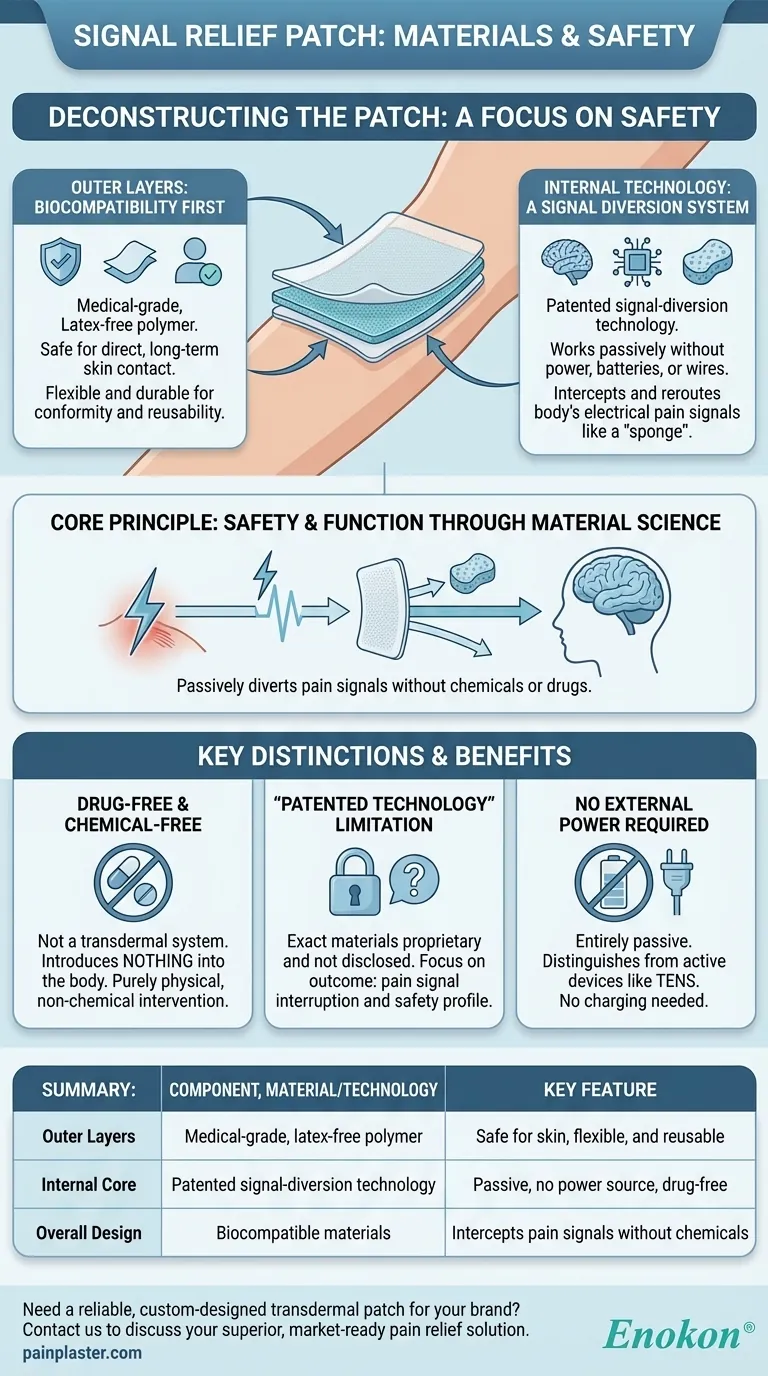
The Signal Relief Patch is constructed from two primary components: outer layers made of a flexible, medical-grade, latex-free material designed for skin contact, and an internal core containing the patented technology that interacts with the body's electrical signals. This design ensures that nothing is introduced into the body, making it a drug-free and chemical-free approach to pain management.
The core principle of the Signal Relief Patch is safety and function through material science. It uses biocompatible external materials for comfort and reusability, while its undisclosed internal technology works passively to divert pain signals without chemicals or drugs.
Deconstructing the Patch: A Focus on Safety
Understanding the materials is key to understanding how the patch works and why it is considered safe for repeated use. The design focuses on interacting with the body's systems from the outside, rather than altering them from the inside.
The Outer Layers: Biocompatibility First
The top and bottom layers of the patch are made from a medical-grade material. This designation means it's designed to be safe for direct, long-term contact with skin.
Critically, this material is also latex-free, which eliminates the risk of allergic reactions for a significant portion of the population.
The material is also chosen for its flexibility and durability, allowing the patch to conform to different body parts and withstand repeated applications, supporting its reusable nature.
The Internal Technology: A Signal Diversion System
The core of the patch contains a patented technology that functions without any power source, batteries, or wires. Its purpose is to interact with the body's natural electrical field.
When you experience pain, your body sends electrical signals from the source of the discomfort to your brain. This technology is designed to intercept and reroute these signals.
The references describe this process as absorbing the pain signals "like a sponge," effectively interrupting the message before it is fully registered by the brain.
Understanding the Key Distinctions
The material composition directly informs the patch's primary benefits and sets it apart from other pain relief methods. Acknowledging its limitations is also crucial for an objective assessment.
Drug-Free and Chemical-Free by Design
The patch is not a transdermal system. Unlike patches that deliver medication or substances through the skin, Signal Relief introduces nothing into the body.
Its effect is based entirely on the passive rerouting of existing electrical pain signals, making it a purely physical, non-chemical intervention.
The 'Patented Technology' Limitation
While the function of the internal technology is described, the exact materials and composition are proprietary and not publicly disclosed. This is common for patented inventions.
This means users must trust the device's described mechanism of action—signal diversion—rather than an ingredient list. The focus is on the outcome (pain signal interruption) and the stated safety profile (no chemicals, no drugs).
No External Power Required
The materials used do not require charging or batteries. This distinguishes the patch from devices like TENS (Transcutaneous Electrical Nerve Stimulation) units, which actively introduce an electrical current into the body. The Signal Relief patch is entirely passive.
How to Apply This to Your Goal
Your primary motivation for investigating the patch's materials will determine how you interpret this information.
- If your primary focus is avoiding drugs and chemicals: The patch is explicitly designed for this, relying on inert external materials and a non-chemical internal mechanism.
- If your primary focus is skin safety and allergies: The use of a medical-grade, latex-free material directly addresses common concerns about skin compatibility.
- If your primary focus is reusability and convenience: The durable materials are built for long-term use without the need for batteries, wires, or power sources.
Ultimately, the Signal Relief patch is designed as a physical tool that works with your body's electrical system, not a chemical one.
Summary Table:
| Component | Material / Technology | Key Feature |
|---|---|---|
| Outer Layers | Medical-grade, latex-free polymer | Safe for skin, flexible, and reusable |
| Internal Core | Patented signal-diversion technology | Passive, no power source, drug-free |
| Overall Design | Biocompatible materials | Intercepts pain signals without chemicals |
Need a reliable, custom-designed transdermal patch for your brand?
As Enokon, a bulk manufacturer of reliable transdermal patches and pain plasters for healthcare and pharmaceutical distributors and brands, we understand the critical importance of material science and safety. Our technical expertise in custom R&D and development ensures your product meets the highest standards for efficacy and user comfort.
Contact us today to discuss how we can help you develop a superior, market-ready pain relief solution.
Visual Guide
Related Products
- Far Infrared Deep Heat Relief Patches Medicated Pain Relief Patches
- Far Infrared Heat Pain Relief Patches Transdermal Patches
- Far Infrared Pain Patch Relief Pain Reliever for Back
- Far Infrared Knee Pain Patch Heat Patches for Pain Relief
- Natural Herbal Patch for Motion Sickness and Car Sickness Relief
People Also Ask
- How do Deep Heat Pain Relief Patches provide pain relief? Discover the Drug-Free Mechanism
- How effective are pain relief patches for muscle pain? Target Localized Pain with Transdermal Delivery
- What are pain relief patches and how are they used? A Guide to Safe, Targeted Relief
- When should you consider using pain relief products like creams and patches? Optimize Comfort & Safety
- What is the purpose of pain relief patches? Get Targeted Relief with Fewer Side Effects



















