
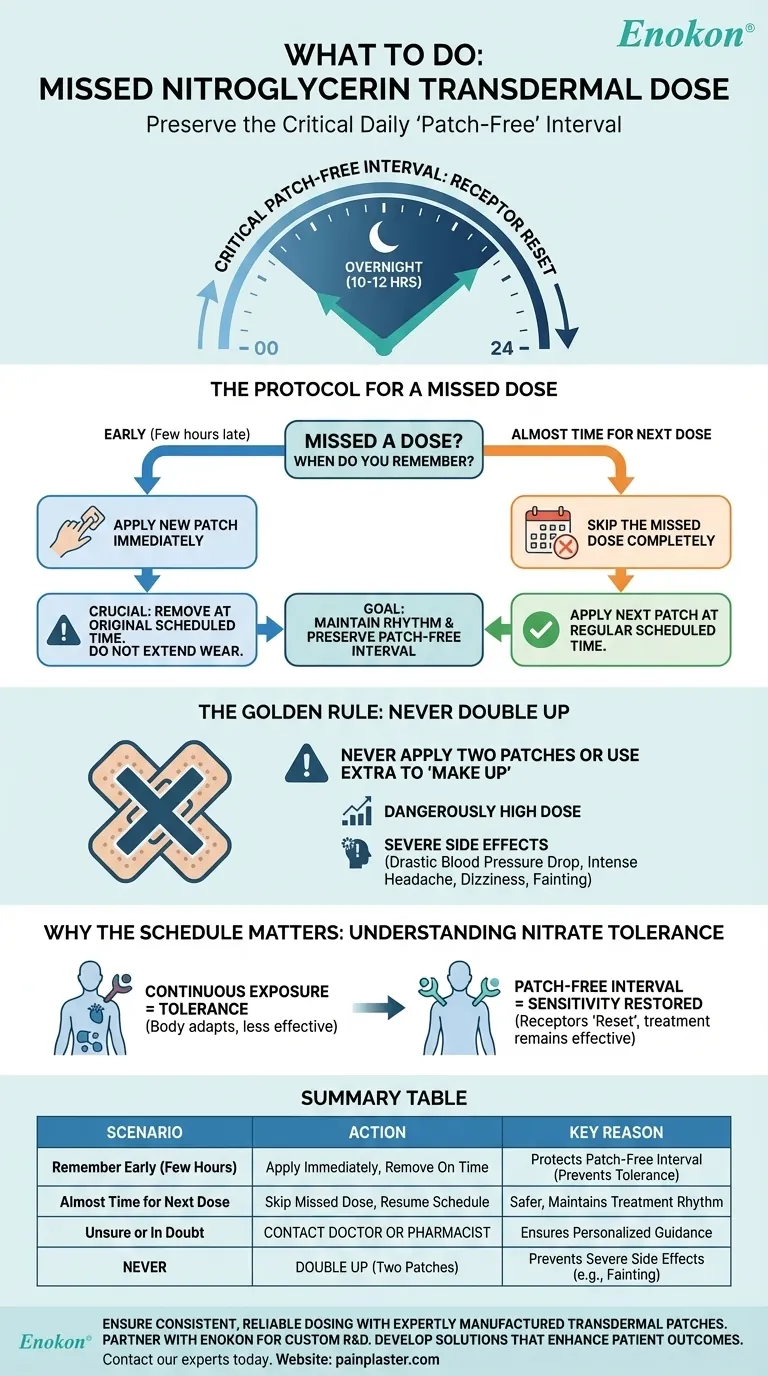
In the event of a missed nitroglycerin transdermal patch, the correct action depends on timing. If you remember relatively soon after the missed application, apply a new patch immediately but maintain your original removal schedule. However, if it is almost time for your next scheduled dose, you should skip the missed dose entirely and simply continue with your regular schedule.
The primary goal when managing a missed dose is not just to replace the medication, but to preserve the crucial daily "patch-free" interval. This period is essential for preventing your body from developing a tolerance, which would render the medication ineffective.

The Protocol for a Missed Dose
Navigating a missed dose is straightforward if you understand the underlying principle. The key is to get back on your regular schedule as safely as possible without compromising the medication's long-term effectiveness.
If You Remember Early
If you remember the missed dose within a few hours of the scheduled application time, apply a new patch as soon as possible.
Crucially, you must still remove this patch at your regularly scheduled removal time. Do not wear it for extra hours to "make up" for the late start.
If It's Almost Time for the Next Dose
If a significant portion of the day has passed and it is nearly time for your next scheduled application, skip the missed dose completely.
Do not apply a patch late in the day. Simply wait and apply your next patch at the correct, scheduled time. This is the safer and more effective option in this scenario.
The Golden Rule: Never Double Up
Under no circumstances should you ever apply two patches or use an extra patch to compensate for a missed dose.
Doing so can deliver a dangerously high amount of medication, leading to severe side effects such as a drastic drop in blood pressure, intense headaches, dizziness, and fainting.
Why the Schedule Matters: Understanding Nitrate Tolerance
The rigid schedule for nitroglycerin patches is not arbitrary. It is a deliberate medical strategy designed to overcome a specific biological challenge: nitrate tolerance.
What Is Nitrate Tolerance?
When your body is continuously exposed to nitroglycerin, it begins to adapt and becomes less responsive to the drug's effects.
This is called tolerance. Over time, the same dose will fail to provide the necessary protection against angina (chest pain), making the treatment ineffective.
The Critical Role of the "Patch-Free" Interval
To combat tolerance, treatment with nitroglycerin patches requires a daily "patch-free" period, typically lasting 10 to 12 hours (often overnight).
This break allows your body's receptors to "reset," restoring their sensitivity to the medication. Without this interval, the therapeutic benefit of the patch would quickly diminish.
How This Affects a Missed Dose
Maintaining this patch-free interval is more important than ensuring the patch is worn for its full 12-14 hour duration.
Applying a patch too late and leaving it on longer would shorten your patch-free period, directly increasing your risk of developing nitrate tolerance. Skipping the dose is preferable to disrupting this essential cycle.
Making the Right Choice for Your Treatment
Adhering to your nitroglycerin patch schedule is key to managing your condition effectively. Consistency protects you from both immediate risks and the long-term risk of treatment failure.
- If you remember within a few hours of your missed application: Apply the patch, but be sure to remove it at the original, scheduled time to protect your patch-free interval.
- If it is almost time for your next scheduled patch: Skip the missed dose entirely and apply your next patch at the regular time to maintain the treatment's rhythm and prevent tolerance.
- If you are ever in doubt: The safest course of action is to contact your doctor or pharmacist for personalized advice.
Ultimately, consistent and correct application is what ensures your medication continues to work for you as intended.
Summary Table:
| Scenario | Action | Key Reason |
|---|---|---|
| Remember within a few hours | Apply new patch immediately. Remove at original scheduled time. | Protects the critical daily "patch-free" interval to prevent tolerance. |
| Almost time for next dose | Skip the missed dose. Apply next patch at the regular time. | Safer than applying late; maintains the treatment schedule. |
| Unsure or in doubt | Contact your doctor or pharmacist for advice. | Ensures personalized guidance for your specific situation. |
| Never | Apply two patches to "make up" for a missed dose. | Prevents a dangerously high dose and severe side effects like fainting. |
Ensure Consistent, Reliable Dosing with Expertly Manufactured Transdermal Patches
For healthcare distributors and pharmaceutical brands, patient adherence and safety are paramount. A missed dose protocol is only effective if the transdermal patch itself delivers medication reliably and consistently.
Partner with Enokon, a bulk manufacturer of reliable transdermal patches and pain plasters. Benefit from our technical expertise for custom R&D and development to create patches that support precise dosing schedules and patient compliance.
Let's develop a solution that enhances patient outcomes. Contact our experts today to discuss your transdermal patch needs.
Visual Guide
Related Products
- Icy Hot Menthol Medicine Pain Relief Patch
- Menthol Gel Pain Relief Patch
- Far Infrared Heat Pain Relief Patches Transdermal Patches
- Silicone Scar Sheets Patch Transdermal Drug Patch
- Mugwort Wormwood Pain Relief Patch for Neck Pain
People Also Ask
- What are the key components of a pain relief patch? Unlock the Science of Targeted Pain Relief
- When should the pain relief patch not be used? Key Safety Rules to Avoid Risks
- Can the pain relief patch be used with oral pain relief products? Avoid Dangerous Drug Interactions
- What should you consider when choosing between a pain relief patch and a cream? Key Factors for Effective Pain Management
- What factors should be considered when choosing between pills and patches for pain relief? A Guide to Personalized Pain Management



















