
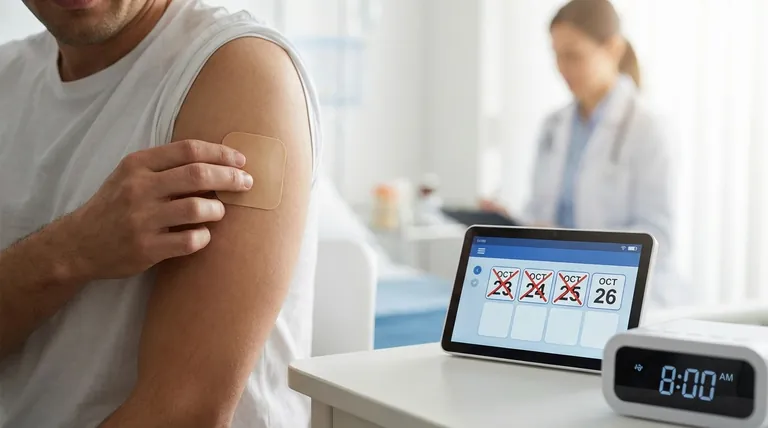
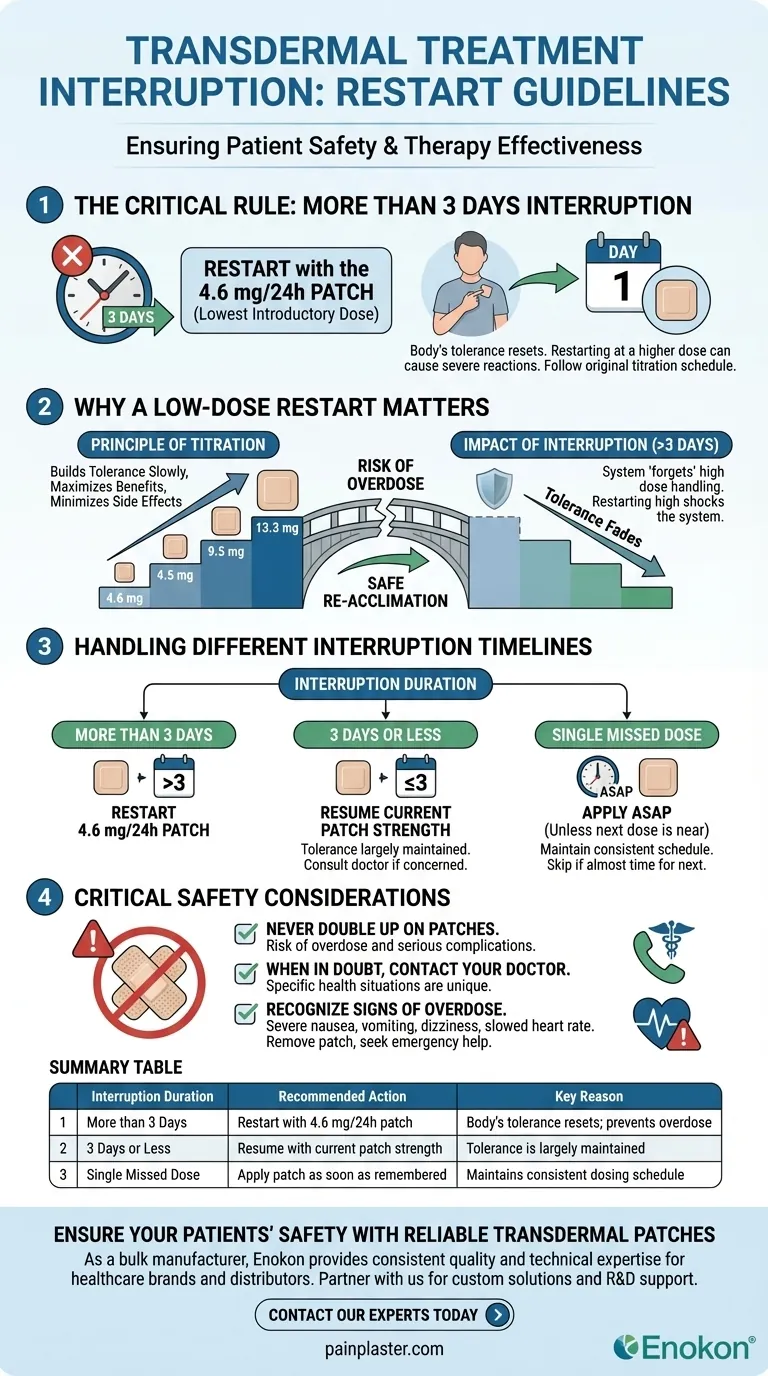
In the event your transdermal treatment is interrupted for more than three days, you must restart the therapy at a low introductory dose. Specifically, treatment should be reinitiated with the 4.6 mg/24 hours patch. This is not just a suggestion but a critical safety measure to prevent significant side effects as your body re-acclimates to the medication.
After a break of more than three days, your body's tolerance to the medication resets. Restarting at your previous, higher dose can lead to an overdose or severe adverse reactions, making it essential to begin again at the lowest dose and gradually titrate upwards.
Why a Low-Dose Restart is Critical
Understanding the principle behind this instruction is key to managing your treatment safely. The core concepts are titration and tolerance.
The Principle of Titration
Most transdermal treatments, particularly for conditions like Alzheimer's, are not started at the full therapeutic dose. Instead, doctors use titration—a process of starting with a low dose and increasing it slowly over weeks or months.
This allows your body to build a tolerance to the medication, maximizing its benefits while minimizing potential side effects like nausea, dizziness, or vomiting.
The Impact of an Interruption
When you stop treatment for more than three days, the tolerance your body has carefully built begins to fade.
Essentially, your system "forgets" how to handle the higher concentration of the drug. Restarting at your previous maintenance dose would be like starting for the first time at a high level, shocking your system and risking significant discomfort and adverse events.
The 4.6 mg/24h Safety Net
The instruction to restart with the 4.6 mg/24 hours patch is a safety-first protocol. This is typically the initial starting dose for new patients.
By restarting here, you are safely reintroducing the medication and beginning the titration process again, just as you did when you first started the therapy.
Handling Different Interruption Timelines
The correct action depends entirely on how long the treatment was paused.
Interruption of More Than 3 Days
This is the most critical scenario. You must restart treatment with the lowest dose, which is the 4.6 mg/24 hours patch.
You will then need to follow the original titration schedule your doctor prescribed, gradually increasing the dose over time.
Interruption of 3 Days or Less
If you miss your medication for three days or fewer, you can typically restart treatment with the same strength patch you were using before the interruption.
However, if you have any concerns, restarting with a lower strength patch or consulting your doctor is a wise precaution.
A Single Missed Dose
If you simply forget to apply a new patch at your scheduled time, put one on as soon as you remember.
If it is almost time for your next scheduled patch, skip the missed dose entirely and continue with your regular schedule.
Critical Safety Considerations
Adhering to correct procedures is non-negotiable for your health and the effectiveness of the treatment.
Never Double Up on Patches
Under no circumstances should you ever apply two patches at once to "make up" for a missed dose.
Doing so delivers a double dose of medication, which can lead to an overdose and serious medical complications.
When in Doubt, Contact Your Doctor
This guide provides general, evidence-based instructions. However, your specific health situation is unique.
If you are ever unsure about how to proceed after missing a dose or interrupting treatment, the safest course of action is always to call your doctor or pharmacist for instructions.
Recognize Signs of Overdose
Be aware of the symptoms of a potential overdose, which can include severe nausea, vomiting, dizziness, or slowed heart rate.
If you suspect an overdose, remove the patch immediately and seek emergency medical attention.
How to Apply This to Your Situation
Your response to a treatment interruption should be guided by the duration of the break.
- If your treatment was paused for more than 3 days: Restart with the lowest dose (4.6 mg/24h) and prepare to follow the original titration plan again.
- If your treatment was paused for 3 days or less: You can generally resume with your current patch, but stay vigilant for any side effects and contact your doctor if they occur.
- If you forgot a single daily application: Apply a patch as soon as you remember, but never wear two patches at the same time.
Following these precise guidelines ensures you can safely and effectively resume your transdermal therapy.
Summary Table:
| Interruption Duration | Recommended Action | Key Reason |
|---|---|---|
| More than 3 Days | Restart with 4.6 mg/24h patch | Body's tolerance resets; prevents overdose |
| 3 Days or Less | Resume with current patch strength | Tolerance is largely maintained |
| Single Missed Dose | Apply patch as soon as remembered | Maintains consistent dosing schedule |
Ensure Your Patients' Safety with Reliable Transdermal Patches
Adherence to precise dosing schedules is critical for transdermal therapy success. As a bulk manufacturer of reliable transdermal patches and pain plasters, Enokon provides the consistent quality and technical expertise that healthcare brands and pharmaceutical distributors need.
We partner with you to develop custom solutions, ensuring your therapies are delivered safely and effectively. Benefit from our custom R&D support for your specific requirements.
Contact our experts today to discuss how we can support your transdermal product development and supply.
Visual Guide
Related Products
- Far Infrared Heat Pain Relief Patches Transdermal Patches
- Silicone Scar Sheets Patch Transdermal Drug Patch
- Icy Hot Menthol Medicine Pain Relief Patch
- Menthol Gel Pain Relief Patch
- Mugwort Wormwood Pain Relief Patch for Neck Pain
People Also Ask
- Why is the selection of matrix materials critical when developing customized transdermal patches? Optimize Efficacy
- What are the physical impacts of external heat exposure on the performance and safety of transdermal patches? - Guide
- What role does a skin tolerance scoring system play in the safety evaluation of transdermal patches? Key Safety Metrics
- What are the clinical advantages of local transdermal delivery systems? Unlock Safer, More Effective Pain Relief Solutions
- How does high-purity far-infrared ceramic powder contribute to the efficacy of far-infrared physical therapy patches?



















