
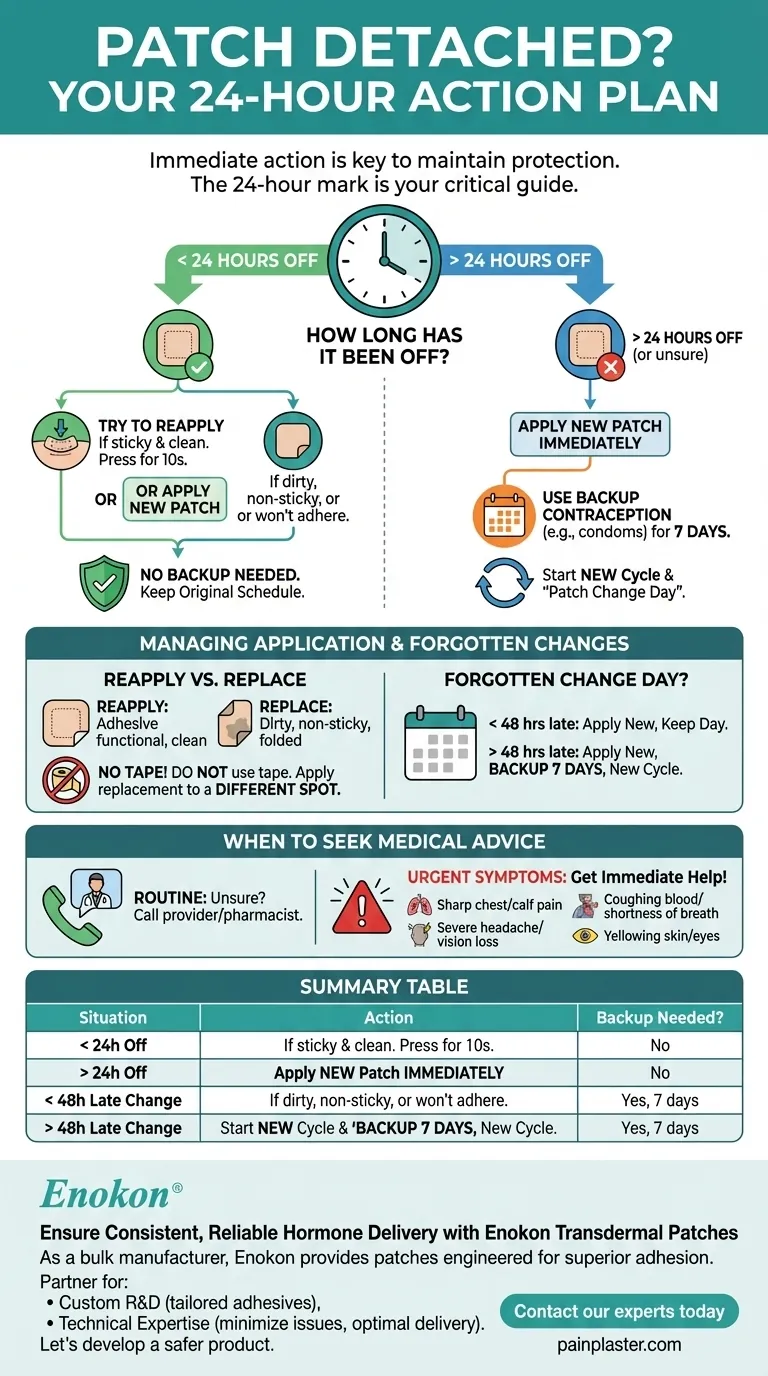
If your birth control patch has loosened or fallen off, your immediate action depends on how long it has been detached and whether it's still sticky. The key is to re-establish a consistent level of hormones as quickly as possible to maintain contraceptive protection.
Your primary goal is to minimize any interruption in hormone delivery. If a patch has been detached for less than 24 hours, you can typically fix the issue and stay on schedule. If it has been off for longer, you must assume your protection has lapsed and take steps to restart your cycle safely.
Immediate Action: The 24-Hour Rule
The effectiveness of your response is measured in hours. The 24-hour mark is the critical dividing line for determining your next steps and whether you need backup contraception.
When the Patch is Detached for Less Than 24 Hours
If the patch has been partially or completely detached for less than a full day, first try to reapply it. Press down firmly for about 10 seconds to ensure the edges are secure.
If the patch is no longer sticky, has lint or other material stuck to it, or will not re-adhere completely, discard it.
Apply a brand new patch immediately. You do not need to use a backup method of contraception, and your "patch change day" remains the same.
When the Patch is Detached for More Than 24 Hours
If the patch has been off for more than 24 hours, or if you are unsure how long it has been off, you may not be protected against pregnancy.
You must apply a new patch immediately. This day now becomes the first day of a new 4-week cycle, and you will need to set this as your new "patch change day."
Crucially, you must use a non-hormonal backup method of contraception, such as condoms, for the next seven consecutive days to ensure you are fully protected.
Managing Application and Schedules
Properly handling a detached patch involves more than just putting a new one on. Understanding the mechanics ensures you maintain maximum effectiveness.
When to Reapply vs. When to Replace
A patch can only be reapplied if its adhesive is still fully functional. Do not try to use tape or other adhesives to hold a loose patch in place.
Some brands may come with an adhesive cover designed to help secure a loosening patch. Use this if available.
If the patch is dirty, no longer sticky, or has been folded over on itself, it must be replaced. Its ability to deliver the correct dose of medication has been compromised.
Applying a New Patch Correctly
When you apply a replacement patch, choose a different spot on your clean, dry skin than the one you just used.
This helps prevent skin irritation and ensures proper absorption of the hormones.
Forgetting to Change Your Patch
A similar time-based rule applies if you forget to change your patch on your scheduled day.
If you are late changing your patch by less than 48 hours, simply remove the old one, apply a new one, and keep your original "patch change day."
If you are 48 hours or more late, apply a new patch immediately, use backup contraception for the next 7 days, and set this day as the start of a new cycle.
When to Seek Medical Advice
While managing a detached patch is usually straightforward, it's important to recognize situations that require professional guidance.
Routine Questions vs. Urgent Symptoms
If you are ever unsure about what to do after a mistake with your patch, contact your healthcare provider or pharmacist for advice. It is always better to confirm than to risk a lapse in protection.
Warning Signs of Serious Complications
The patch, like other hormonal contraceptives, carries a risk of serious side effects. Seek immediate medical attention if you experience any of the following:
- Sharp chest pain, coughing up blood, or sudden shortness of breath
- Persistent pain in your calf
- Crushing chest pain or pressure
- Sudden, severe headache or numbness
- Sudden vision loss
- Yellowing of the skin or eyes
These symptoms can indicate a serious condition like a blood clot, heart attack, or stroke and require urgent evaluation.
Making the Right Choice for Your Situation
Your response to a detached patch should be deliberate and based on a clear understanding of your situation.
- If your primary focus is immediate correction (<24 hours off): Reapply or replace the patch immediately and keep your original schedule; no backup contraception is needed.
- If your primary focus is safety after a long detachment (>24 hours off): Apply a new patch, use backup contraception for 7 days, and start a new cycle on this day.
- If you forgot to change your patch for more than 2 days: Treat it as a long detachment—start a new patch, use backup for a week, and reset your schedule.
- If you experience any severe physical symptoms: Prioritize your health by seeking emergency medical care immediately.
By understanding these simple, time-based rules, you can confidently manage interruptions and maintain effective protection.
Summary Table:
| Situation | Action | Backup Contraception Needed? |
|---|---|---|
| Detached < 24 hours | Reapply if sticky, or apply a new patch. | No |
| Detached > 24 hours | Apply a new patch immediately; start a new cycle. | Yes, for 7 days |
| Forgot to change patch (< 48 hours late) | Apply a new patch; keep original change day. | No |
| Forgot to change patch (> 48 hours late) | Apply a new patch; start a new cycle. | Yes, for 7 days |
Ensure Consistent, Reliable Hormone Delivery with Enokon Transdermal Patches
Did you know that patch detachment issues can often be traced back to the quality of the adhesive and manufacturing? As a bulk manufacturer of reliable transdermal patches and pain plasters, Enokon provides healthcare and pharma distributors and brands with patches engineered for superior adhesion and consistent performance.
Partner with us to benefit from:
- Custom R&D: We tailor patch formulations, including adhesives, to meet your specific product requirements and enhance user compliance.
- Technical Expertise: Our team works with you on development to minimize application issues and ensure optimal drug delivery.
Let's develop a safer, more reliable product for your customers. Contact our experts today to discuss your transdermal patch needs.
Visual Guide
Related Products
- Prostate Pain Kidney Health Care Patch for Men
- Heating Pain Relief Patches for Menstrual Cramps
- Silicone Scar Sheets Patch Transdermal Drug Patch
- Menthol Gel Pain Relief Patch
- Icy Hot Menthol Medicine Pain Relief Patch
People Also Ask
- What are the key components of Chinese herbal pain patches? Discover the Science Behind Natural Pain Relief
- What role do Chinese pain patches play in arthritis relief? Discover Natural Pain Management Solutions
- What should be avoided when using Chinese pain patches? Key Safety Tips for Effective Relief
- How can Chinese pain patches help with back pain? Natural Relief & Healing Benefits
- What complementary practices enhance the effectiveness of Chinese pain patches? Boost Relief with Holistic Care








