
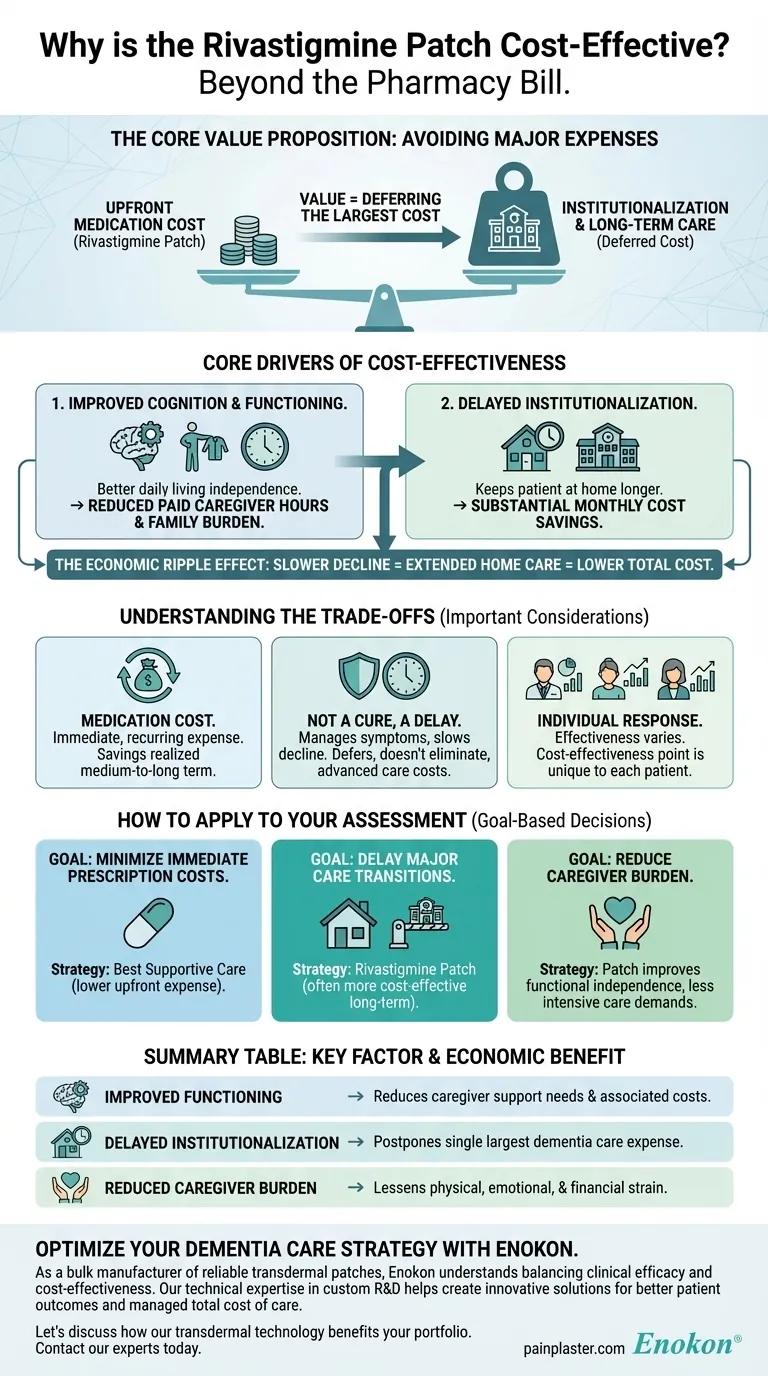
From a purely financial perspective, the cost-effectiveness of the rivastigmine patch compared to best supportive care is not about the price of the medication itself. Instead, its value stems from its ability to improve patient cognition and functioning, which in turn significantly delays the need for expensive institutionalization.
The key insight is that the rivastigmine patch’s value is measured by the major expenses it helps avoid. Its cost-effectiveness is realized by deferring the single largest cost in dementia care: the transition to a full-time residential facility.
The Core Drivers of Cost-Effectiveness
To understand the economic argument for the rivastigmine patch, we must look beyond the pharmacy bill and analyze the total cost of patient care over time. The primary value is generated by altering the trajectory of the disease's functional impact.
Factor 1: Improved Cognition and Functioning
When a patient's cognitive abilities and daily functioning are better maintained, the need for intensive, hands-on care is reduced. This has a direct economic benefit.
A patient who can perform more activities of daily living independently requires fewer hours from paid caregivers. This also lessens the immense, and often un-costed, burden on family members who provide care.
Factor 2: Delayed Institutionalization
This is the most significant financial factor. The transition to a long-term care facility or nursing home represents a massive and sustained increase in the cost of care.
By improving function and managing behavioral symptoms, the rivastigmine patch can help keep a patient at home for longer. Every month that this transition is delayed represents a substantial cost saving that can easily outweigh the cumulative cost of the medication.
The Economic Ripple Effect
These two factors are directly linked. Better functioning at home is precisely what enables the delay in needing institutional care.
The medication's ability to slow the decline in functional independence is therefore the central mechanism behind its cost-effectiveness. It addresses the most expensive consequences of the disease's progression.
Understanding the Trade-offs
An objective analysis requires acknowledging that the cost-benefit calculation is not absolute and involves important considerations.
The Upfront Medication Cost
Compared to best supportive care that does not include this specific therapy, the patch is an immediate and recurring expense. The cost savings it generates are realized over the medium to long term, not on day one.
Not a Cure, But a Delay
It is critical to understand that rivastigmine manages symptoms and slows functional decline; it does not stop or reverse the underlying disease. The high costs of advanced care are ultimately deferred, not eliminated entirely.
Individual Patient Response
The effectiveness of any treatment can vary between individuals. The degree of cognitive and functional improvement will differ, meaning the exact point of cost-effectiveness is unique to each patient's journey.
How to Apply This to Your Assessment
When evaluating treatment options, the decision should be based on a clear understanding of the primary goal for the patient and their care ecosystem.
- If your primary focus is minimizing immediate prescription costs: Best supportive care without this specific medication will have a lower upfront pharmaceutical expense.
- If your primary focus is delaying major care transitions and associated costs: The rivastigmine patch is often the more cost-effective long-term strategy by reducing larger, non-medication expenses.
- If your primary focus is reducing caregiver burden: Improving a patient's functional independence with the patch can directly translate to less intensive and stressful care demands.
Ultimately, making an informed decision requires looking at the total cost of care over the patient's entire journey, not just the price of a single intervention.
Summary Table:
| Factor | How It Drives Cost-Effectiveness |
|---|---|
| Improved Functioning | Reduces need for intensive daily caregiver support, lowering associated costs. |
| Delayed Institutionalization | Postpones the single largest expense in dementia care: full-time residential facility placement. |
| Reduced Caregiver Burden | Lessens the physical, emotional, and financial strain on family caregivers, an indirect economic benefit. |
Optimize Your Dementia Care Strategy with Enokon
As a bulk manufacturer of reliable transdermal patches for leading healthcare and pharma brands, Enokon understands the critical balance between clinical efficacy and cost-effectiveness. Our technical expertise in custom R&D and development can help you create innovative solutions that improve patient outcomes while managing the total cost of care.
Let's discuss how our transdermal technology can benefit your product portfolio. Contact our experts today to explore partnership opportunities.
Visual Guide
Related Products
- Lidocaine Hydrogel Pain Relief Patch for Pain Relief
- Menthol Gel Pain Relief Patch
- Icy Hot Menthol Medicine Pain Relief Patch
- Far Infrared Pain Patch Relief Pain Reliever for Back
- Capsaicin Chili Medicated Pain Relief Patches
People Also Ask
- How does the aqueous base in a lidocaine patch contribute to drug delivery? Unlocking Sustained Pain Relief Technology
- What are the advantages of topical anesthetics over invasive Lidocaine infiltration? Discover Safer, Scalable Relief
- Which pain patch is most effective for arthritis? Find the Best Relief for Your Joint Pain
- How should lidocaine patches be applied for optimal use? Maximize Pain Relief with Proper Application
- Why are lidocaine patches preferred over oral medications? Targeted Relief & Scale Your Brand with OEM R&D Solutions



















