The Moment of Injury, The Moment of Choice
It happens in an instant. A weekend soccer game, a misstep on a trail run, a simple household accident. The result is a sharp pain, swelling, and the sudden loss of function—a sprain, a strain, a contusion.
The immediate goal is relief. But the path to recovery is paved with small, repeated decisions. The most crucial one is often the first: choosing a treatment. For most, the choice for acute, soft-tissue injuries comes down to two topical NSAID options: a familiar gel or a modern patch.
The decision seems simple, but it carries unseen weight. The effectiveness of a treatment is not just about its chemical composition; it's profoundly influenced by the patient's ability and willingness to use it correctly. This is where the psychology of adherence meets the science of pharmacology.
The Friction of Treatment
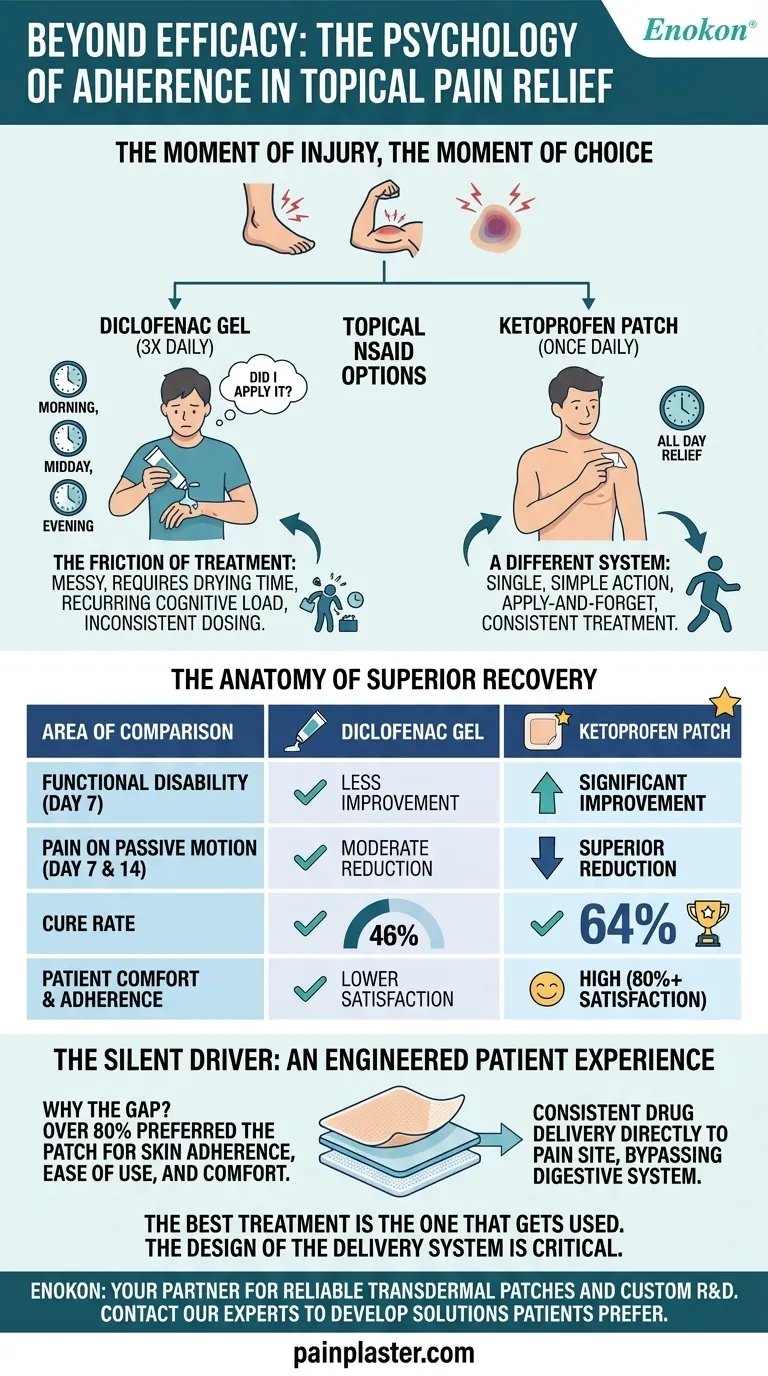
A diclofenac gel is a common choice. The instructions are straightforward: apply it three times a day. But life isn't straightforward.
Applying a gel is a process. It can be messy. It requires time to dry. It introduces a recurring cognitive load—a mental reminder that fires three times daily. Did I apply it this morning? Do I have it with me for the midday application? This small friction, repeated over days, can lead to missed doses and inconsistent treatment.
The alternative, a ketoprofen patch, presents a different system entirely. Apply once, and it works for the entire day. The treatment becomes a single, simple action rather than a persistent chore. This seemingly minor difference in the delivery system has a dramatic impact on results.
The Anatomy of Superior Recovery
A recent study comparing the two treatments for sport-related soft-tissue injuries revealed a clear pattern. While both reduced pain, the ketoprofen patch consistently outperformed the gel in metrics that matter most for an active recovery.
More Than Pain Scores: Restoring Function
Pain is a symptom. The true measure of recovery is the restoration of function.
By day 7, patients using the ketoprofen patch showed a significantly greater reduction in functional disability. They weren't just feeling less pain; they were regaining their mobility and returning to normal life faster. This advantage extended to specific pain triggers:
- Pain on Passive Motion: Superior relief at both day 7 and day 14.
- Pain on Pressure: Better relief from localized tenderness by day 7.
The Decisive Difference in Cure Rates
The ultimate goal of any treatment is a cure. Here, the data is stark. The ketoprofen patch achieved a 64% cure rate for sports-related injuries, compared to just 46% with the diclofenac gel.
This isn't a marginal improvement. It’s a fundamental difference in clinical outcome, driven by a combination of sustained drug delivery and superior patient adherence.
| Area of Comparison | Ketoprofen Patch | Diclofenac Gel |
|---|---|---|
| Functional Disability (Day 7) | Significant Improvement | Less Improvement |
| Pain on Passive Motion (Day 7 & 14) | Superior Reduction | Moderate Reduction |
| Cure Rate | 64% | 46% |
| Patient Comfort & Adherence | High (80%+ Satisfaction) | Lower Satisfaction |
The Silent Driver: An Engineered Patient Experience
Why such a large gap in performance? The answer lies in the patient experience.
When surveyed, patients overwhelmingly preferred the patch. Over 80% rated its skin adherence and removal process as "good" or "excellent." They valued its overall comfort, its ease of use, and the "apply-and-forget" convenience of a once-daily dose.
This isn't about luxury; it's about removing barriers to successful treatment. A delivery system that aligns with human psychology—one that is simple, clean, and unobtrusive—naturally encourages better adherence. Better adherence leads to more consistent dosing, which in turn leads to better clinical results.
The transdermal patch is an elegant piece of engineering designed to solve a biological problem with human behavior in mind. It delivers a consistent dose of medication directly to the site of pain, bypassing the digestive system and maintaining steady-state plasma concentrations for sustained relief.
This level of performance—in both efficacy and patient satisfaction—is the product of deep expertise in material science and transdermal drug delivery. As a bulk manufacturer specializing in reliable transdermal patches and pain plasters, Enokon provides this technical expertise to healthcare and pharmaceutical distributors worldwide, offering custom R&D to create solutions that excel both in the lab and in the real world.
Ultimately, the best treatment is the one that gets used. By minimizing friction and maximizing convenience, the transdermal patch proves that the design of the delivery system is as critical as the drug it delivers.
If you're looking to develop a pain management solution that patients prefer and physicians trust, we can help engineer the answer. Contact Our Experts
Visual Guide
Related Products
- Mugwort Wormwood Pain Relief Patch for Neck Pain
- Menthol Gel Pain Relief Patch
- Far Infrared Deep Heat Relief Patches Medicated Pain Relief Patches
- Icy Hot Menthol Medicine Pain Relief Patch
- Far Infrared Heat Pain Relief Patches Transdermal Patches
Related Articles
- More Than a Sticker: The Hidden Engineering of a Safe Pain Patch
- The Unseen Calculus of a Simple Pain Patch
- The Architecture of Relief: Deconstructing the Modern Pain Patch
- Beyond the Molecule: The Behavioral Science of the Simple Pain Patch
- The Human Interface of Pain Relief: Why Delivery Systems Define Success