
The Illusion of Simplicity
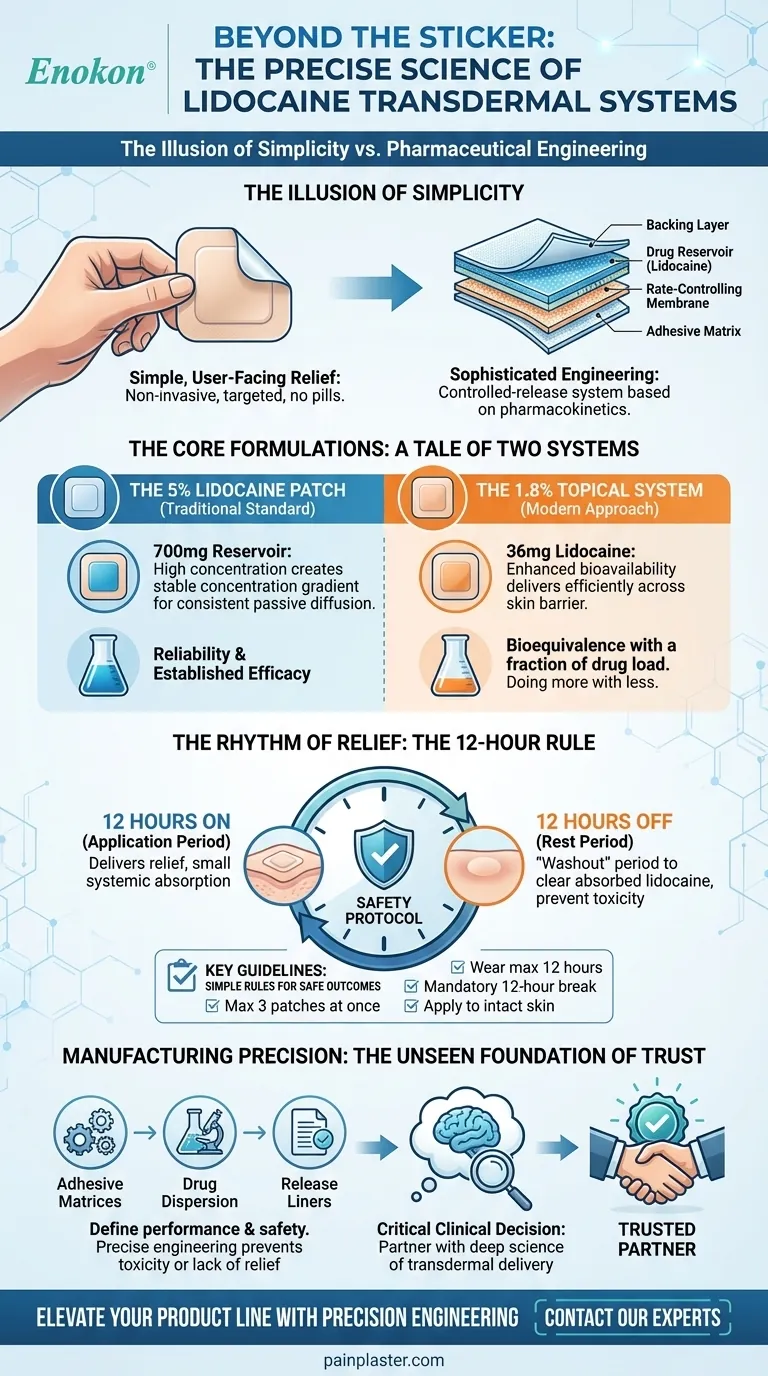
A transdermal patch feels like the simplest form of medicine. A thin, flexible adhesive that delivers relief directly where it's needed. For a patient managing localized pain, this simplicity is a profound comfort—a non-invasive, targeted solution that doesn't involve pills or systemic side effects.
But this user-facing simplicity is an illusion. It is the elegant output of complex pharmaceutical engineering. The lidocaine patch is not just a sticker with medicine; it's a sophisticated, controlled-release system designed around a deep understanding of pharmacokinetics and human psychology.
The Core Formulations: A Tale of Two Systems
The effectiveness of a lidocaine transdermal system hinges on its formulation. The two primary prescription forms look similar but are engineered differently to achieve a common goal: predictable, localized pain relief.
The Workhorse: The 5% Lidocaine Patch
The 5% patch is the traditional standard, containing a significant reservoir of 700mg of lidocaine. This high concentration isn't about brute force. Instead, it creates a stable concentration gradient that ensures a consistent, passive diffusion of the active ingredient through the skin's layers over a prolonged period. It’s a testament to reliability and established efficacy.
The Refined System: The 1.8% Topical System
The 1.8% topical system, containing just 36mg of lidocaine, represents a more modern approach. How does it achieve the same level of pain relief as its 700mg counterpart? Through superior engineering.
This system features enhanced bioavailability, meaning the formulation is optimized to deliver the lidocaine more efficiently across the skin barrier. It’s a beautiful example of doing more with less—achieving bioequivalence with a fraction of the drug load, which in turn minimizes the total amount of lidocaine applied to the body.
The Rhythm of Relief: The 12-Hour Rule
Why can a patch only be worn for 12 hours? This isn't an arbitrary guideline; it's the core of the system's safety protocol. It's a carefully engineered rhythm of application and rest.
The "12 hours on, 12 hours off" cycle is designed to prevent the gradual buildup of lidocaine in the bloodstream. While the patch is designed for local action, a small amount is always absorbed systemically. The 12-hour rest period acts as a "washout," allowing the body to clear this absorbed amount, preventing it from reaching a level that could cause toxicity.
This simple rule transforms a potent anesthetic into a safe, repeatable therapy. For clinicians and patients, this clarity is crucial. Simple, memorable rules drive adherence, and adherence drives safe outcomes.
- Maximum Dosage: No more than 3 patches or systems at once.
- Application Cycle: Wear for a maximum of 12 hours.
- Rest Period: Follow with a mandatory 12-hour break.
- Application Site: Only apply to intact, unbroken skin.
| Aspect | Details | Rationale |
|---|---|---|
| Primary Forms | 5% Patch (700mg) & 1.8% System (36mg) | Offers bioequivalent pain relief through different formulations. |
| Dosage & Frequency | Once daily, max 3 patches | Balances therapeutic effect with a conservative safety margin. |
| Usage Guidelines | 12 hours on, 12 hours off | Prevents systemic accumulation and potential toxicity. |
| Safety Notes | Avoid broken skin; monitor use with other anesthetics | Ensures localized action and prevents adverse drug interactions. |
Manufacturing Precision: The Unseen Foundation of Trust
A patient trusts that their patch will deliver the right amount of medication at the right speed. A doctor trusts that the 1.8% system is truly bioequivalent to the 5% patch. This entire chain of trust rests on one thing: manufacturing precision.
The subtle differences in adhesive matrices, drug dispersion, and release liners are not minor details; they define the product's performance and safety. A patch that releases too quickly could risk systemic toxicity. One that releases too slowly offers no relief.
For healthcare distributors and pharmaceutical brands, the choice of a manufacturing partner is therefore a critical clinical decision. It requires a partner who doesn't just assemble materials but understands the deep science of transdermal delivery. This is where expertise in custom R&D and formulation development becomes paramount. The reliability of your brand is built on the reliability of their engineering.
For healthcare brands and distributors committed to delivering this level of engineered reliability, understanding the nuances of formulation and manufacturing is the first step. Contact Our Experts to explore how precision engineering can elevate your product line.
Visual Guide
Related Products
- Lidocaine Hydrogel Pain Relief Patch for Pain Relief
- Far Infrared Heat Pain Relief Patches Transdermal Patches
- Menthol Gel Pain Relief Patch
Related Articles
- Beyond the Adhesive: The Precarious Balance of Transdermal Drug Delivery
- The Unseen Dangers of Numbness: Navigating the Physics and Psychology of Lidocaine Patches
- The Efficacy Paradox: Why Lower-Dose Lidocaine Patches Are Redefining Pain Management
- Beyond the Patch: The Hidden Dialogue Between Lidocaine, Your Body, and Your Lifestyle
- Beyond Efficacy: The Psychology of Adherence in Topical Pain Relief


