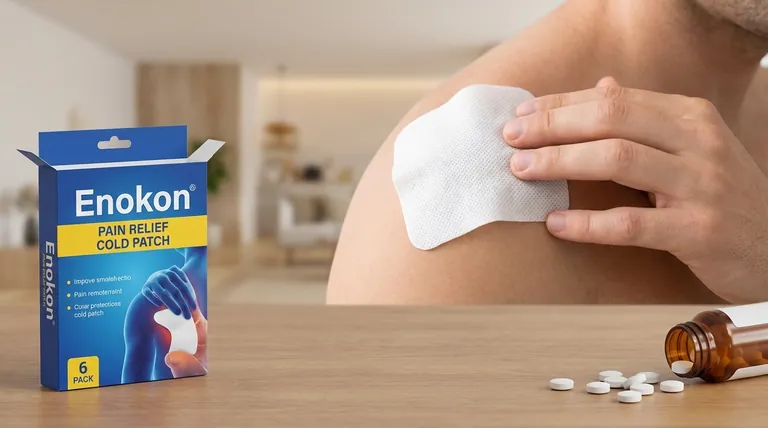
The Patient’s Silent Dilemma
Consider a patient leaving the dentist's office after a root canal. They are handed a prescription for pain relief: a bottle of pills to be taken three times a day.
The instructions seem simple. Yet, a silent calculation begins in the patient's mind. Will I remember the midday dose at work? Will this irritate my sensitive stomach? The fear of side effects and the mental load of a multi-dose regimen are often as burdensome as the pain itself.
This is the classic trade-off in pain management: the battle between therapeutic efficacy and human behavior. A treatment is only as good as a patient's ability—and willingness—to follow it.
The Tyranny of the Pill Bottle
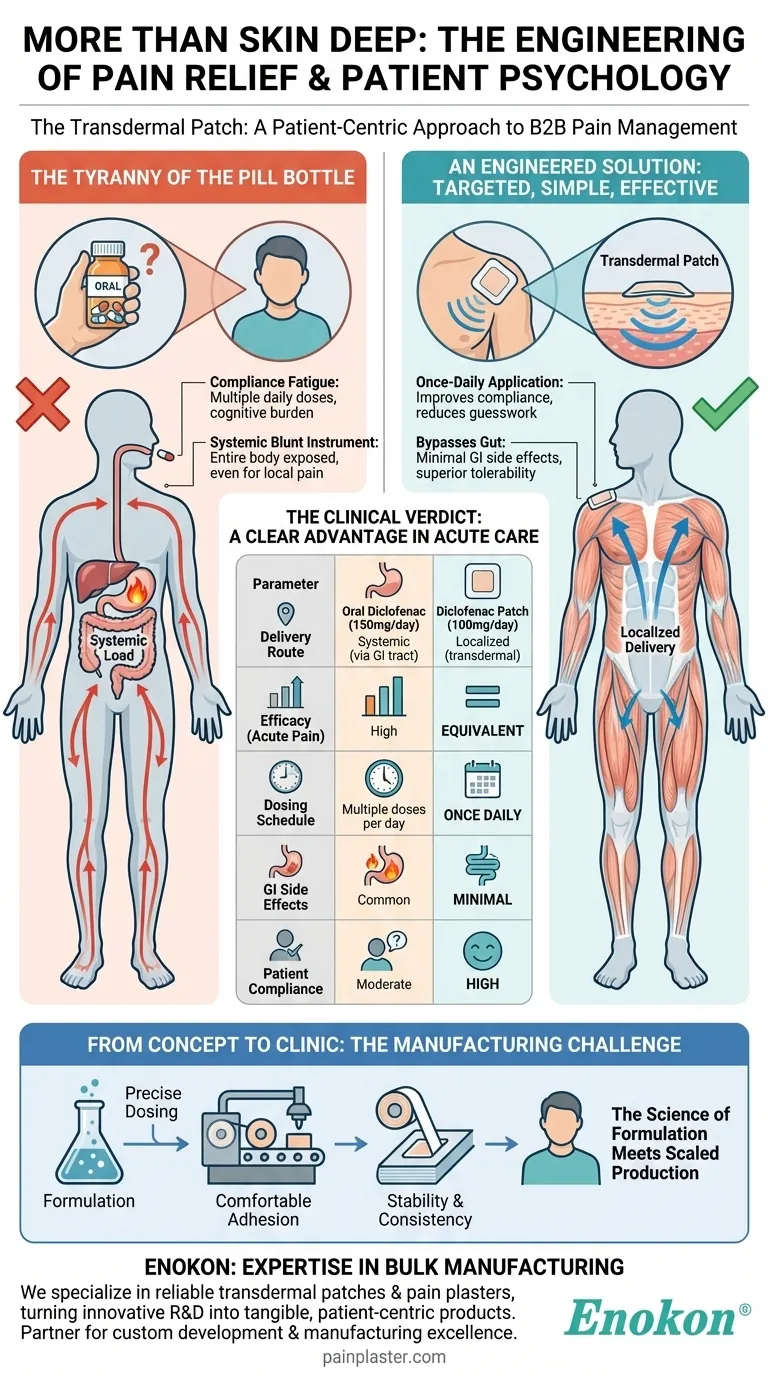
Oral NSAIDs like diclofenac are effective, but they are a systemic blunt instrument. To treat a sore tooth or a sprained ankle, the drug must first pass through the digestive tract, get processed by the liver, and circulate throughout the entire body.
This journey is fraught with potential complications:
- Gastrointestinal Distress: Stomach pain, irritation, and even ulcers are well-documented risks.
- Compliance Fatigue: Remembering multiple daily doses is a cognitive burden. A missed dose can lead to breakthrough pain, undermining the treatment's goal.
- Systemic Load: The entire body is exposed to the drug, even though the pain is localized.
The core problem isn't the drug's effectiveness, but its delivery method. We ask patients to swallow a systemic solution for what is often a local problem.
An Engineered Solution: Targeted, Simple, Effective
This is where the transdermal patch represents an elegant feat of biomedical engineering. It's not just a sticker; it's a sophisticated delivery system designed to bypass the gut entirely.
A diclofenac patch delivers the drug directly through the skin to the muscle and tissue beneath. This localized approach fundamentally changes the equation.
Recent studies confirm this elegance isn't just theoretical. A 100 mg once-daily diclofenac transdermal patch demonstrates comparable analgesic efficacy to a 150 mg daily oral dose for acute dental and musculoskeletal pain. Patients get the same relief without the systemic detour.
The Clinical Verdict: A Clear Advantage in Acute Care
The evidence highlights where the patch excels and what its current limitations are.
- Equivalent Efficacy, Superior Tolerability: For short-term, acute pain, the patch is a validated alternative to oral tablets. The key difference is a significantly lower incidence of systemic side effects, particularly gastrointestinal issues.
- The Compliance Breakthrough: The simplicity of a once-daily application is its most powerful psychological advantage. It removes the guesswork and the "pill fatigue," making it far more likely that patients will complete their course of treatment successfully.
- The Next Frontier: Evidence for long-term use in chronic conditions like osteoarthritis is still developing. Further research is also needed to determine optimal dosing for severe trauma, which may require higher drug concentrations.
This makes the patch an ideal solution for a specific, but very large, group of patients: those with oral NSAID intolerances, those prioritizing convenience, and anyone needing reliable relief from short-term, post-procedural pain.
| Parameter | Oral Diclofenac (150mg/day) | Diclofenac Patch (100mg/day) |
|---|---|---|
| Delivery Route | Systemic (via GI tract) | Localized (transdermal) |
| Efficacy (Acute Pain) | High | Equivalent |
| Dosing Schedule | Multiple doses per day | Once daily |
| GI Side Effects | Common | Minimal |
| Patient Compliance | Moderate | High |
From Concept to Clinic: The Manufacturing Challenge
The simple appearance of a transdermal patch belies its manufacturing complexity. Ensuring each patch delivers a precise, consistent dose, adheres comfortably to the skin without irritation, and maintains stability is a significant technical challenge.
This is where the science of formulation meets the discipline of scaled production. For pharmaceutical brands and healthcare distributors, partnering with a manufacturer that possesses deep technical expertise isn't just a supply chain decision; it's fundamental to delivering a safe and effective product. Mastering adhesive technology, drug-release matrixes, and barrier-film properties is what separates a lab concept from a market-leading therapeutic solution.
At Enokon, we specialize in the bulk manufacturing of reliable transdermal patches and pain plasters, turning innovative R&D into tangible products for patients. Our expertise in custom development allows healthcare brands to create tailored solutions that meet specific clinical needs, ensuring quality, compliance, and efficacy from the first patch to the last.
The future of pain management lies in systems that work with, not against, human psychology. The transdermal patch is a prime example of this philosophy—an engineered solution that delivers relief quietly, effectively, and simply. If your goal is to provide such advanced, patient-centric solutions, expertise in manufacturing is your critical first step. Contact Our Experts
Visual Guide
Related Products
- Menthol Gel Pain Relief Patch
- Lidocaine Hydrogel Pain Relief Patch for Pain Relief
- Herbal Medicated Anti Diarrhea Patch for Digestive Relief
- Cooling Fever Patches Color Change Cold Fever Patch
- Icy Hot Menthol Medicine Pain Relief Patch
Related Articles
- Beyond Efficacy: The Psychology of Adherence in Topical Pain Relief
- The 60-Minute Architecture: Engineering Predictability in Topical Pain Relief
- More Than a Feeling: The Precise Engineering of Cold vs. Hot Pain Relief
- Beyond the Molecule: The Behavioral Science of the Simple Pain Patch
- The Human Interface of Pain Relief: Why Delivery Systems Define Success



















