
The Illusion of "More is Better"
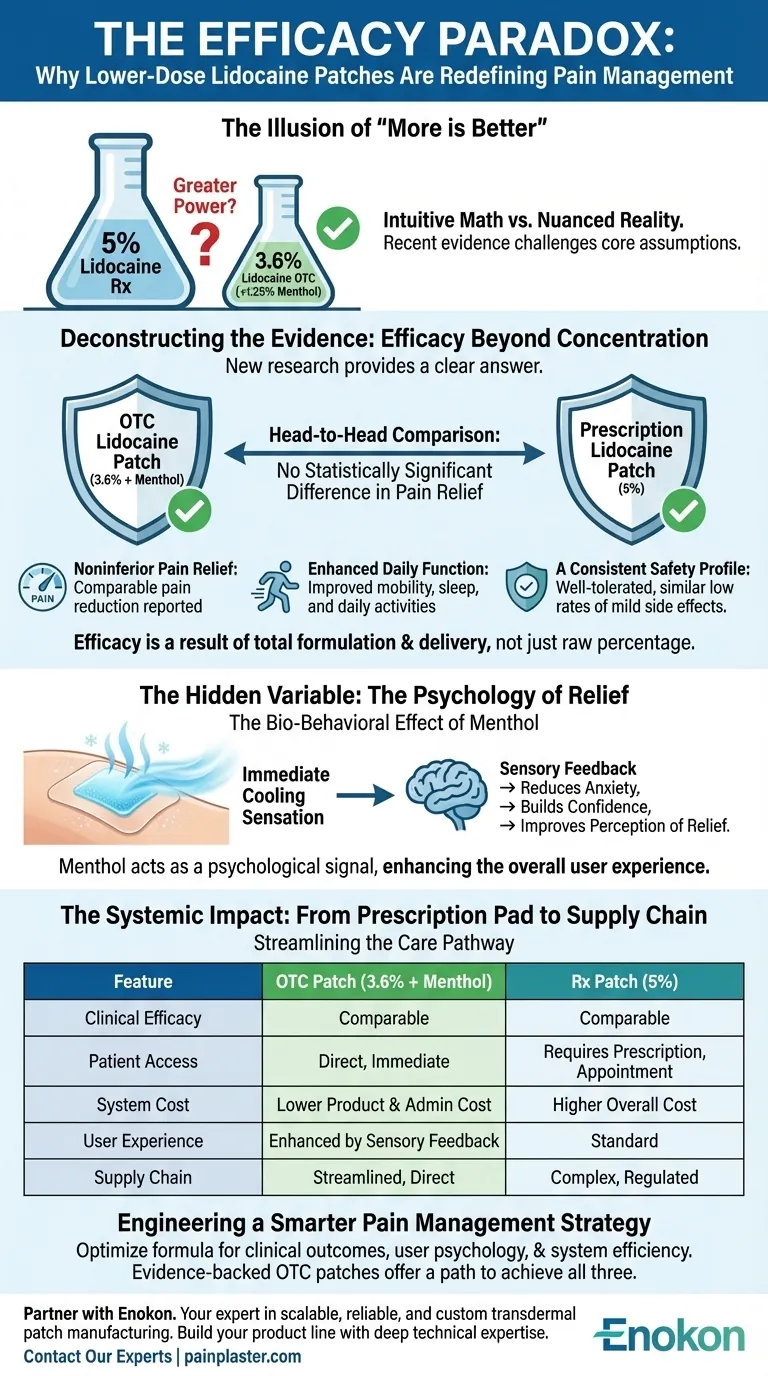
We have a cognitive bias toward bigger numbers. In medicine, as in life, we often equate higher dosage with greater power. A 5% solution feels intuitively superior to a 3.6% one. This heuristic simplifies decision-making but can obscure a more nuanced reality.
For decades, the 5% prescription lidocaine patch has been a gold standard for localized pain relief. It's effective, trusted, and backed by a history of clinical use. But this reliance on prescription-strength solutions creates friction—for patients, providers, and entire healthcare systems.
What if our intuitive math is wrong? Recent clinical evidence challenges this core assumption, forcing us to reconsider what "effective" truly means.
Deconstructing the Evidence: Efficacy Beyond Concentration
Imagine a hospital's formulary committee debating its pain management options. The goal is to balance three pillars: clinical efficacy, patient safety, and economic viability. The discussion often stalls on a single question: can a more affordable, accessible option perform as well as the established prescription incumbent?
New research provides a clear answer. A head-to-head comparison between an over-the-counter (OTC) 3.6% lidocaine patch (fortified with 1.25% menthol) and the 5% prescription version found no statistically significant difference in their ability to relieve pain.
Key Performance Metrics
- Noninferior Pain Relief: Patients using the OTC patch reported pain reduction comparable to those using the prescription version. The higher concentration did not translate to superior outcomes.
- Enhanced Daily Function: Both formulations were significantly better than a placebo at improving mobility, sleep quality, and the ability to perform daily activities. This isn't just about a number on a pain scale; it's about restoring quality of life.
- A Consistent Safety Profile: Both patches were well-tolerated, with similar low rates of mild side effects. The lower dose of the OTC option presents no compromise in safety.
This data dismantles the "more is better" argument. Efficacy is a result of the total formulation and delivery system, not just the raw percentage of the active ingredient.
The Hidden Variable: The Psychology of Relief
The OTC patch in the study contained a second component: menthol. From an engineering perspective, this is an elegant addition that addresses the human element of pain relief.
Lidocaine works by blocking sodium channels to numb local nerve endings—a process that is imperceptible to the user. Menthol, however, provides an immediate cooling sensation. This sensory feedback acts as a psychological signal that the product is working.
This isn't a placebo effect; it's a bio-behavioral one. The immediate sensation can reduce anxiety and build a user's confidence in the treatment, enhancing their overall perception of relief. It’s a small detail in formulation that creates a vastly improved user experience.
The Systemic Impact: From Prescription Pad to Supply Chain
The implications of this clinical equivalence extend far beyond the patient. For healthcare distributors, pharmaceutical brands, and formulary managers, it represents a strategic shift.
By removing the prescription barrier, OTC patches streamline the entire care pathway. Patients get faster access to relief without the time and cost of a doctor's visit. Healthcare systems reduce administrative burdens. This is system optimization at its best.
Here’s how the two options stack up from a procurement and distribution perspective:
| Feature | OTC Lidocaine Patch (3.6% + Menthol) | Prescription Lidocaine Patch (5%) |
|---|---|---|
| Clinical Efficacy | Comparable | Comparable |
| Patient Access | Direct, immediate | Requires prescription, appointment |
| System Cost | Lower product & administrative cost | Higher overall cost |
| User Experience | Enhanced by sensory feedback | Standard |
| Supply Chain | Streamlined, direct to consumer/pharmacy | Complex, regulated pathway |
Engineering a Smarter Pain Management Strategy
The evidence is clear: effective pain management is not solely about maximizing dosage. It's about optimizing the formula for clinical outcomes, user psychology, and system efficiency. The rise of evidence-backed OTC lidocaine patches offers a path to achieving all three.
For healthcare distributors and brands, this is more than an academic finding—it's a market opportunity. Partnering with a manufacturer who possesses deep technical expertise in transdermal technology is essential to capitalize on this trend. Enokon specializes in the bulk manufacturing of reliable, effective transdermal patches, offering the custom R&D support needed to develop optimized formulations like menthol-enhanced lidocaine patches. We provide the scalable production to ensure your supply chain is as robust as your product's clinical data.
To build a product line that balances clinical efficacy with market accessibility, it's crucial to partner with a manufacturer who understands both the science and the supply chain. Contact Our Experts
Visual Guide
Related Products
- Lidocaine Hydrogel Pain Relief Patch for Pain Relief
- Herbal Medicated Anti Diarrhea Patch for Digestive Relief
- Menthol Gel Pain Relief Patch
- Icy Hot Menthol Medicine Pain Relief Patch
- Asthma Cough and Pain Relief Patch for Adults and Kids
Related Articles
- Beyond the Adhesive: The Precarious Balance of Transdermal Drug Delivery
- The Unseen Dangers of Numbness: Navigating the Physics and Psychology of Lidocaine Patches
- Beyond the Patch: The Hidden Dialogue Between Lidocaine, Your Body, and Your Lifestyle
- Beyond Efficacy: The Psychology of Adherence in Topical Pain Relief
- The Elegant Thermodynamics of Relief: How Hydrogel Patches Master Fever and Pain



















