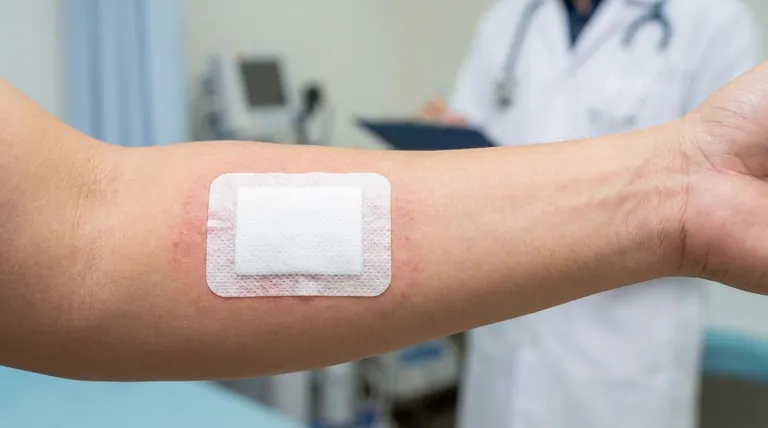
The Doctor's Dilemma: A Simple Rash, A Complex System
A patient receives a transdermal patch for steady, non-invasive pain relief. Days later, the application site is marked by an erythematous rash. The next patient, using a seemingly identical patch for a different condition, experiences no issues at all.
This isn't a rare anomaly. It's a daily occurrence in clinics worldwide. We expect medical technology to be predictable, a constant variable in the chaotic equation of human health. Yet, the simple transdermal patch presents a paradox: its safety profile, particularly regarding skin reactions, is rife with contradictory findings in clinical studies.
This isn't a failure of the technology. It's an invitation to look deeper—beyond the surface of the skin and into the interconnected system of materials, methods, and human biology.
The Three Variables That Define Safety
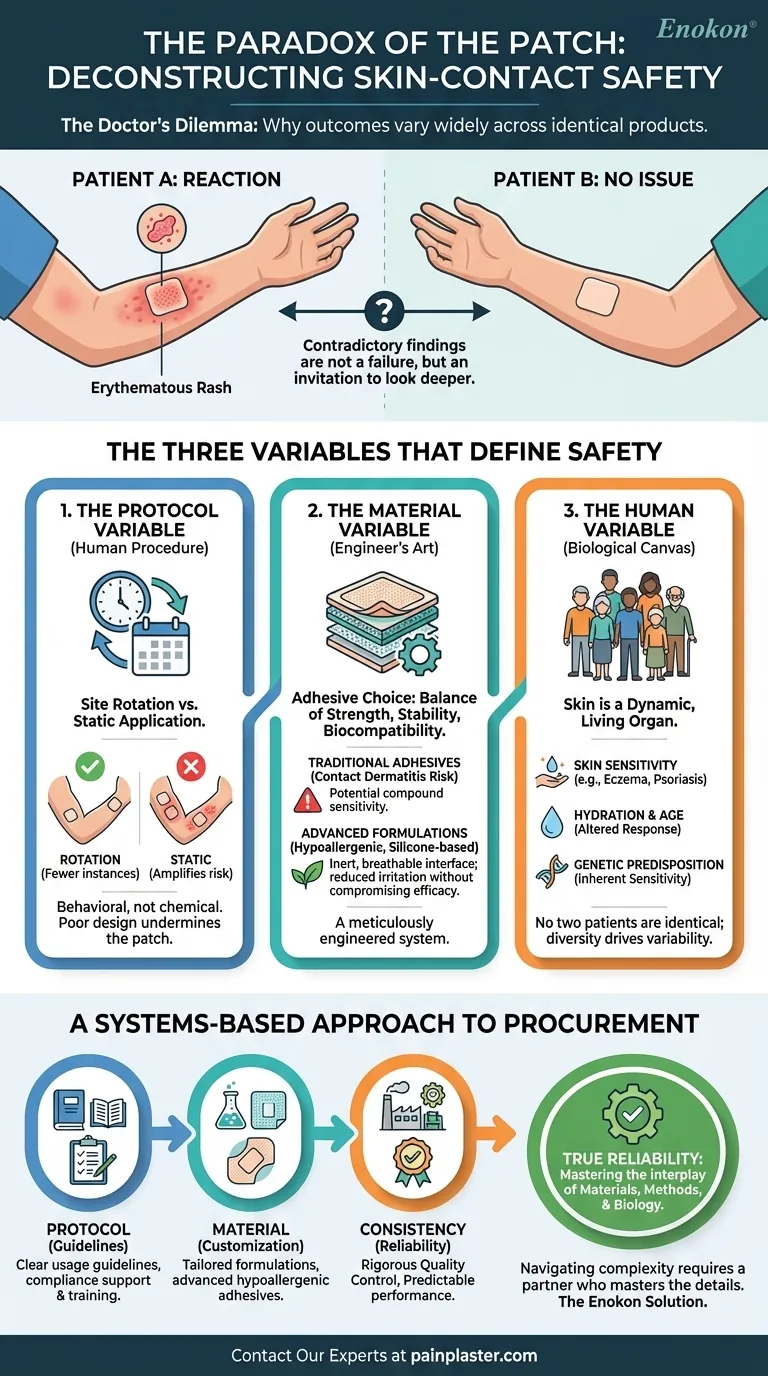
The reason one study reports skin irritation while another finds none isn't because one is "wrong." It’s because they are measuring the outcomes of slightly different systems. The variability can be traced to three critical factors.
1. The Protocol Variable: The Ghost in the Machine
The most overlooked factor is often the simplest: human procedure.
- Site Rotation: Studies where application sites are diligently rotated between doses report significantly fewer instances of irritation.
- Static Application: Protocols that involve reapplying a patch to the same location amplify the risk, as the skin's barrier function is continuously challenged.
This isn’t a chemical problem; it’s a behavioral one. The inconsistency in data often reflects an inconsistency in practice. A well-designed patch can be undermined by a poorly designed application protocol.
2. The Material Variable: The Engineer's Art
A patch is not just a drug and a sticker. It's a sophisticated drug delivery vehicle where the adhesive is as critical as the active ingredient.
The choice of adhesive is a delicate balance between adhesion strength, drug matrix stability, and biocompatibility.
- Traditional Adhesives: Can sometimes contain compounds that a subset of the population is sensitive to, leading to contact dermatitis.
- Advanced Formulations: Innovations in materials, like hypoallergenic, silicone-based adhesives, represent a quiet but profound evolution. They create a more inert, breathable interface with the skin, drastically reducing the potential for irritation without compromising efficacy.
The patch itself is a meticulously engineered system. Differences in its composition explain why one brand may be tolerated perfectly while another causes issues.
3. The Human Variable: The Biological Canvas
Ultimately, a transdermal patch interacts with a living, dynamic organ: the skin. We treat it as a uniform surface, but it is anything but.
- Skin Sensitivity: Pre-existing conditions like eczema or psoriasis can predispose a patient to reactions.
- Hydration & Age: The hydration level, thickness, and elasticity of the skin change with age and health status, altering how it responds to an adhesive.
- Genetic Predisposition: Some individuals are simply more prone to skin sensitivity.
No two patients are identical. The contradictory findings in large-scale studies are, in part, a statistical reflection of this fundamental human diversity.
A Systems-Based Approach to Procurement
For healthcare distributors and pharmaceutical brands, navigating this complexity isn't about finding a single "perfect" patch. It's about building a resilient supply chain with a manufacturing partner who understands and controls for these variables.
This means moving beyond a simple spec sheet and asking deeper questions:
| System Variable | Key Consideration for Procurement | The Enokon Solution |
|---|---|---|
| Protocol | Does the manufacturer provide clear usage guidelines to minimize application error? | We provide detailed compliance support and training materials to ensure best practices are followed. |
| Material | Can the manufacturer customize formulations to enhance biocompatibility for sensitive populations? | Our custom R&D allows for the development of tailored formulations using advanced, hypoallergenic adhesives. |
| Consistency | Is the manufacturing process reliable enough to eliminate batch-to-batch variability? | As a bulk manufacturer, we ensure rigorous quality control for reliable, predictable product performance. |
The solution to the paradox of the patch is not to ignore the contradictory data, but to embrace it as a guide. It points toward a more sophisticated approach—one that prioritizes not just the product, but the entire system in which it operates.
True reliability is born from mastering the interplay between material science, clinical protocols, and human biology. Navigating this complexity requires a partner who masters the details. Contact Our Experts
Visual Guide
Related Products
- Far Infrared Heat Pain Relief Patches Transdermal Patches
- Icy Hot Menthol Medicine Pain Relief Patch
- Silicone Scar Sheets Patch Transdermal Drug Patch
- Menthol Gel Pain Relief Patch
- Mugwort Wormwood Pain Relief Patch for Neck Pain
Related Articles
- Engineering Certainty: The Invisible Architecture of a Gold-Standard Clinical Trial
- The Silent Workhorse: How Transdermal Patches Rewrote the Rules of Pain Management
- Beyond the Pill: The Silent Engineering of Safer Pain Relief
- Beyond Efficacy: The Psychology of Adherence in Topical Pain Relief
- Beyond the Molecule: The Behavioral Science of the Simple Pain Patch



















