The Unseen Burden of Modern Pain
A software developer leans forward, the dull ache in her lower back a constant companion to her flashing cursor. A weekend runner grimaces, feeling the familiar delayed soreness settle into his calves. An arthritis sufferer navigates their morning, each step a negotiation with their own joints.
Pain isn't just a signal. It's a systemic drag on focus, mood, and productivity. While its sources are complex, one of the most elegant solutions is surprisingly simple: the controlled, targeted application of heat.
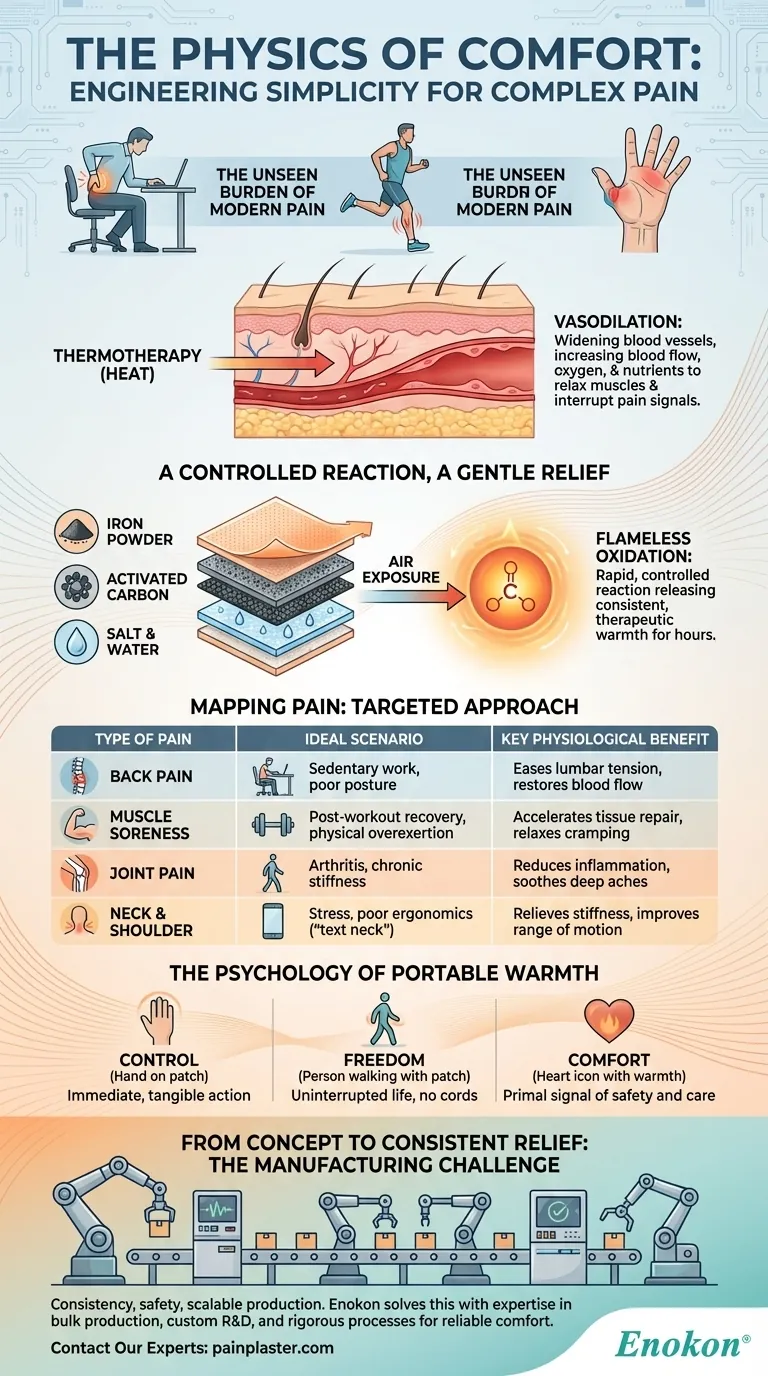
This isn't just about feeling good. It’s about intervening in a physiological cycle. Heat therapy, or thermotherapy, works by promoting vasodilation—widening blood vessels to increase blood flow. This brings more oxygen and nutrients to damaged tissues, helping to relax tight muscles, reduce stiffness, and interrupt pain signals sent to the brain.
The self-heating patch is a marvel of this principle, packaged as portable, discreet engineering.
A Controlled Reaction, A Gentle Relief
At its core, a self-heating patch is a masterpiece of applied chemistry. Most contain a simple mix of iron powder, activated carbon, salt, and water. When exposed to air, the iron oxidizes in a rapid, controlled reaction. It’s essentially a slow, flameless rusting process, engineered to release a consistent, therapeutic warmth for hours.
There’s a certain romance in this. We’ve harnessed a fundamental chemical reaction and contained it in a soft, pliable patch that can be worn under clothing, turning a natural process into a tool for healing and comfort.
Mapping Pain: A Targeted Approach
The brilliance of the patch lies in its targeted application. Unlike systemic pain relievers, it delivers relief precisely where it's needed, minimizing side effects and maximizing efficiency.
For the Modern, Desk-Bound Spine
Prolonged sitting forces the lumbar spine into a state of chronic tension. Muscles tighten, blood flow is restricted, and discomfort becomes the norm. A heat patch applied to the lower back doesn't just mask the pain; it actively works against the physiological stress of a sedentary job, providing continuous warmth that coaxes muscles to relax. It’s a silent intervention in the middle of a busy workday.
The Athlete's Recovery Protocol
For athletes, recovery is as critical as the workout itself. Delayed Onset Muscle Soreness (DOMS) is the price of progress. Heat patches accelerate this recovery process. By increasing circulation to overworked muscles in the legs, shoulders, or back, they help flush out metabolic waste products and deliver the resources needed for tissue repair. It’s a component of a sophisticated performance-optimization system.
Soothing the Echoes of Chronic Conditions
For those with chronic joint pain from conditions like arthritis, pain is a constant presence. A heat patch offers a gentle, non-invasive counter-signal. Applied to stiff knees, elbows, or wrists, the warmth can reduce inflammation, soothe aches, and significantly improve mobility and quality of life. It provides a measure of control and comfort in a situation that often feels uncontrollable.
The Psychology of Portable Warmth
The appeal of a heat patch extends beyond its physical effects. It taps into a deep psychological need for comfort and agency.
- Control: It provides an immediate, tangible action one can take against their pain.
- Freedom: Unlike bulky heating pads, it allows life to continue uninterrupted, offering relief without tethering you to a power outlet.
- Comfort: Warmth is a primal signal of safety and care, and this discreet source provides a subtle, constant reminder of that comfort throughout the day.
| Type of Pain | Ideal Scenario | Key Physiological Benefit |
|---|---|---|
| Back Pain | Sedentary work, poor posture, minor strains | Eases lumbar tension, restores blood flow |
| Muscle Soreness | Post-workout recovery, physical overexertion | Accelerates tissue repair, relaxes cramping |
| Joint Pain | Arthritis, chronic stiffness (knees, wrists) | Reduces inflammation, soothes deep aches |
| Neck & Shoulder | Stress, poor ergonomics ("text neck") | Relieves stiffness, improves range of motion |
From Concept to Consistent Relief: The Manufacturing Challenge
The idea of a self-heating patch is simple. But manufacturing millions of them that deliver a precise temperature, for a specific duration, without fail, is a complex engineering feat.
Consistency is everything. An ineffective patch fails the user. A patch that gets too hot is a safety hazard. This is where material science, quality control, and scalable production expertise become critical. The reliability of that gentle warmth hinges on rigorous processes that ensure every patch performs exactly as intended.
This is the challenge that a specialized manufacturer like Enokon solves. By focusing exclusively on the research, development, and bulk production of transdermal patches and pain plasters, we provide the technical foundation that healthcare distributors and pharmaceutical brands rely on. Our expertise in custom R&D allows for tailored solutions that meet specific therapeutic needs, ensuring the final product is not just a patch, but a reliable instrument of comfort and relief.
For brands and distributors looking to provide this level of reliable, engineered comfort to their customers, the first step is a conversation with those who have mastered the science behind it. Contact Our Experts
Visual Guide
Related Products
- Heating Pain Relief Patches for Menstrual Cramps
- Far Infrared Heat Pain Relief Patches Transdermal Patches
- Far Infrared Deep Heat Relief Patches Medicated Pain Relief Patches
- Heat Relief Capsicum Patch for Lower Back Pain Relief
- Far Infrared Knee Pain Patch Heat Patches for Pain Relief
Related Articles
- The Unseen Protocol: The Engineering and Psychology of Self-Heating Patch Safety
- The Hidden Economics of Pain Relief: Why a $2 Patch Can Outperform a $150 Session
- Precision Over Pills: The Engineering and Psychology of Targeted Pain Relief
- Beyond the Pill: The Engineering and Psychology of Targeted Heat Therapy
- The Multiplier Effect: Why Integrated Heat Therapy is the Future of Recovery



















