
The Precision of a Signal
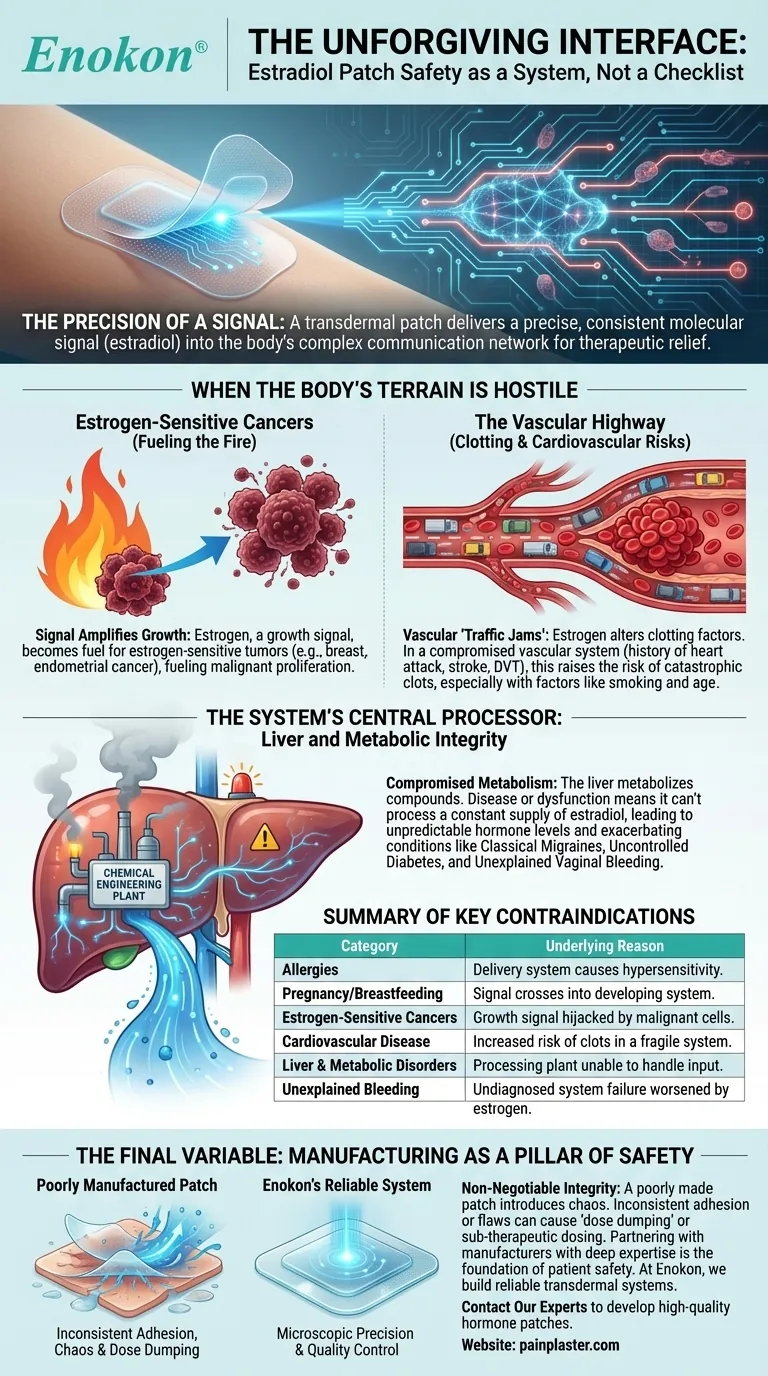
A transdermal patch is a marvel of controlled engineering. It's designed to deliver a precise, consistent molecular signal—in this case, estradiol—directly into the body’s complex communication network. The goal is elegant: supplement a natural hormone to alleviate symptoms and improve quality of life.
But this elegance depends on a stable, predictable environment.
When the biological system receiving the signal is compromised, the message can be misinterpreted. What was intended as a therapeutic whisper becomes a destructive command. Understanding the contraindications for an estradiol patch is not about memorizing a list; it's about appreciating the unforgiving nature of the human body's internal logic.
When the Body’s Terrain Is Hostile
The decision to use hormone therapy often boils down to a psychological balancing act: the immediate relief from debilitating symptoms versus abstract, long-term risks. This is why a systemic view is critical. Certain pre-existing conditions create a biological terrain where estradiol is no longer a helpful messenger.
The Signal That Amplifies Growth: Estrogen-Sensitive Cancers
Estrogen is fundamentally a signal for growth. It tells cells in the endometrium and breast tissue to proliferate. This is a normal, healthy process.
However, in the presence of an estrogen-sensitive tumor, the patch’s steady signal becomes a constant stream of fuel for a fire. The body can't distinguish between the therapeutic intent and the cancerous cells' demand for growth signals. For patients with a history of breast cancer, endometrial cancer, or related conditions, using an estradiol patch is like trying to fix a faulty wire in a house filled with gasoline fumes.
The Vascular Highway: Clotting and Cardiovascular Risks
Think of the circulatory system as a vast, high-speed logistics network. Estrogen influences the "rules of the road," subtly altering clotting factors in the blood. For most, this change is insignificant.
But for an individual with a history of heart attack, stroke, or deep vein thrombosis (DVT), the system is already compromised. Their vascular highway has bottlenecks, rough patches, and a history of traffic jams. Adding estrogen is like increasing the size of every vehicle on the road—it dramatically raises the probability of a catastrophic pile-up (a clot). This risk is amplified by lifestyle factors, turning a calculated risk into a near certainty for some profiles, like older smokers with hypertension.
The System’s Central Processor: Liver and Metabolic Integrity
Every compound introduced to the body must be processed, metabolized, and cleared. The liver is the master chemical engineering plant responsible for this.
If the liver is damaged by disease or dysfunction, its capacity is diminished. Introducing a constant supply of estradiol is like forcing a struggling factory to run a new, complex production line 24/7. It can't keep up. The hormone isn't metabolized correctly, leading to unpredictable levels in the body and potentially exacerbating the underlying liver condition.
This same principle applies to other metabolic systems.
- Classical Migraines (with aura): Hormonal fluctuations can trigger severe neurological events.
- Uncontrolled Diabetes: Estrogen can interfere with glucose metabolism, complicating an already delicate balancing act.
- Unexplained Vaginal Bleeding: This is a critical red flag—an unknown system error. Introducing a powerful hormone before diagnosing the source is a profound risk.
Summary of Key Contraindications
| Contraindication Category | Underlying Reason |
|---|---|
| Allergies | The delivery system itself causes a hypersensitivity reaction. |
| Pregnancy/Breastfeeding | The signal crosses into a developing system (fetus or infant). |
| Estrogen-Sensitive Cancers | The growth signal is hijacked by malignant cells. |
| Cardiovascular Disease | Increased risk of "traffic jams" (clots) in a fragile system. |
| Liver & Metabolic Disorders | The body's processing plant is unable to handle the new input. |
| Unexplained Bleeding | An undiagnosed system failure that could be worsened by estrogen. |
The Final Variable: Manufacturing as a Pillar of Safety
This entire framework of risk assessment assumes one critical factor: the patch itself performs flawlessly. It must adhere correctly, resist environmental factors, and—most importantly—release its active ingredient at the exact specified rate.
A poorly manufactured patch introduces chaos. Inconsistent adhesion can lead to sub-therapeutic dosing or sudden detachment. A flaw in the matrix or adhesive could cause "dose dumping," releasing a surge of hormone that overwhelms the body's systems. The materials themselves could be the source of an allergic reaction, a contraindication that has nothing to do with the drug itself.
For healthcare distributors and pharmaceutical brands, the integrity of the transdermal patch is non-negotiable. The safety of the end-user rests not only on the clinician's diagnosis but also on the microscopic precision of the product. Partnering with a manufacturer that possesses deep technical expertise in formulation, material science, and quality control is the foundation of a safe and effective therapeutic system.
At Enokon, we build reliable transdermal systems because we understand that patient safety is an end-to-end responsibility. If you're looking for a partner to develop and manufacture high-quality hormone patches or pain plasters, let's ensure every variable is controlled. Contact Our Experts
Visual Guide
Related Products
- Menthol Gel Pain Relief Patch
- Icy Hot Menthol Medicine Pain Relief Patch
- Mugwort Wormwood Pain Relief Patch for Neck Pain
- Herbal Medicated Anti Diarrhea Patch for Digestive Relief
- Lidocaine Hydrogel Pain Relief Patch for Pain Relief
Related Articles
- Beyond Efficacy: The Psychology of Adherence in Topical Pain Relief
- The 60-Minute Architecture: Engineering Predictability in Topical Pain Relief
- More Than a Feeling: The Precise Engineering of Cold vs. Hot Pain Relief
- Beyond the Molecule: The Behavioral Science of the Simple Pain Patch
- The Human Interface of Pain Relief: Why Delivery Systems Define Success



















