
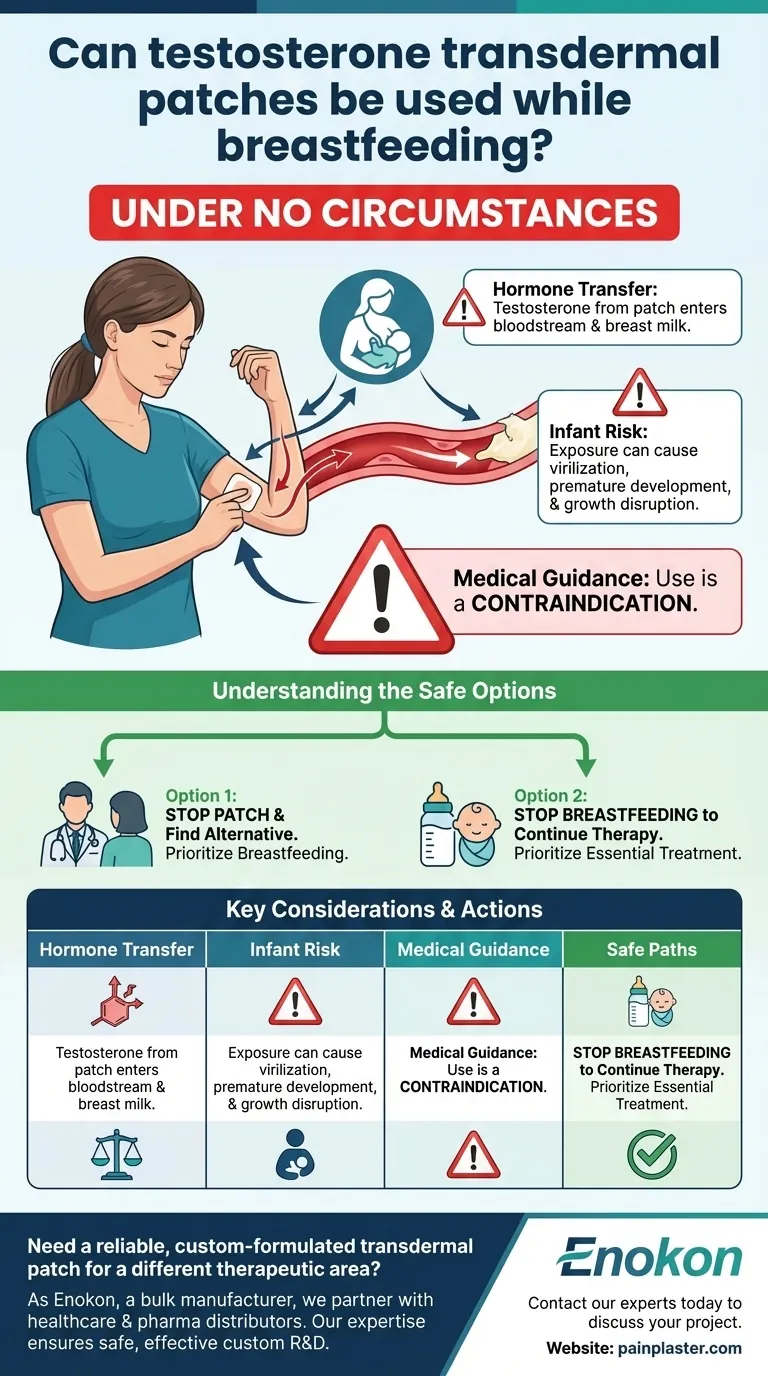
Under no circumstances should testosterone transdermal patches be used while breastfeeding. The medication is absorbed into the mother's bloodstream and can pass to the infant through breast milk. Studies have demonstrated that this exposure can cause harmful effects on the nursing infant's development.
The core principle is absolute risk avoidance. Because testosterone is a powerful hormone with documented harmful effects on infants, its use is considered incompatible with breastfeeding. A choice must be made between the medication and breastfeeding to ensure the child's safety.

The Core Risk: Hormone Transfer to the Infant
The primary danger of using a testosterone patch while breastfeeding is the direct transfer of a potent hormone to a developing baby. This process is straightforward and presents a significant, unacceptable risk.
How Transdermal Patches Function
A transdermal patch is designed to deliver a steady dose of medication through the skin and directly into your bloodstream. This creates a systemic level of the drug—in this case, testosterone—circulating throughout your body.
Passage into Breast Milk
Any medication present in the mother's bloodstream has the potential to pass into her breast milk. Because testosterone circulates systemically from the patch, it will inevitably be present in the milk the infant consumes.
An Infant's Sensitivity to Hormones
An infant's body is in a state of rapid and precisely coordinated development. This growth is regulated by their own delicate hormonal systems. Introducing an external hormone like testosterone can disrupt these critical processes.
Documented Effects and Medical Guidance
The medical community's guidance on this issue is not based on theory but on observed, harmful effects. The potential for developmental disruption is too significant to ignore.
The Danger of Hormonal Disruption
Exposure to external testosterone can cause serious health issues in an infant. These may include premature sexual development, virilization (the development of masculine characteristics regardless of gender), and interference with normal growth patterns.
Why Medical Advice is Unequivocal
Due to these known risks, there is no safe level of testosterone exposure for a nursing infant. This is why healthcare providers will universally advise against using this medication while breastfeeding. It is considered a contraindication, meaning it is a situation in which the drug should not be used.
Understanding the Safe Options
When faced with this situation, the priority must be the infant's health. This leaves two clear, safe paths forward, which must be discussed with your healthcare provider.
Option 1: Find an Alternative Medication
If you intend to continue breastfeeding, you must stop using the testosterone patch. Speak with your doctor about your underlying medical condition to determine if an alternative treatment compatible with breastfeeding is available.
Option 2: Stop Breastfeeding
If testosterone therapy is medically essential and cannot be substituted, you must stop breastfeeding to protect your child. This allows you to focus on your own health needs without putting your infant at risk.
Never "Wait and See"
It is critical not to attempt to use the patch and simply monitor the baby for side effects. The potential harm is serious, and some developmental effects may not be immediately apparent.
How to Apply This to Your Situation
Your decision requires a direct conversation with your healthcare provider to weigh your health needs against the absolute necessity of protecting your infant.
- If your primary focus is continuing to breastfeed: You must stop using testosterone patches immediately and consult your doctor for a safe alternative treatment.
- If your primary focus is continuing essential testosterone therapy: You must stop breastfeeding to eliminate the risk of hormonal exposure to your infant.
Ultimately, protecting your infant is non-negotiable, and making a clear choice with your doctor is the only responsible path forward.
Summary Table:
| Key Consideration | Explanation |
|---|---|
| Hormone Transfer | Testosterone from the patch enters the bloodstream and passes into breast milk. |
| Infant Risk | Exposure can cause virilization, premature development, and growth disruption. |
| Medical Guidance | Use is an absolute contraindication; a choice between therapy and breastfeeding is required. |
| Safe Paths | 1. Stop patch, find alternative treatment. 2. Stop breastfeeding to continue therapy. |
Need a reliable, custom-formulated transdermal patch for a different therapeutic area?
As Enokon, a bulk manufacturer of reliable transdermal patches and pain plasters, we partner with healthcare and pharma distributors and brands. Our technical expertise ensures safe, effective, and custom R&D for your specific product needs, guaranteeing quality and compliance.
Contact our experts today to discuss your custom transdermal development project.
Visual Guide
Related Products
- Silicone Scar Sheets Patch Transdermal Drug Patch
- Far Infrared Heat Pain Relief Patches Transdermal Patches
- Menthol Gel Pain Relief Patch
- Icy Hot Menthol Medicine Pain Relief Patch
- Cooling Fever Patches Color Change Cold Fever Patch
People Also Ask
- What role does a silicone-based transdermal delivery system play in Parkinson's? Enhancing Early-Stage Patient Care
- How is the long-term skin tolerance of silicone-based transdermal patches evaluated in clinical settings? R&D and Safety
- Why is a polarizing microscope used to evaluate the long-term stability of transdermal drug patches? Ensure Efficacy.
- What are common adverse effects of transdermal drug delivery? Risks & Prevention Tips
- What are the advantages of transdermal drug patches? Optimize Medication Delivery with Patches







